Industrial Security Houston: Preventing Theft, Trespass, and After-Hours Incidents
Houston’s warehouses, distribution centers, and light manufacturing sites move fast and store what matters—inventory, equipment, and time-sensitive shipments. After hours, those same assets become inviting targets. If your goal is to cut down on theft, trespass, and late-night activity without adding complexity, you need a practical, layered approach to industrial security Houston facilities can trust. As a Houston-based provider with 15+ years on patrol, American S.E.A.L. Patrol Division creates property-specific plans that blend GPS-verified perimeter patrols, access control, and real-time CCTV response—coordinated by 24/7 live dispatch and backed by clear documentation.
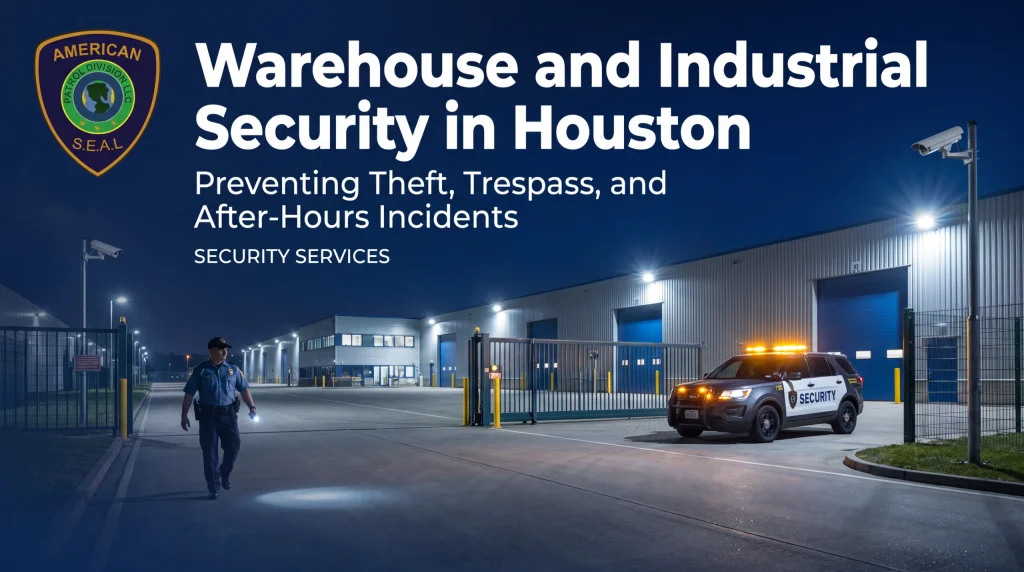
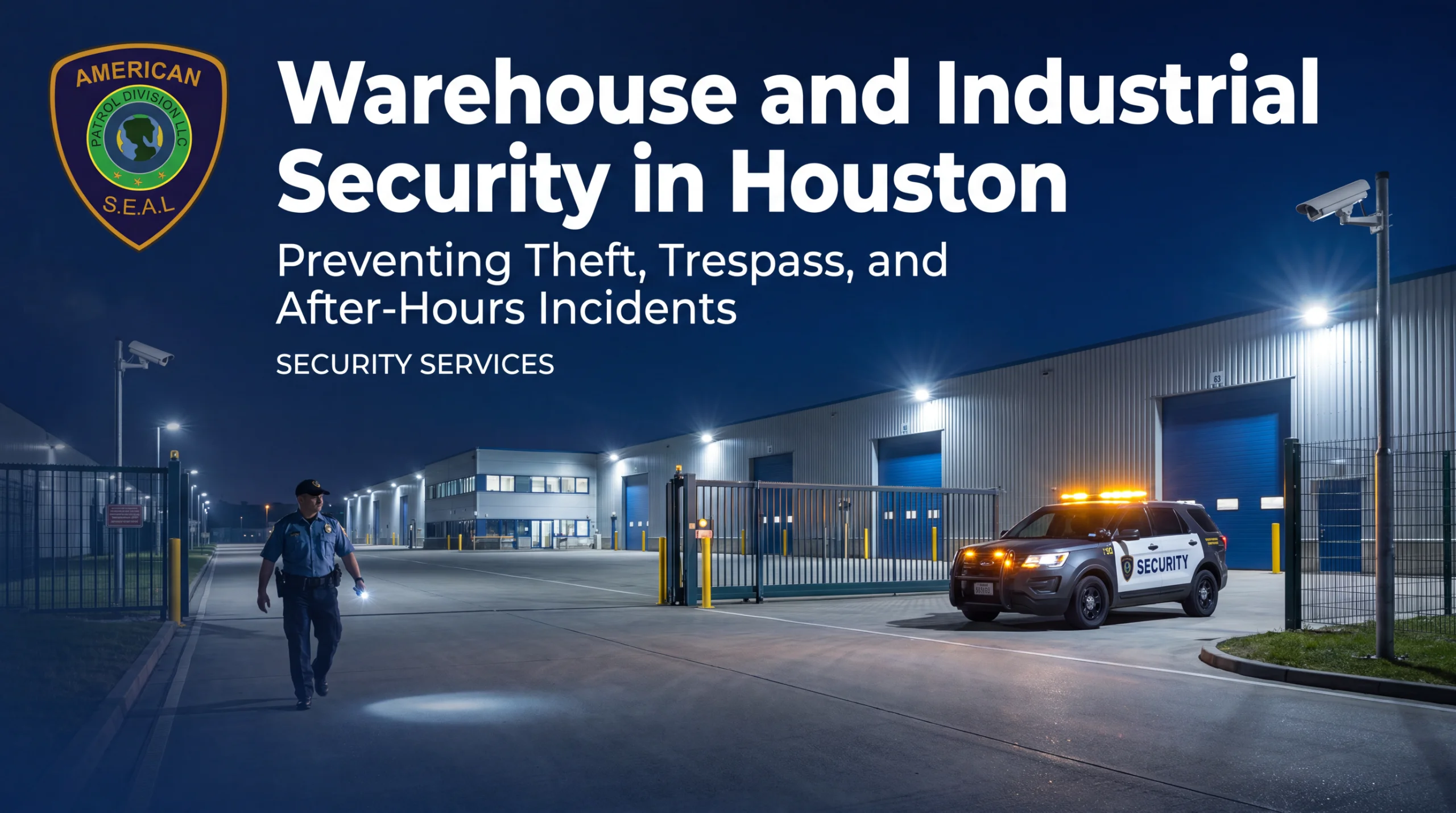
[Image alt text: industrial security Houston perimeter patrol vehicle at warehouse gate]
Why Industrial and Warehouse Sites in Houston Need Targeted Security
From the I-10 Energy Corridor to Beltway-adjacent distribution hubs, Houston’s industrial corridors face similar risks. Nightfall doesn’t pause the work of protecting long perimeters, shared access points, and high-value goods, and it often amplifies vulnerabilities.
Common after-hours risks: theft, trespass, vandalism, copper/wire theft
Opportunistic theft from trailers and yard storage
After-hours trespass by individuals testing gates or doors
Vandalism around dark corners or low-visibility docks
Copper and wire theft targeting rooftop units, generators, and bays
Long fence lines and infill lots can create hidden approach paths
Multiple gates for vendors, employees, and yard traffic complicate control
Camera blind spots appear where coverage doesn’t align with patrol routes
Trailer parking and stacked containers can obstruct sightlines
Core Components of Industrial Security in Houston
Perimeter patrols: GPS-verified mobile and foot patrol coverage
Mobile patrols quickly extend coverage across long fence lines, trailer yards, and auxiliary lots.
Foot patrols are essential at dock doors, man-gates, and blind spots vehicles can’t safely reach.
Time-stamped, GPS-verified logs validate that specific gates, doors, and zones were checked at agreed intervals. For a deeper dive into how these patrols work, see Mobile Security Patrols in Houston: https://www.americanspd.com/?p=3944
Pair cameras with live operators to verify alarms, direct patrol units, and capture incident clips.
Camera-to-patrol handoffs close the loop: a camera flags motion, dispatch verifies, a patrol responds and documents.
For a practical setup guide, see CCTV Monitoring and Gate Access Control for Houston Apartments (many principles carry over to industrial sites): https://www.americanspd.com/?p=3947
On-site guards: armed vs. unarmed roles, courtesy officers for docks/common areas
Armed guards fit higher-risk facilities or operations involving cash, high-value cargo, or sensitive materials.
Unarmed guards excel at gate control, vendor verification, and maintaining a steady perimeter presence. Training emphasizes de-escalation, customer service, and thorough documentation.
Courtesy officers assigned to common areas and docks reinforce compliance with post orders—from PPE reminders to lock checks.
Fire watch and safety checks where required
When alarm systems or sprinklers are offline, fire watch ensures continuous rounds with documented checks until systems are restored.
Safety sweeps can include blocked egress checks, extinguisher visibility, and identifying lighting failures before they create blind spots. For the essentials, review Fire Watch Services in Houston: https://www.americanspd.com/?p=3952
Myth vs. Fact: Cameras Alone Stop Theft
Myth: “If we add more cameras, problems go away.”
Fact: Cameras deter and document, but they rarely stop a live incident without a response layer. Pairing live monitoring with GPS-verified patrols and clear escalation procedures is what turns a camera alert into incident prevention.
A Data-Driven Patrol Model for Incident Prevention
Time-stamped, GPS-verified logs and reporting
Every patrol pass, gate check, and door inspection is recorded with time, location, and notes. You get a verifiable record mapped to your site and post orders.
Photos and short clips (when applicable) confirm corrective actions: re-locking a door, tagging a damaged fence panel, or securing a loose chain.
24/7 live dispatch with incident documentation
Real people answer, dispatch, and document. That matters when seconds count and you need escalation without guesswork.
Incident documentation ties together camera events, officer observations, and actions taken—creating a usable record for insurance, internal reviews, and service adjustments.
Integrating patrol routes with camera views and lighting audits
Patrol routes are aligned to your camera coverage to ensure blind spots receive physical checks.
Lighting audits identify failed fixtures and dark corners; sometimes a quick bulb replacement is as effective as adding a new post order.
Over time, logs reveal patterns (a specific gate probed on Fridays; repeated motion near a particular bay) so routes and camera angles can be adjusted proactively.
Building a Property-Specific Security Plan
Risk assessment: perimeter, gates, loading docks, yard and trailer parking
Perimeter condition: fence integrity, tamper points, and approach paths
Gate profiles: primary vs. after-hours access, credentialing, and visitor/vendor flow
Docks and doors: lock practices, alarm status, and lighting
Yard layout: trailer locations, double-stacked containers, and camera lines of sight
Layered approach: deter, detect, delay, respond
Deter: visible patrols, signage, lighting, and controlled gate schedules
Detect: camera analytics, motion alerts, and set patrol intervals
Delay: strong locks, tamper-resistant seals, and proper fencing
Respond: live dispatch, clear escalation procedures, and verified documentation
Escalation protocols with Houston PD and site contacts
Establish call trees and thresholds in advance (for example: verified trespass vs. a suspicious vehicle lingering).
Confirm points of contact by shift, plus weekend and holiday variations.
Replace or repair failed lights, especially near man-doors and dock edges.
Post simple, high-contrast signs: “No Trespassing,” “Vendors by Appointment,” and “Cameras in Use.”
Standardize a lock and key/credential policy; remove “extra” padlocks and track who has access.
Tighten gate schedules. If a gate must stay open late, require dispatch notification and a defined close-out time.
Vendor access windows and delivery cutoffs
Set vendor windows that match staffing and patrol coverage.
Require seal numbers on inbound/outbound loads and verify at the gate or dock.
Add delivery cutoff times and redirect late arrivals via dispatch, not an open gate.
Incident trend reviews and shift handoff notes
Hold a 10-minute monthly review: where were alerts, what changed, what’s next.
Use shift handoff notes so night observations lead to day fixes (for example, replace a failing lock, trim vegetation near a fence line, adjust a camera angle).
Real-World Experience on Patrol in Houston
Perimeter patrols, access control, and CCTV monitoring work together to protect Houston warehouses after hours.
On a recent after-hours patrol in West Houston, an officer rolled the perimeter by vehicle, then dismounted to check a dark corner near the loading bays where cameras had flagged motion earlier. A loose gate chain was secured, a vendor box truck’s seal number was verified against the log, and dispatch attached photos to the report. Nothing dramatic—just steady, documented work that keeps small issues from turning into incidents.
How American S.E.A.L. Patrol Division Supports Industrial Facilities
Mobile patrols, on-site guards, CCTV monitoring, and gate control
Mobile and foot perimeter patrols with GPS-verified logs
On-site armed or unarmed guards for access control, dock oversight, and common areas
CCTV monitoring with real-time response and incident clip documentation
Gate operations support: visitor/vendor verification, badge checks, and schedule adherence
Reporting that facilities managers can act on
Time-stamped reports, photos, and concise action items so maintenance and operations can close loops fast
Trend insights that inform patrol routing, lighting repairs, and camera re-aiming
24/7 live dispatch and incident documentation, reducing ambiguity across shifts
We’re based in Houston with 15+ years on patrol and a record of supporting busy sites across the metro.
Our team is licensed, bonded, and insured, operating under Texas DPS Private Security Bureau License #C28662701.
In heavily patrolled zones, our reports have shown meaningful incident reductions over time, driven by consistent, documented coverage and responsive dispatch.
Getting Started: Scope, Coverage Hours, and Budget Alignment
Walkthrough, site map review, and pilot period option
Begin with a facility walkthrough and a review of your site map, shift schedules, and vendor flow.
Align on high-priority zones and quick wins; then set post orders and patrol intervals.
Consider a pilot period to validate coverage, test routes, and confirm reporting meets your needs.
Metrics to watch: incident counts, response times, patrol adherence
Incident counts (trespass attempts, door propping, suspicious vehicles) by week/month
Response times from camera alert to patrol arrival
Patrol adherence to intervals and GPS-verified checkpoints
Maintenance close-out rates for issues identified during rounds (locks, lights, fence repairs)
The Bottom Line on Industrial Security Houston Facilities Can Trust
Industrial security Houston operations require isn’t about more gadgets or guesswork—it’s about a layered plan you can validate: GPS-verified perimeter patrols, controlled access, live-monitored cameras, and accountable documentation. That’s how you prevent theft, deter trespass, and keep after-hours incidents from disrupting your business.
If you’re ready to put a practical, data-driven plan in place, contact us to discuss your site and goals. Or, if you already know your coverage hours and priorities, request a free quote and we’ll tailor a proposal to your property.
Frequently Asked Questions
What does a “layered” industrial security plan look like in Houston?
Short answer: It combines perimeter patrols, access control, live-monitored CCTV, and clear response procedures.
Expanded answer: A practical layered plan for industrial security Houston sites can trust blends GPS-verified mobile and foot perimeter patrols, controlled gate and badge access, real-time CCTV monitoring with operator verification, and 24/7 live dispatch. These layers deter, detect, delay, and respond—turning alerts into documented action rather than after-the-fact reviews.
How do GPS-verified perimeter patrols work?
Short answer: Officers follow site-specific routes, and each checkpoint is time-stamped and GPS-verified.
Expanded answer: Patrols are mapped to your fence lines, dock doors, man-gates, and blind spots. Officers log checkpoints with GPS and timestamps so you can confirm coverage and intervals. Photos or short clips can be attached when actions are taken (for example, re-securing a gate). For more detail, see Mobile Security Patrols in Houston: https://www.americanspd.com/?p=3944
Do we need armed or unarmed guards at our warehouse?
Short answer: It depends on your risk profile; higher-risk operations may warrant armed officers, while many access-control posts are well served by unarmed guards.
Expanded answer: We match guard type to your facility’s risk and post orders. Armed guards suit higher-risk environments (for example, high-value cargo), while unarmed guards excel at gate control, vendor verification, and steady perimeter presence. Both prioritize de-escalation, documentation, and coordination with dispatch.
How does CCTV monitoring reduce after-hours incidents?
Short answer: Cameras paired with live operators enable alarm verification, direct patrol response, and incident clips.
Expanded answer: Cameras alone don’t stop incidents; they must be paired with people and procedures. Live operators verify alerts, dispatch patrols, and capture useful clips. Camera-to-patrol handoffs close the loop, and reports tie together camera events and officer actions. Many principles from apartment CCTV apply to industrial sites: https://www.americanspd.com/?p=3947
What are the most common after-hours risks for Houston industrial sites?
Short answer: Theft, trespass, vandalism, and copper/wire theft—especially around long perimeters and dimly lit docks.
Expanded answer: We frequently see opportunistic trailer and yard theft, gate or door testing, vandalism in low-visibility areas, and copper/wire theft targeting rooftop units and generators. Long fence lines, multiple gates, and camera blind spots can compound these risks without targeted patrols and lighting audits.
How do access control and gate schedules prevent trespass?
Short answer: By controlling when gates are open and verifying who comes in, you reduce random entries and tailgating.
Expanded answer: Clear gate schedules and vendor windows limit exposure after hours. Verification steps (driver ID, load numbers, seal integrity, and dock assignment) close gaps that trespassers exploit. Late-shift badge or PIN checks further curb unauthorized access. Tight schedules plus verification help keep activity accountable.
What’s included in your incident documentation and reporting?
Short answer: Time-stamped logs, GPS checkpoints, notes, and relevant photos or clips.
Expanded answer: Reports record patrol passes, gate/door checks, and actions taken, backed by timestamps and GPS. When applicable, photos or brief clips verify corrective steps (for example, securing a chain, tagging a damaged fence panel). 24/7 dispatch ensures camera alerts, officer observations, and follow-up actions are documented in one place.
When do we need fire watch, and what does it cover?
Short answer: When alarms or sprinklers are offline, continuous rounds with documented checks are required until systems are restored.
Expanded answer: Fire watch provides ongoing patrols focused on life safety: egress routes, extinguisher visibility, and identifying hazards like failed lighting near exits or docks. Rounds are documented to meet requirements while systems are down. Learn the essentials here: https://www.americanspd.com/?p=3952
How do you coordinate with Houston PD and our site contacts?
Short answer: We set call trees and thresholds in advance, then dispatch and escalate per your protocols.
Expanded answer: During onboarding, we define verified trespass vs. suspicious activity thresholds, confirm site contacts by shift, and align with Houston Police Department non-emergency procedures. This reduces guesswork and ensures timely, consistent enforcement and documentation.
What are quick wins we can implement this month?
Short answer: Fix lighting, post clear signage, standardize locks/credentials, and tighten gate schedules.
Expanded answer: Replace failed lights (especially at man-doors and docks), add high-contrast “No Trespassing” and “Vendors by Appointment” signs, streamline lock and credential policies, and set vendor windows matched to staffing. These basics often prevent avoidable after-hours entries.
How do we get started and align on budget and coverage hours?
Short answer: Schedule a walkthrough, review your site map and priorities, then consider a pilot period to validate routes and reporting.
Expanded answer: We begin with a facility walkthrough, map review, and discussion of shifts, vendor flow, and hot spots. Together we set post orders, patrol intervals, and metrics like response time and checkpoint adherence. A short pilot can validate coverage and refine routes before long-term deployment. Contact us: https://www.americanspd.com/contact-us/ or request a proposal: https://www.americanspd.com/free-quote/
Real-world note from patrol
Short answer: Simple, verified actions prevent incidents.
Expanded answer: On West Houston rounds, we’ve secured loose gate chains, verified seal numbers against logs, and flagged failed lights by docks—small, documented fixes that reduce the chance of after-hours trespass or theft without adding complexity.