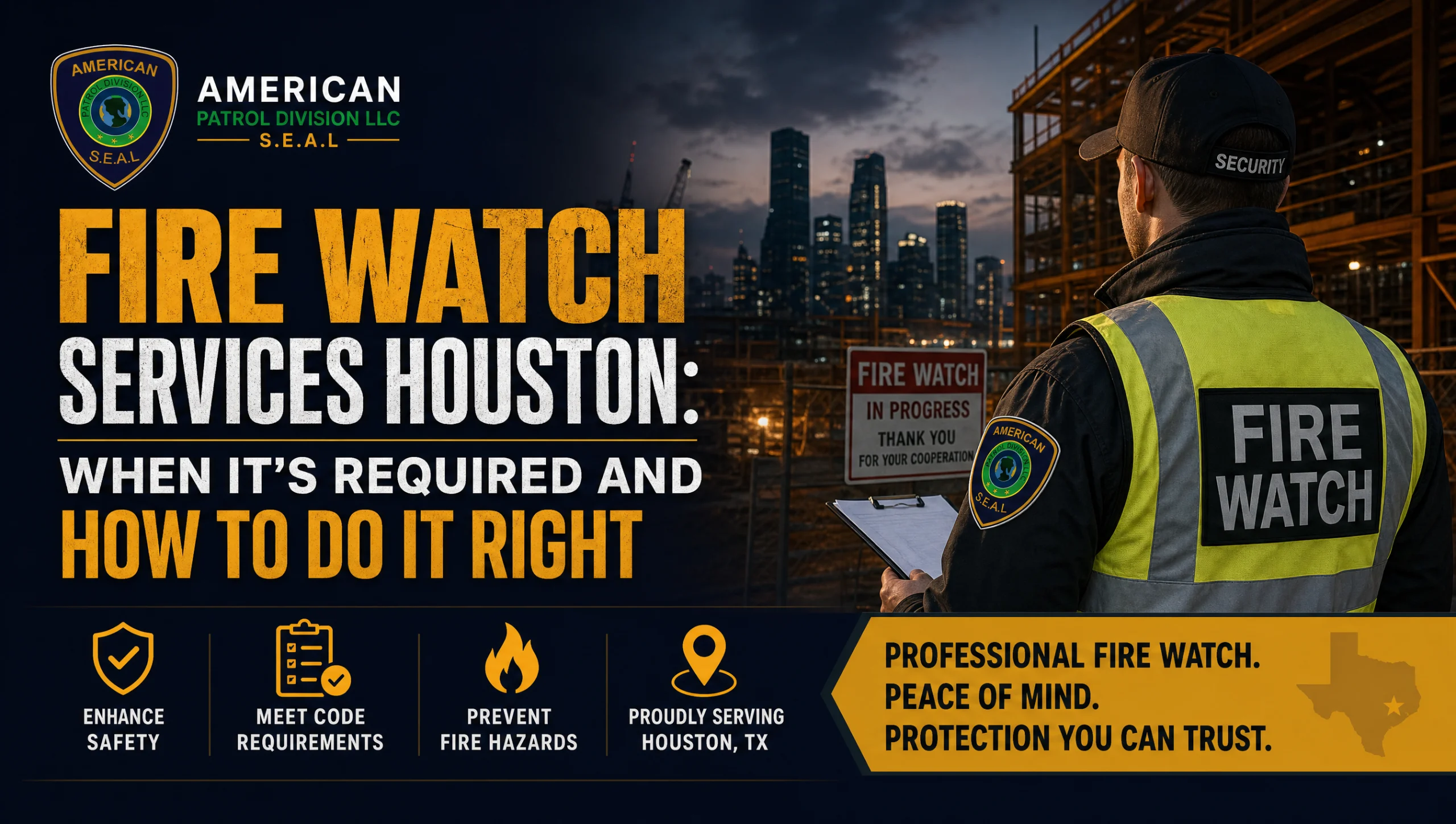
Fire Watch Services Houston: When It’s Required and How to Do It Right
Moe Shariff · May 18, 2026
Fire Watch Services Houston: When It’s Required and How to Do It Right
Fire Watch Services Houston: What Property and Apartment Managers Need to Know
When a fire alarm, sprinkler system, or other life safety feature goes down, the clock starts. Property and apartment managers in Houston need a clear, calm plan to keep residents safe and stay compliant. This guide explains when to activate fire watch, what the Houston Fire Marshal typically expects, and how a licensed local provider executes reliable, documented coverage. If you’re searching for fire watch services Houston, you’re in the right place.
Fire watch services Houston refers to continuous, documented patrols that monitor for signs of fire when life safety systems are impaired or offline. Managers use fire watch to maintain life safety compliance, meet Houston Fire Marshal expectations, and reduce risk until alarms or sprinklers are restored.
What Is Fire Watch and When Is It Required in Houston?
Fire watch is a temporary safety measure used when required detection, alarm, or suppression systems are impaired or taken out of service. A designated, responsible person continuously patrols affected areas to spot early signs of fire, notify occupants, and call 911 if needed. In Houston, activate fire watch whenever a required system is offline and your life safety plan—or the Fire Marshal—indicates a watch is needed until restoration.
Common triggers: impaired fire alarm, sprinkler system outage, hot work, power loss, post-incident
Fire alarm or sprinkler impairment (planned maintenance or unexpected failure)
Extended power loss affecting panels, pumps, elevators used in egress, or alarm components
Hot work (welding, cutting, torch work) or testing that temporarily disables detection devices
Post-incident damage to detection devices, risers, or heads after leaks or fire events
Emergency fire watch vs. temporary fire watch
Emergency fire watch: Unplanned, immediate coverage initiated when a system fails without notice (for example, a burst sprinkler riser at 9:30 p.m.). Start patrols right away and notify stakeholders.
Temporary fire watch: Planned coverage during scheduled maintenance, inspections, or testing windows. Define start/stop time, patrol scope, and documentation in advance.
Houston Fire Marshal Requirements and Life Safety Compliance Basics
American SEAL Patrol Division conducting a documented fire watch at a Houston apartment community to maintain life safety compliance.
Because Houston properties vary, always follow your building’s life safety plan and the Fire Marshal’s direction. The basics below reflect common expectations that keep managers on solid footing and help avoid missteps during an impairment.
Notifying authorities and documenting the impairment
Identify the system out of service, affected zones/floors, and estimated duration.
Notify your alarm monitoring center so they don’t treat alarms as system-driven when they may be manual.
Inform the Houston Fire Marshal or follow your impairment plan’s notification procedures.
Post impairment tags where required (riser rooms, panels) and record the start time.
Patrol scope, frequency, and coverage expectations
Align coverage with affected areas, including corridors, stairwells, mechanical rooms, attics/voids where accessible, laundry rooms, trash rooms, and any hot work or renovation zones.
Set frequency to continuous or at frequent intervals appropriate to the risk profile and occupancy. Define it clearly (for example, rounds every 15 minutes in active corridors and high-risk rooms).
Maintain clear egress: check doors, stairwells, and emergency lighting along patrol routes.
Documentation: time-stamped logs, incident notes, and restoration records
Time-stamped entries for each patrol round with location check-ins
GPS-verified logs or equivalent verification where feasible
Notes on hazards found, mitigations, resident notifications, and contractor coordination
Start-of-watch, handoff, and end-of-watch times
Restoration records: date/time system returned to service, technician/company, and any Fire Marshal sign-off when applicable
Myth vs. fact: fire watch compliance
Myth: A concierge or on-site porter casually “keeping an eye out” counts as fire watch.
Fact: Fire watch requires a designated, responsible person performing continuous or defined-interval patrols with documented rounds and the ability to initiate emergency procedures.
Myth: If only part of the building is impaired, you can ignore the rest.
Fact: You must document the affected zones, cover adjacent/high-risk areas, and keep egress paths clear throughout your patrol routes.
Myth: A single sign at the lobby covers your duty to notify.
Fact: Use layered communication: resident notices, contractor coordination, and posted impairment information where required by your plan.
How to Activate Fire Watch the Right Way (Step-by-Step)
Confirm the impairment and affected areas
Verify which system is down (alarm, sprinkler, standpipe, smoke control) and the exact zones/floors.
Notify building stakeholders and the monitoring center
Advise ownership/management, maintenance, courtesy officers, and your alarm monitoring center.
Inform residents if access or amenities are affected and reinforce no-prop rules for fire doors.
Contact a licensed provider; define patrol frequency and posts
Engage a licensed, bonded, and insured security partner. Align on patrol frequency, checkpoints, and reporting expectations.
Start time-stamped, GPS-verified patrols and maintain a fire watch log
Begin immediately for emergency fire watch, or at the scheduled start for temporary fire watch.
Use GPS-verified checkpoints, time-stamped logs, and incident notes for each round.
Coordinate with technicians; end fire watch only after restoration and sign-off
Keep an open line with alarm/sprinkler technicians throughout the impairment.
Document the exact time systems are restored and obtain any required sign-offs per the Houston Fire Marshal or your plan before ending the watch.
What Fire Watch Looks Like on the Ground
Patrol routes, stairwells, mechanical rooms, and high-risk zones
Officers walk interior corridors, stairwells, mechanical and riser rooms, laundry rooms, trash chutes, and renovation areas. Exterior checks include trash enclosures, generator pads, and any hot work locations.
Patrols verify that exit paths are clear, fire doors close and latch, and no hazardous storage or ignition sources are present.
Communication with maintenance, residents, and contractors
Quick two-way communication with maintenance ensures hazards are addressed fast (for example, removing propped doors or relocating combustible materials).
Resident notices can reduce nuisance risks, like grilling where prohibited during impairment periods.
Contractors doing hot work receive site rules and a clear escalation path.
Handling escalations and calling 911
Fire watch personnel must be trained to call 911 immediately upon detecting smoke, flame, or a confirmed hazard.
While waiting for responders, they assist with occupant notifications and keep egress routes clear—without attempting firefighting beyond their training and site policy.
Fire Watch for Apartments and Multifamily Communities in Houston
After-hours issues, gate access control, and amenity areas
After-hours impairments are common. Ensure keys/fobs and gate codes are ready so patrols can access riser rooms, panels, roofs (if required), and amenity spaces.
Amenity checks include gyms, lounges, package rooms, and laundry areas where residents may still be active.
Courtesy officer coordination and quiet hours considerations
Coordinate with courtesy officers to align noise controls with life safety needs. For example, a brief resident knock-and-notify is acceptable when removing a propped fire door, even during quiet hours.
For manager resources tailored to multifamily operations, see Apartment Services Group. https://apartmentservicesgroup.com/
How American S.E.A.L. Patrol Division Delivers Compliant Fire Watch Services Houston
American S.E.A.L. Patrol Division is licensed, bonded, and insured under Texas DPS Private Security Bureau License #C28662701. Our team is based in Houston and serves communities across Harris County.
Mobile and foot patrols with GPS-verified, time-stamped logs
We conduct mobile and foot patrols with defined checkpoints, GPS-verified and time-stamped for transparency. Logs capture start/stop times, route coverage, hazards found, and corrective actions taken.
24/7 live dispatch with real people and incident documentation
Our 24/7 dispatch center manages activation calls, supervisor check-ins, and incident documentation in real time so managers can follow the impairment from start to finish.
Property-specific plans and real-time response, including CCTV support
We build property-specific fire watch plans, integrating gate access, riser locations, hot work areas, and resident communication steps. If your site uses our CCTV monitoring, we coordinate live camera checks and gate access control alongside on-the-ground patrols.
On a recent overnight call in West Houston, our team initiated emergency fire watch after a sprinkler riser issue. We mapped routes covering stairwells, risers, and a laundry area with dryers still in use, maintained a live log with five-minute updates during testing, and coordinated with the technician on-site until the system cleared. The quick start and clean documentation made the morning follow-up straightforward for the manager.
Practical Checklist: Staying Ready for a Fire Watch Event
Keep this kit and plan current so you can launch within minutes:
Contacts: building owner/manager, maintenance, monitoring center, alarm/sprinkler vendors, Houston Fire Marshal office line, preferred fire watch provider
Documentation: impairment tags, fire watch log template, incident report forms, resident notice templates (English/Spanish if needed)
Communication templates: quick email/SMS to residents, vendor alert script, and a 911 call checklist
Coordination notes: patrol frequency table by risk area, handoff protocol for shift changes, and restoration/sign-off steps
Quick-reference: common triggers and key steps
Common triggers
Fire alarm or sprinkler impairment
Power loss affecting life safety systems
Hot work or system testing
Post-incident or damage to detection devices
Key steps
Confirm the impairment and affected zones
Notify stakeholders and the monitoring center
Start emergency or temporary fire watch with defined patrol frequency
Keep time-stamped, GPS-verified logs and incident notes
Coordinate repairs; end fire watch only after system restoration and sign-off
Next Steps for Houston Property Managers
Request a property-specific fire watch plan
A short site walkthrough and plan reduces activation time and compliance risk. We’ll map patrol routes, define frequencies by zone, and prepare your documentation kit in advance.
Prepare a standing impairment response checklist
Keep vendor contacts, access tools, and resident templates together so anyone on duty can start the process within minutes.
Or contact us to activate coverage now: https://www.americanspd.com/contact-us/
Want to see how fire watch fits into a larger security program? Visit our Houston Security Services page: https://americanspd.com/
Photo suggestion for your page: “fire watch services Houston – officer checking a riser room during a documented patrol round” (use this caption as image alt text to support accessibility and relevance).
Frequently Asked Questions
1) When do I need to activate fire watch in Houston?
Short answer: Start fire watch any time a required alarm, sprinkler, or other life safety system is impaired.
Expanded: In Houston, activate fire watch when detection, alarm, or suppression systems are offline—planned or unplanned. Common triggers include alarm/sprinkler impairments, extended power loss that affects life safety components, hot work that disables detection, and post-incident damage. Follow your life safety plan and any Houston Fire Marshal direction.
2) What’s the difference between emergency fire watch and temporary fire watch?
Short answer: Emergency is unplanned and starts immediately; temporary is scheduled for known outages.
Expanded: Emergency fire watch begins right away after an unexpected failure (for example, a burst riser at night). Temporary fire watch is scheduled for maintenance, inspections, or testing, with defined start/stop times, scope, and documentation.
3) Who can perform fire watch—can my concierge or porter do it?
Short answer: Use a designated, trained person with documented patrols and clear procedures.
Expanded: Casual observation isn’t enough. Fire watch requires continuous or defined-interval patrols, time-stamped logs, and personnel who can notify occupants and call 911. Many properties choose a licensed provider to ensure compliance and documentation.
4) How often should patrols occur during fire watch?
Short answer: Continuously or at defined intervals based on risk and occupancy.
Expanded: Set frequency by area risk and building use. For example, high-traffic corridors or mechanical rooms might require 15-minute rounds, while quieter zones may differ. Always keep egress paths clear and document each round with time-stamped entries.
5) What documentation is required for compliant fire watch?
Short answer: Time-stamped rounds, locations, hazards found, and restoration records.
Expanded: Maintain GPS-verified (or equivalent) logs, start/hand-off/end times, and notes on hazards and mitigations. Record when systems return to service, which technician restored them, and any Fire Marshal sign-off per your plan.
6) Do I need to notify anyone when systems go down?
Short answer: Yes—your monitoring center, stakeholders, and per your plan, the Houston Fire Marshal.
Expanded: Identify the impaired system and affected areas, then notify the alarm monitoring center, ownership/management, maintenance, and follow your impairment plan for Fire Marshal notification. Post impairment tags where required and record the start time.
7) What areas must be covered on patrol routes?
Short answer: Affected zones plus corridors, stairwells, mechanical/riser rooms, and high-risk spaces.
Expanded: Include laundry and trash rooms, attics/voids where accessible, renovation or hot work areas, and relevant exterior spots (e.g., generator pads). Verify doors and stairwells are clear and that emergency lighting is functional along routes.
8) When can I end fire watch?
Short answer: Only after systems are restored and required sign-offs are complete.
Expanded: Coordinate with your alarm/sprinkler technicians and document the exact restoration time. End fire watch when the system is confirmed operational and any Houston Fire Marshal or plan-required approvals are met.
9) How fast can a licensed provider start in an emergency?
Short answer: Providers with 24/7 live dispatch can activate quickly, often the same call.
Expanded: American S.E.A.L. Patrol Division runs 24/7 Houston-based dispatch to launch emergency fire watch, define patrol frequency, and start GPS-verified logs. To activate coverage now, contact us: https://www.americanspd.com/contact-us/ or request a plan/quote: https://www.americanspd.com/free-quote/
10) What does fire watch look like during an overnight impairment at an apartment community?
Short answer: Focused patrols of stairwells, riser rooms, and active amenities with live documentation.
Expanded: At night, officers need gate/roof access, keys/fobs, and quick communication with maintenance. In practice, we’ve mapped routes through stairwells, risers, and laundry rooms still in use, kept five-minute test updates, and coordinated directly with the technician until restoration—then documented the handoff.
11) How do hot work and power outages affect fire watch?
Short answer: They can trigger fire watch if detection or suppression is impaired.
Expanded: Welding, cutting, or testing may disable detectors, requiring temporary fire watch. Extended power loss that affects panels, pumps, elevators used in egress, or alarm components also warrants fire watch until normal protection returns.
12) How do fire watch services Houston providers support compliance beyond patrols?
Short answer: With property-specific plans, GPS-verified logs, and coordinated response.
Expanded: A licensed Houston team can build site-specific routes, integrate gate access and riser locations, run live incident documentation, and—when available—coordinate CCTV monitoring and gate control alongside on-the-ground patrols. Learn more: https://americanspd.com/
Calm close and invitation to connect
Fire watch services Houston doesn’t have to be stressful. With a clear plan, verified documentation, and a licensed local team, you can meet Houston Fire Marshal requirements and keep life safety compliance on track. If you’re facing an impairment now or want to get ahead of the next one, our Houston-based dispatch can help you activate coverage quickly and professionally. Contact us about fire watch to get started, or reach out for a plan tailored to your property’s layout and risk profile.