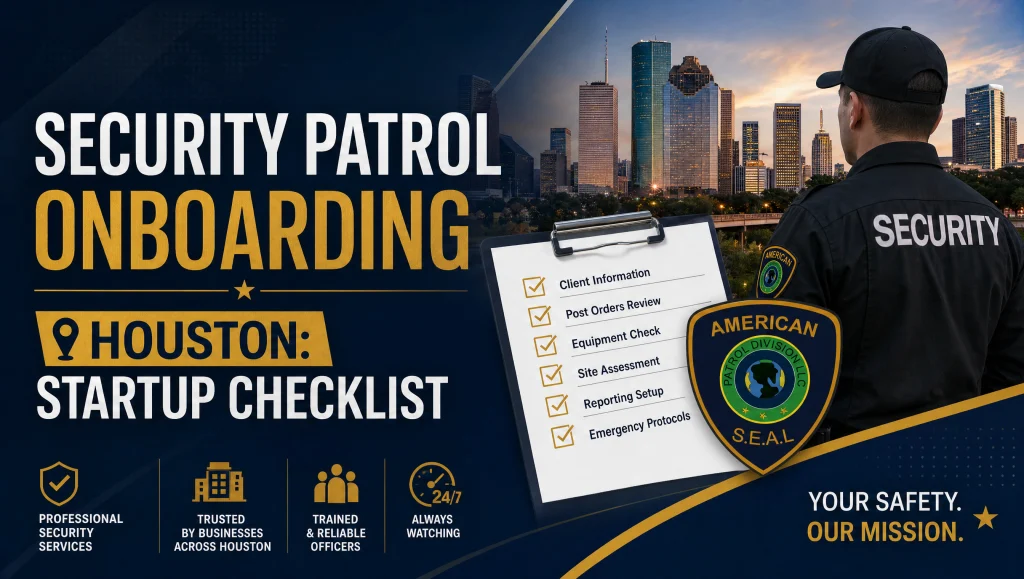
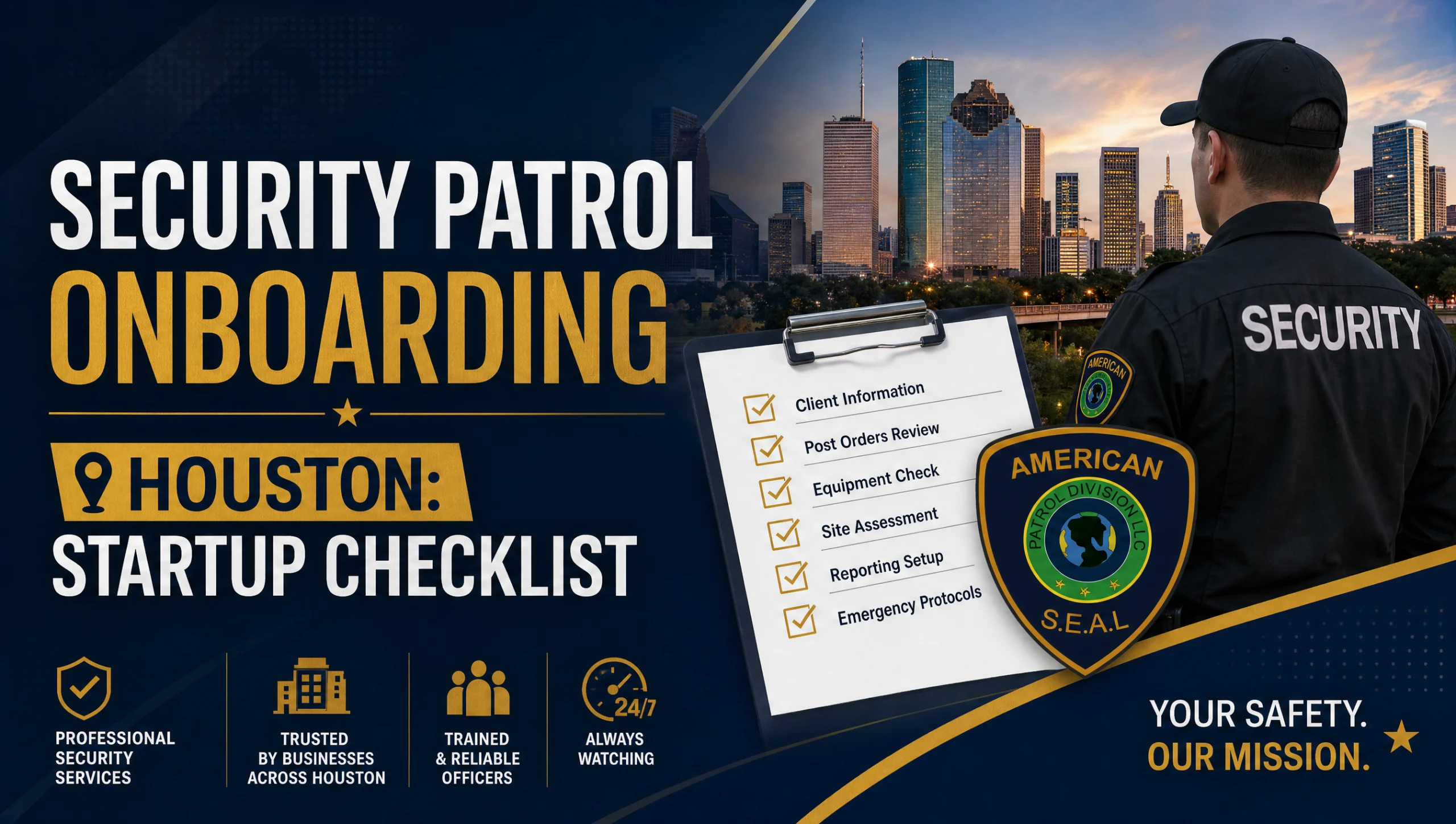
Security Patrol Onboarding Houston: What to Expect in the First 30 Days
Security patrol onboarding in Houston is a purposeful first 30 days where your provider completes a site assessment, sets post orders, integrates dispatch and gate access, and launches GPS-verified mobile and foot patrols with clear communication and reporting. If you manage an apartment community, multifamily property, or HOA in Greater Houston, here’s exactly how American S.E.A.L. Patrol Division approaches kickoff—what will happen, when it will happen, and how you’ll see early results.
Who This 30‑Day Plan Is For
Apartments, multifamily, and HOAs in Greater Houston
Communities with gates, garages, visitor lots, pools, package rooms, and shared amenities
Properties that need after-hours nuisance deterrence, parking reinforcement, and fast incident response
Sites with existing cameras or gate access systems that benefit from 24/7 live dispatch integration
Property managers, asset managers, and on‑site teams
On‑site managers, leasing teams, maintenance supervisors, and courtesy officers
Regional managers and owners who want clear performance metrics and GPS‑verified accountability
Vendors and partners who need agreed communication and access protocols
Week 0–1: Startup Checklist and Site Assessment
The first week sets the foundation for everything that follows. Expect a thorough walk, clean documentation setup, and immediate communication clarity so patrols can launch smoothly and predictably across your Houston property.
Site assessment scope: access points, lighting, camera coverage, common areas
Document after‑hours emergency procedures to align with your risk management plan
Communication Protocol: How We Coordinate Day to Day
Good security relies on predictable, fast, and well‑routed communication. We make this explicit on day one so your team knows exactly who to call and what to expect.
24/7 live dispatch, escalation paths, and response times
Dispatch answers live around the clock, routing calls based on urgency and your post orders
Response times are captured in logs and summarized weekly for transparency
Primary contacts and backup contacts
List your daytime lead, after‑hours lead, and maintenance on‑call
Provide our patrol supervisor and dispatch contact lines for direct coordination
Keep an updated contact sheet in both teams’ hands; review monthly
Radio/phone/email channels and after‑hours call tree
Define the primary channel for urgent alerts (usually a phone call to dispatch)
Use email for daily summaries and weekly roll‑ups
Trigger the after‑hours call tree for emergencies, property damage, or gate failures
Incident documentation and photo/video handling
Standardized incident reports capture date/time, zone, narrative, and disposition
Photos/video are attached when appropriate and stored per your retention policy
Sensitive footage is shared via secure links on request from management or law enforcement
Mobile Patrol and Reporting: What You’ll See in the Logs
From day one, your logs should make it clear where, when, and how patrols occurred—and what officers found on site.
GPS‑verified, time‑stamped patrol stops
Each patrol stop includes location, timestamp, and action taken
Exceptions (e.g., construction blocking a route) are noted with a reason code
Foot patrol vs. vehicle patrol notes
Distinguish vehicle loops from foot sweeps for full transparency
Foot patrols document stairwells, breezeways, mail areas, and amenities
Vehicle patrols document perimeters, lots, garages, and gate operations
Courtesy officer check‑ins and common‑area sweeps
If courtesy officers are assigned, you’ll see their check‑ins and visitor interactions
Common‑area sweeps list doors secured, pool gates latched, and noise checks completed
Daily summaries and weekly roll‑ups
Daily: snapshot of patrol completion, notable incidents, and gate/lighting issues
Weekly: roll‑up of incidents by type/time, heat maps for hot‑spots, and recommended adjustments
For deeper detail on logs and accountability, see our published overview of mobile security patrols in Houston: https://www.americanspd.com/?p=3944
Week 2–3: Stabilization and Early Wins
As initial data rolls in, we refine routes and focus on the quick wins that matter to residents and staff. This phase is where you’ll often see quality-of-life improvements across Greater Houston communities.
Adjusting patrol routes and frequencies from field data
Shift more foot presence into evening hot‑spots (mail center, pool deck) if the logs warrant it
Add targeted checks for recurring nuisances (dumpster enclosures, stairwells)
Update the coverage map and post orders to reflect these changes
Parking, gate, and nuisance policy reinforcement
Reinforce visitor parking rules per your policy, with attention to repeat offenders
Test gate timing and tailgating risks; coordinate fixes with your access vendor
Use standardized, respectful resident notices and escalate per your rules only when needed
For broader policy cost impacts, see security guard cost in Houston: https://www.americanspd.com/?p=3950
Coordination with CCTV monitoring for real‑time response
If applicable on your property, pair motion or analytics alerts with immediate patrol dispatch
Document camera‑triggered responses distinctly for clarity during reviews
Consider short‑term camera repositioning to close blind spots identified in the logs
Performance Metrics to Review in Month One
You don’t need a dozen dashboards. A few practical indicators will tell you whether the plan is working and where to fine‑tune.
Patrol completion rate and coverage adherence
Target consistent completion of scheduled loops and checkpoints
Track exceptions with reasons (e.g., resident event, maintenance closure)
Response times and escalation resolution
Measure response bands (e.g., 0–10 min, 11–20 min) to common incidents
Log whether issues were resolved at the patrol level or required escalation
Incident volume, types, and documentation quality
Look for stabilization or downward trends in nuisance categories
Audit a sample of reports for clarity, photos, and follow‑through notes
American S.E.A.L. Patrol Division reports documented incident reductions of 60%+ in a heavily patrolled Houston zone per our internal reports; your property’s pattern will be reviewed without assumptions
Stakeholder feedback from management and maintenance
Brief check‑ins gather on‑the‑ground feedback from your team
Fold maintenance notes (e.g., lighting repairs) back into patrol priorities
Week 4: First 30‑Day Review and Next‑Step Plan
Day-one walkthrough in a Houston community: site assessment, communication protocol setup, and patrol routing for a new mobile security program.
At the end of the month, we meet with your team to validate what’s working and align on what to improve next. This is where the onboarding transitions into a steady, data‑driven rhythm.
What’s working, what needs adjustment
Review the weekly roll‑ups and the incident heat map together
Confirm whether high‑visibility hours align with nuisance peaks
Post‑order refinements and seasonal considerations
Adjust for seasonal changes: earlier darkness, pool season, holiday package surges
Re‑balance foot vs. vehicle patrol during periods of higher foot traffic
Plan for month two and quarterly goals
Set modest, measurable targets (e.g., reduce parking violations in Building C by 30% over Q1)
Schedule a quarterly review to reassess coverage using site data and resident feedback
First‑Hand Experience: What This Looks Like on a Houston Property
On a recent Houston multifamily onboarding, our team spent the first week walking every access point with management, testing gate credentials, and marking dimly lit areas on the coverage map. By week two, early logs showed activity around the mail center after 8 p.m., so we added two evening foot sweeps and tightened visitor parking checks nearby. During the 30‑day review, we focused on response times and documentation quality and refined post orders around visitor parking—balancing consistency with minimal disruption to residents.
Myth vs. Fact: First 30 Days
Myth: “Security results take months to show up.”
Fact: While broad crime trends take time, early wins—like better parking compliance, quicker responses, and fewer after‑hours disturbances—often appear within weeks when routes and post orders are targeted.
Myth: “One fixed route works everywhere.”
Fact: Houston properties can differ block‑to‑block. Data from GPS‑verified logs should drive route and frequency tweaks by week two.
Myth: “Cameras alone are enough.”
Fact: Cameras deter and document; patrols intervene and resolve. Pairing CCTV alerts with mobile patrol delivers faster, more visible outcomes.
How American S.E.A.L. Patrol Division Onboards Houston Properties
15+ years on patrol and 24/7 live dispatch
We’re a Houston‑based team with over 15 years on patrol and a live dispatch center staffed around the clock by real people who know the city’s patterns and routes.
GPS‑verified mobile patrol and incident documentation
Mobile vehicle and foot patrols include time‑stamped, GPS‑verified logs
Incident reports include narrative detail, photos/video as appropriate, and disposition notes
For a deeper look at our approach to apartment communities, visit our overview of Houston apartment security: https://www.americanspd.com/?p=3951
Fire watch and CCTV integration when needed
We provide fire watch services and integrate with your camera system for real‑time response
For specifics on compliance and process, see fire watch services in Houston: https://www.americanspd.com/?p=3952
We are licensed, bonded, and insured. Texas DPS Private Security Bureau License #C28662701
Headquartered at 16420 Park Ten Place, #590, Houston, TX 77084
Get Started: Request a Site Walk and 30‑Day Plan
What to have ready before kickoff
Property map and building list (including amenities)
Access credentials for gates, garages, and control rooms
Current post orders or house rules (parking, noise, towing, visitor policy)
Primary and backup contacts with after‑hours phone numbers
Known trouble spots and incident highlights from the past 60–90 days
Free quote and contact options
Want a clear, property‑specific 30‑day startup checklist and coverage map? Request a site walk. Start by exploring our Houston security services at https://americanspd.com/
It’s built for local realities: gates, garages, visitor parking, and late‑evening amenities
It’s transparent: GPS‑verified patrol logs and a clear reporting cadence
It’s adaptable: early field data informs route adjustments within two weeks
It’s collaborative: property‑specific post orders and a standing communication protocol
If you’re evaluating providers, you can also compare service models and expectations here:
Mobile security patrols in Houston: https://www.americanspd.com/?p=3944
Security guard cost in Houston: https://www.americanspd.com/?p=3950
Conclusion: Security Patrol Onboarding Houston—Set Expectations, See Early Results
Security patrol onboarding Houston works best when it’s transparent, data‑driven, and tailored to how your community actually operates. In the first 30 days, you should expect a thorough site assessment, clear post orders, integrated 24/7 communication, and GPS‑verified reporting—followed by a focused 30‑day review that tightens routes and goals. American S.E.A.L. Patrol Division brings 15+ years of Houston experience, live dispatch, and property‑specific plans to help your team see early wins and steady improvement. To start your site walk and customized 30‑day plan, visit https://americanspd.com/, request a free quote at https://www.americanspd.com/free-quote/, or contact our dispatch team at https://www.americanspd.com/contact-us/.
Frequently Asked Questions
What does security patrol onboarding in Houston include during the first 30 days?
Short answer: A site assessment, property‑specific post orders, dispatch and gate integration, GPS‑verified patrols, and a 30‑day review.
Expanded: In weeks 0–1, we complete a detailed site walk and draft post orders and a coverage map. We integrate 24/7 live dispatch, gate access, and (if applicable) CCTV alerts. Patrols launch with GPS‑verified mobile and foot sweeps, daily summaries, and weekly roll‑ups, leading to a week‑4 review with refinements.
How soon do patrols start after kickoff?
Short answer: Patrols typically begin immediately after the initial site walk and access testing in week one.
Expanded: Once credentials, gates, and communication protocols are confirmed, mobile and foot patrols start with time‑stamped, GPS‑verified logs. We prioritize a smooth launch so you see activity and reporting from day one.
What should our team have ready for the startup checklist?
Short answer: Property maps, access credentials, current rules/post orders, key contacts, and recent incident highlights.
Expanded: Bring a building list, gate/garage codes or fobs, parking/towing and nuisance policies, primary/backup contacts, and known hot‑spots from the past 60–90 days. This speeds post‑order drafting and coverage accuracy. For an overview of our Houston security services, visit https://americanspd.com/.
How do you integrate with our gates and cameras?
Short answer: We test access points and tie your call flow and camera alerts into 24/7 live dispatch.
Expanded: During the site walk, we capture credentials and verify gate readers and door controllers. If cameras are live‑monitored, we coordinate event‑based alerts so patrols respond in real time and document camera‑triggered actions distinctly.
What will I see in patrol reports and how often?
Short answer: Daily snapshots and weekly roll‑ups with GPS‑verified stops, foot/vehicle notes, and incidents.
Expanded: Logs include time‑stamped locations, actions taken, exceptions, and photo/video when appropriate. Daily summaries flag notable issues; weekly reports group incidents by type/time with hot‑spot heat maps. For more on logs, see our mobile patrol overview: https://www.americanspd.com/?p=3944.
How are incidents handled and documented?
Short answer: Dispatch routes calls by urgency; officers document narratives, timestamps, zones, and outcomes.
Expanded: We use standardized incident reports with photos/video when appropriate. Sensitive footage is shared securely on request with management or law enforcement. Escalation is tiered: patrol officer → field supervisor → your designated contacts.
How do you measure success in the first month?
Short answer: Completion of patrol coverage, response times, incident trends, and documentation quality.
Expanded: We monitor scheduled loop completion, response time bands, and incident categories for stabilization or decline. We also review sample reports for clarity and follow‑through, and gather manager/maintenance feedback. See cost and policy impacts here: https://www.americanspd.com/?p=3950.
Can you work with our on‑site courtesy officer and vendors?
Short answer: Yes—post orders define courtesy officer check‑ins and vendor verification after hours.
Expanded: We align on shared expectations for common‑area presence, noise mediation, and visitor/parking reminders, plus when to involve management or maintenance. Courtesy officer activities appear in your logs for transparency.
What’s the difference between foot patrols and vehicle patrols during onboarding?
Short answer: Foot patrols cover interiors and amenities; vehicle patrols cover perimeters, lots, garages, and gates.
Expanded: Foot sweeps document stairwells, breezeways, mail areas, and pools; vehicle loops document lots, garages, and gate operations. Early data often shifts more foot presence into evening hot‑spots like mail centers or pool decks.
Who do I contact after hours, and how fast is the response?
Short answer: Call our 24/7 live dispatch, which routes by urgency and your post orders; response times are logged and reported.
Expanded: We establish a clear call tree on day one. Dispatch engages patrols, then escalates to field supervisors and your listed contacts if needed. Response times and resolutions are summarized weekly for transparency.
Are you licensed and insured in Texas?
Short answer: Yes—licensed, bonded, and insured; Texas DPS Private Security Bureau License #C28662701.
Expanded: We exchange COIs and additional insured details during onboarding and document after‑hours emergency procedures to align with your risk management plan. Headquarters: 16420 Park Ten Place, #590, Houston, TX 77084.
How do we request a site walk, pricing, or get in touch?
Short answer: Explore services, request a free quote, or contact our team online.
Expanded: Start with our Houston security services at https://americanspd.com/, request a free quote at https://www.americanspd.com/free-quote/, or contact us anytime at https://www.americanspd.com/contact-us/ to schedule your site walk and customized 30‑day plan.