Moe Shariff · November 5, 2026
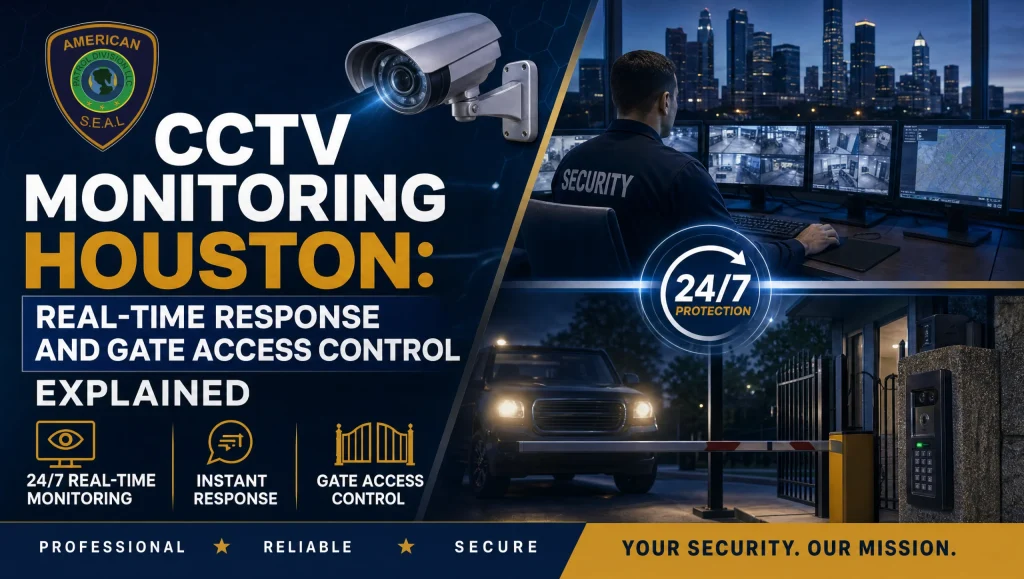
CCTV monitoring Houston is a live, operator-led service that watches your cameras in real time, verifies activity, and coordinates rapid response—often including remote gate access control—so property managers get faster outcomes with clear documentation. If you manage an apartment community or commercial property in Greater Houston, this integrated model closes the gap between what your cameras capture and what actually gets handled on the ground.
CCTV monitoring is more than “watching cameras.” It’s a coordinated workflow that connects your video system to real people who can verify events, intervene through voice-down and gate controls, notify the right contacts, and dispatch help—without wasting time on guesswork or false alarms. At American S.E.A.L. Patrol Division, our monitoring model is anchored in Houston with 24/7 live dispatch, real-time incident documentation, and the option to pair with GPS-verified mobile patrols when needed. We’re licensed, bonded, and insured in Texas (DPS PSB License #C28662701), and our local team understands how Houston properties move throughout the day and night.
Live video response means a trained operator immediately reviews camera footage when an alert or activity comes in. Instead of blasting a blanket alarm, the operator:
When your gates and doors are integrated with your monitoring platform, operators can do more than watch—they can actively manage entry without creating bottlenecks or security gaps. Gate access control in Houston properties commonly covers resident lanes, visitor lanes, vendor deliveries, parking structures, and pedestrian entries.
Property managers need clean records. A typical documented incident might include:
Not every alert needs a patrol car or police response. Verified video helps decide:
Verification shortens delays. Operators confirm what’s happening and trigger the right next step—opening a gate, denying entry, calling a resident, dispatching patrol, or contacting HPD—based on a property-approved plan.
On a recent overnight in West Houston, our operator flagged repeat tailgating at a resident gate. We adjusted the camera angle slightly, added a short voice-down greeting at the pinch point, and tightened the vendor schedule by 30 minutes. Within a week, entries normalized and after-hours calls to the office dropped. No headline moment—just small, practical tweaks that came from watching the site closely and documenting what we saw.
Here’s what property managers typically notice within the first 60–90 days:
If you’re managing multifamily assets, you can also pair these controls with resident updates—simple notes about what to expect at the gate, how visitors are approved, and why tailgating matters. That communication builds cooperation and keeps expectations aligned.
We’re a Houston-based, licensed provider with more than 15 years on patrol, serving 45+ communities with integrated camera monitoring, gate access control, and GPS-verified mobile patrols. Our 24/7 live dispatch is staffed by real people, and our process centers on documentation, verified response, and property-specific plans that adjust over time. Explore our Houston security services to see how we approach coverage across the city. For a deeper dive into apartment gate integrations, review our CCTV monitoring for Houston apartments guide. If you anticipate pairing monitoring with patrols, our overview of mobile security patrols in Houston can help you visualize the combined model. And if you manage properties with system outages or construction, our fire watch services in Houston explain how we maintain compliance during transitions.
If you’re ready to explore CCTV monitoring Houston with integrated gate access control, we’ll help you scope a plan that fits your property and budget:
You can contact our Houston team, request a proposal, or get a free quote to check pricing and availability:
CCTV monitoring Houston works best when it’s human-led, documented, and connected to real levers like gate access and dispatch. With live video response, authorized entry workflows, and clear escalation to mobile patrols or HPD, you get faster outcomes and cleaner records—without overbuilding posts. If that’s the direction you’re considering for your community or commercial site, our Houston team is ready to help you build a smart, right-sized plan and bring it online with confidence.
Image alt text suggestion: CCTV monitoring Houston with live video response and gate access control at a multifamily community entrance
Short answer: It’s live, operator-led camera monitoring with real-time verification, documentation, and response—not just passive recording.
Expanded: CCTV monitoring Houston connects your cameras to trained operators who verify events as they happen, manage gate access (when integrated), issue voice-down warnings (if installed), notify 24/7 dispatch, and document incidents with time-stamped logs. It closes the gap between what cameras see and what actually gets handled on the ground.
Short answer: Operators manage entries in real time using authorized lists, schedules, and verified visitor workflows.
Expanded: When your gates and doors are integrated, operators confirm who is requesting entry, check against approved lists and schedules, call the resident or property contact if needed, and open or deny the gate remotely. Every action is time-stamped for an audit trail. This reduces bottlenecks, tailgating, and unauthorized after-hours entries.
Short answer: No—monitoring and guards work best together in a hybrid model.
Expanded: Remote monitoring provides always-on coverage and rapid verification, while courtesy officers or on-site posts handle hands-on needs during peak times or at hot spots like gates, lobbies, and loading docks. Pairing the two controls costs and keeps response times fast and predictable.
Short answer: They verify the event, act (open/deny, voice-down), notify dispatch, and document.
Expanded: On an alert, operators confirm what, where, and who; determine whether to grant or deny access (if integrated); issue a voice warning (when speakers are in place); contact our 24/7 Houston dispatch or your designated contacts; and record the incident with time, location, camera ID, actions taken, and outcomes.
Short answer: Verified threats, crimes in progress, or unresolved activity trigger escalation per your plan.
Expanded: Many issues resolve remotely with voice-down and access denial. If people remain on-site, damage is suspected, or in-person verification is required, we dispatch GPS-verified mobile patrols. For crimes in progress or safety threats, we immediately escalate to HPD with precise, verified details to speed communication.
Short answer: Site map, camera list, access control details, contacts, and recent concerns.
Expanded: Prepare a property map with gates/doors, a camera inventory (make/model, coverage, NVR/VMS), access control info (controllers/readers/intercoms) with schedules, your contact hierarchy for approvals, and a few recent incident examples. When ready, contact our Houston team or request a free quote: https://www.americanspd.com/contact-us/ and https://www.americanspd.com/free-quote/.
Short answer: Often yes—most modern systems can tie into live monitoring and access control workflows.
Expanded: During the site assessment, we review your cameras, VMS/NVR, access controllers, and intercoms. We recommend any adjustments to camera placement, lighting, or signage, then test scenarios (approve/deny, voice-down, call trees) so you know exactly how events will be handled. See our Houston security services overview: https://americanspd.com/.
Short answer: Many sites go live within a few weeks after assessment and testing.
Expanded: A typical path is: Week 1 site walk and plan; Weeks 2–3 integrations and testing; Week 4 go-live with documentation and a 30-day review. Single-entry sites with existing equipment can often move faster once rules and approvals are confirmed.
Short answer: You’ll get time-stamped logs with verified details and outcomes.
Expanded: Each incident includes the timestamp, camera location, event type (e.g., trespass, tailgating, gate request), actions taken (verified, voice-down, opened/denied, dispatched), who was notified, and the outcome. Where permissions allow, images or clips are attached. These records make resident updates and vendor accountability straightforward.
Short answer: Yes—licensed, bonded, and insured in Texas with 15+ years on patrol in Houston.
Expanded: We’re Houston-based (16420 Park Ten Place, #590, Houston, TX 77084) and licensed by the Texas DPS Private Security Bureau (License #C28662701). Our 24/7 live dispatch is staffed by real people, and we protect 45+ communities with integrated monitoring, gate access control, and GPS-verified mobile patrols. Learn more: https://americanspd.com/.
Short answer: Yes—video verification filters noise and speeds the right response.
Expanded: Operators confirm what’s happening before acting, which prevents unnecessary alarms and after-hours disruptions. Documented, verified incidents let you update residents with facts. For apartment-focused details, see our Houston guide on CCTV monitoring and gate access control: https://www.americanspd.com/?p=3947.
Short answer: A small camera angle change, tighter vendor window, and brief voice-down cut repeated tailgating in West Houston.
Expanded: On a recent overnight, our operator flagged recurring tailgating at a resident gate. We adjusted the angle, added a short voice-down at the pinch point, and tightened the vendor schedule by 30 minutes. Within a week, entries normalized and after-hours office calls dropped—simple, documented tweaks that came from watching the site closely.
{
“@context”: “https://schema.org”,
“@type”: “FAQPage”,
“mainEntity”: [
{
“@type”: “Question”,
“name”: “What is “CCTV monitoring Houston,” and how is it different from just recording video?”,
“acceptedAnswer”: {
“@type”: “Answer”,
“text”: “Short answer: It’s live, operator-led camera monitoring with real-time verification, documentation, and response—not just passive recording.\n\nExpanded: CCTV monitoring Houston connects your cameras to trained operators who verify events as they happen, manage gate access (when integrated), issue voice-down warnings (if installed), notify 24/7 dispatch, and document incidents with time-stamped logs. It closes the gap between what cameras see and what actually gets handled on the ground.”
}
},
{
“@type”: “Question”,
“name”: “How does gate access control work with live monitoring?”,
“acceptedAnswer”: {
“@type”: “Answer”,
“text”: “Short answer: Operators manage entries in real time using authorized lists, schedules, and verified visitor workflows.\n\nExpanded: When your gates and doors are integrated, operators confirm who is requesting entry, check against approved lists and schedules, call the resident or property contact if needed, and open or deny the gate remotely. Every action is time-stamped for an audit trail. This reduces bottlenecks, tailgating, and unauthorized after-hours entries.”
}
},
{
“@type”: “Question”,
“name”: “Does CCTV monitoring replace on-site guards?”,
“acceptedAnswer”: {
“@type”: “Answer”,
“text”: “Short answer: No—monitoring and guards work best together in a hybrid model.\n\nExpanded: Remote monitoring provides always-on coverage and rapid verification, while courtesy officers or on-site posts handle hands-on needs during peak times or at hot spots like gates, lobbies, and loading docks. Pairing the two controls costs and keeps response times fast and predictable.”
}
},
{
“@type”: “Question”,
“name”: “What do operators actually do during a live video response?”,
“acceptedAnswer”: {
“@type”: “Answer”,
“text”: “Short answer: They verify the event, act (open/deny, voice-down), notify dispatch, and document.\n\nExpanded: On an alert, operators confirm what, where, and who; determine whether to grant or deny access (if integrated); issue a voice warning (when speakers are in place); contact our 24/7 Houston dispatch or your designated contacts; and record the incident with time, location, camera ID, actions taken, and outcomes.”
}
},
{
“@type”: “Question”,
“name”: “When should an incident be escalated to mobile patrol or HPD?”,
“acceptedAnswer”: {
“@type”: “Answer”,
“text”: “Short answer: Verified threats, crimes in progress, or unresolved activity trigger escalation per your plan.\n\nExpanded: Many issues resolve remotely with voice-down and access denial. If people remain on-site, damage is suspected, or in-person verification is required, we dispatch GPS-verified mobile patrols. For crimes in progress or safety threats, we immediately escalate to HPD with precise, verified details to speed communication.”
}
},
{
“@type”: “Question”,
“name”: “What do property managers need to provide to get a quote?”,
“acceptedAnswer”: {
“@type”: “Answer”,
“text”: “Short answer: Site map, camera list, access control details, contacts, and recent concerns.\n\nExpanded: Prepare a property map with gates/doors, a camera inventory (make/model, coverage, NVR/VMS), access control info (controllers/readers/intercoms) with schedules, your contact hierarchy for approvals, and a few recent incident examples. When ready, contact our Houston team or request a free quote: https://www.americanspd.com/contact-us/ and https://www.americanspd.com/free-quote/.”
}
},
{
“@type”: “Question”,
“name”: “Can you integrate with our existing cameras and gate system?”,
“acceptedAnswer”: {
“@type”: “Answer”,
“text”: “Short answer: Often yes—most modern systems can tie into live monitoring and access control workflows.\n\nExpanded: During the site assessment, we review your cameras, VMS/NVR, access controllers, and intercoms. We recommend any adjustments to camera placement, lighting, or signage, then test scenarios (approve/deny, voice-down, call trees) so you know exactly how events will be handled. See our Houston security services overview: https://americanspd.com/.”
}
},
{
“@type”: “Question”,
“name”: “How quickly can CCTV monitoring and gate access control go live?”,
“acceptedAnswer”: {
“@type”: “Answer”,
“text”: “Short answer: Many sites go live within a few weeks after assessment and testing.\n\nExpanded: A typical path is: Week 1 site walk and plan; Weeks 2–3 integrations and testing; Week 4 go-live with documentation and a 30-day review. Single-entry sites with existing equipment can often move faster once rules and approvals are confirmed.”
}
},
{
“@type”: “Question”,
“name”: “How is incident documentation handled, and what will I see in reports?”,
“acceptedAnswer”: {
“@type”: “Answer”,
“text”: “Short answer: You’ll get time-stamped logs with verified details and outcomes.\n\nExpanded: Each incident includes the timestamp, camera location, event type (e.g., trespass, tailgating, gate request), actions taken (verified, voice-down, opened/denied, dispatched), who was notified, and the outcome. Where permissions allow, images or clips are attached. These records make resident updates and vendor accountability straightforward.”
}
},
{
“@type”: “Question”,
“name”: “Is American S.E.A.L. Patrol Division licensed and local to Houston?”,
“acceptedAnswer”: {
“@type”: “Answer”,
“text”: “Short answer: Yes—licensed, bonded, and insured in Texas with 15+ years on patrol in Houston.\n\nExpanded: We’re Houston-based (16420 Park Ten Place, #590, Houston, TX 77084) and licensed by the Texas DPS Private Security Bureau (License #C28662701). Our 24/7 live dispatch is staffed by real people, and we protect 45+ communities with integrated monitoring, gate access control, and GPS-verified mobile patrols. Learn more: https://americanspd.com/.”
}
},
{
“@type”: “Question”,
“name”: “Will CCTV monitoring Houston help reduce false alarms and late-night calls?”,
“acceptedAnswer”: {
“@type”: “Answer”,
“text”: “Short answer: Yes—video verification filters noise and speeds the right response.\n\nExpanded: Operators confirm what’s happening before acting, which prevents unnecessary alarms and after-hours disruptions. Documented, verified incidents let you update residents with facts. For apartment-focused details, see our Houston guide on CCTV monitoring and gate access control: https://www.americanspd.com/?p=3947.”
}
},
{
“@type”: “Question”,
“name”: “Can you share a real example of this working on a Houston property?”,
“acceptedAnswer”: {
“@type”: “Answer”,
“text”: “Short answer: A small camera angle change, tighter vendor window, and brief voice-down cut repeated tailgating in West Houston.\n\nExpanded: On a recent overnight, our operator flagged recurring tailgating at a resident gate. We adjusted the angle, added a short voice-down at the pinch point, and tightened the vendor schedule by 30 minutes. Within a week, entries normalized and after-hours office calls dropped—simple, documented tweaks that came from watching the site closely.”
}
}
]
}