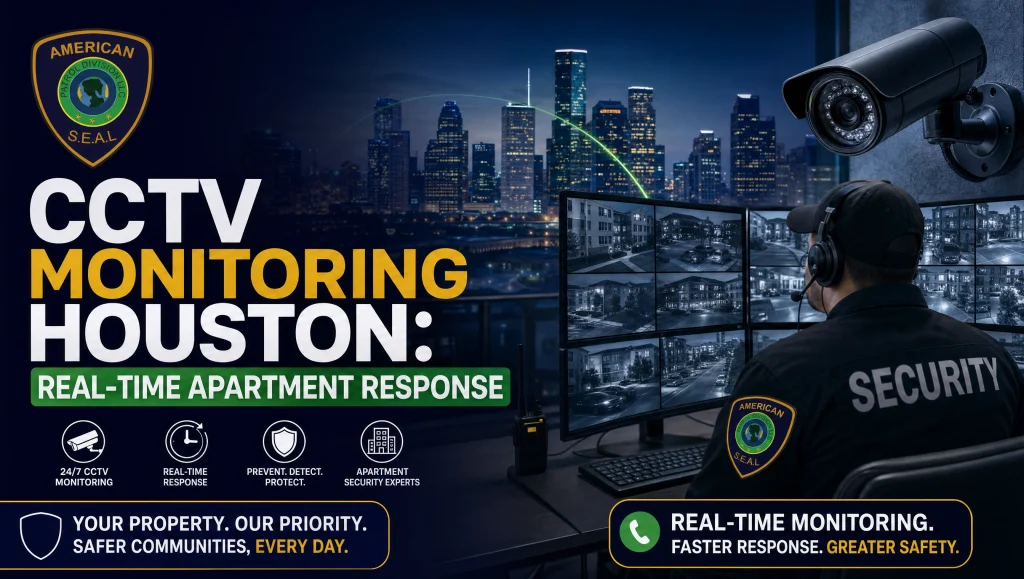
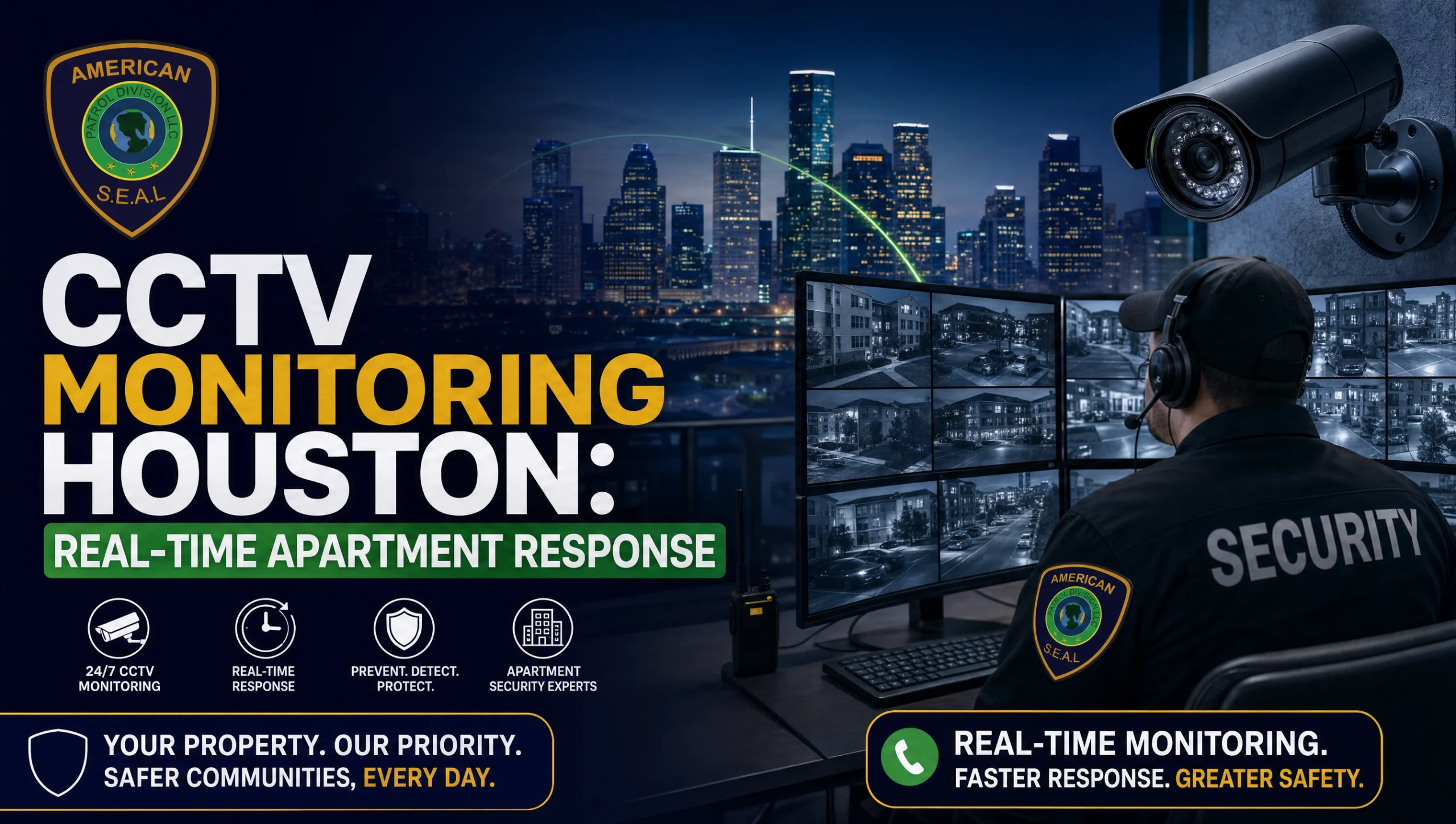
CCTV Monitoring Houston: Real-Time Apartment Response with Patrol Support
CCTV Monitoring Houston: Real-Time Response for Apartment Communities
If you manage a multifamily property in Houston, you already know next-day footage doesn’t solve tonight’s problems. CCTV monitoring Houston for apartments means live, remote video oversight with real-time detection, quick verification, and coordinated dispatch—often tied into gate access control and mobile patrols to speed response and document what occurs. When monitoring, patrol, and 24/7 dispatch operate from the same playbook, your community sees faster help, clearer records, and fewer avoidable disruptions. For a broader look at how these pieces connect across Houston security services, visit American S.E.A.L. Patrol Division’s home page at https://americanspd.com/.
What “real-time” CCTV monitoring means for Houston apartments
Real-time monitoring is human-led oversight of your camera system, guided by property-specific rules and backed by dispatch and patrol. The objective is straightforward: spot an issue, verify it quickly, respond appropriately, and document the event so you can act with confidence.
Key benefits at a glance:
Real-time visibility on high-risk areas: gates, parking, mailrooms, and amenities
Faster response through 24/7 live dispatch and nearby patrol coordination
Clear documentation with time-stamped clips and incident reports
Reduced tailgating and more consistent control of after-hours vendor/visitor access
Monitoring rules aligned with your community’s policies and priorities
Live detection, verification, and dispatch—step by step
Detection: Cameras stream to trained operators who watch for motion in defined hot spots, analytic alerts, or resident-initiated calls to dispatch.
Verification: Operators review multiple angles to confirm what’s happening—tailgating at the gate, loitering near mailboxes, or amenity misuse.
Dispatch: Based on your protocols, the operator may issue two-way audio talk-down, notify on-site staff or a courtesy officer, send mobile patrol, or coordinate with HPD when appropriate.
Documentation: Every step is time-stamped. If patrols respond, GPS-verified logs and incident reports tie back to the original video event, creating clean, durable records.
Remote video monitoring vs. traditional recording-only systems
Recording-only: Useful after the fact, but you’re reviewing footage tomorrow rather than preventing the problem tonight.
Remote video monitoring: Operators watch priority zones in real time and act immediately—especially effective when paired with mobile patrols and 24/7 dispatch coordination.
How CCTV monitoring works with gate access control
Gate access control is one of the most impactful integrations for Houston apartments. With live monitoring, your gate becomes more than a motor and keypad—it becomes an actively managed entry.
Managing visitor entry, vendors, and after-hours deliveries
Verified visitors: Operators confirm identity at call boxes or virtual guard stations according to your property rules.
Vendor windows: After-hours maintenance teams, cleaners, or delivery drivers can be granted temporary access and escorted by camera while activity is recorded.
Policy alignment: Rules for guest parking, towing thresholds, or package courier access are baked into the monitoring checklist and applied consistently.
Reducing tailgating and documenting incidents at controlled entries
Detection: Operators flag tailgating attempts in real time.
Deterrence: Two-way audio allows calm, direct instructions that deter most attempts.
Follow-up: If someone bypasses controls, we dispatch patrol, notify your courtesy officer, or escalate per your protocol—supported by video clips and a time-stamped report.
For a deeper dive into this integration, see our practical guide: CCTV Monitoring and Gate Access Control for Houston Apartments: A Practical Guide at https://www.americanspd.com/?p=3947.
Pairing live monitoring with patrols for faster response
Monitoring is strongest when it’s paired with feet on the ground. That’s why we align live camera oversight with mobile patrols and on-site officers for a coordinated response.
Mobile vehicle and foot patrols with GPS-verified logs
Coverage where and when it matters: Patrol patterns follow your monitoring heat map—parking lots, mailrooms, and perimeter fencing during peak risk windows.
GPS-verified evidence: Patrol stops, routes, and checks are logged with GPS and time stamps so you can confirm coverage and correlate with camera activity.
Data-tuned routes: Monitoring reports help adjust patrol frequency by building, time of night, or recurring issue.
Learn more about our approach: Mobile Security Patrols in Houston at https://www.americanspd.com/?p=3944.
24/7 live dispatch coordination and incident documentation
Single point of contact: Operators, patrols, and on-site teams coordinate through 24/7 live dispatch staffed by real people.
Clear handoffs: When an event occurs, dispatch records the call, patrol ETA, and on-scene notes, then closes the loop with you via an incident report.
Evidence that holds up: Video clips, patrol logs, and dispatch notes are kept together to support lease enforcement and, when necessary, law enforcement.
Apartment surveillance use cases in Houston
Parking areas, mail/package rooms, and perimeter fencing
Parking: Live monitoring helps catch vehicle break-in patterns, loitering, and catalytic converter theft attempts faster than next-day footage ever could.
Mail/package: Operators focus on common theft windows and can issue talk-down warnings, alert patrol, or notify management about recurring hotspots.
Fence lines and gates: Cameras at breach-prone sections help detect after-hours entries and provide time-stamped visuals for repairs or police reports.
Pools, gyms, clubhouses, and quiet hours
Amenity misuse: After-hours swimmers, propped gym doors, and impromptu parties in the clubhouse are flagged, addressed via audio, and escalated if needed.
Quiet hours: Monitoring supports noise policies by documenting repeated issues and confirming whether on-site response is warranted.
Vacant units and construction/maintenance zones
Vacancy checks: Targeted views on vacant units deter unauthorized access and provide clean documentation if damage occurs.
Projects: During roof work or repipes, operators can watch material staging areas, coordinate with vendor schedules, and reduce downtime losses.
Practical setup: cameras, coverage, and monitoring rules
Live apartment surveillance and gate access control from our Houston operations center, supporting patrol teams with faster, documented response.
Camera placement, lighting, and deterrence signage
Placement: Aim for faces at entries/exits, plate reads at vehicle chokepoints, and wide views in open lots—without pointing into private residential windows.
Lighting: Even, consistent lighting beats bright hotspots. Consider low-glare fixtures near gates, mailrooms, and dumpster enclosures.
Signage: Clear, well-placed signs stating active live monitoring and patrol support deter casual misuse and show residents how to contact dispatch.
Priorities matrix: hot spots, peak times, and escalation paths
Hot spots: Map where issues occur—gates, mail areas, pools, and back corners of lots—and rank them.
Peak times: Match monitoring intensity to your incident curve (e.g., weeknights 10 p.m.–2 a.m., package surges, move-in weeks).
Escalation paths: Define precisely who is called first, second, and third by scenario—courtesy officer, mobile patrol, property manager on-call, or HPD when appropriate.
Integrations with gate access, alarms, and courtesy officers
Gate access control: Monitoring teams reference access logs and video together for a complete picture.
Alarms: Door and fence alerts cue cameras to pop on screen and speed verification.
Courtesy officers: Real-time messaging helps on-site officers arrive informed with descriptions, locations, and safest approaches.
Reporting that helps property managers act
Time-stamped video clips, activity summaries, and trend insights
Clips: Short, labeled clips tied to incident IDs make it easy to share context with residents, vendors, and your ownership group.
Summaries: Weekly or monthly rollups show counts by category—tailgating attempts, amenity after-hours alerts, and package room activity.
Trends: We flag rising patterns (e.g., weekend lot activity drifting later) so you can adjust signage, lighting, or patrol frequency.
Coordinating with law enforcement and property policies
Clean handoffs: When police involvement is warranted, consolidated logs and clips reduce back-and-forth and speed case documentation.
Policy reinforcement: Video-backed incident notes support lease compliance and community notices without sounding speculative.
Real-world perspective from the field
One recent evening, a parking-lot camera flagged a person checking door handles. Our operator confirmed with a second angle, issued a brief audio warning, and passed the details to dispatch. A nearby patrol unit rolled in under three minutes, approached calmly, and the individual left without incident. The report bundled the alert time, patrol arrival, and a short clip. For the property manager, it meant a simple morning email instead of a morning full of questions.
Myth vs. fact: Live monitoring for apartments
Myth: “If I have cameras recording, I don’t need live monitoring.”
Fact: Recording helps after the fact. Live monitoring helps prevent or interrupt incidents and guides a faster on-the-ground response.
Myth: “Remote video monitoring replaces patrols.”
Fact: Monitoring and patrols are complementary. Operators verify and direct; patrols resolve in person and document on scene.
Myth: “Gate access control is just a keypad.”
Fact: With live oversight, gates become managed entries—reducing tailgating, tracking vendors, and aligning access with your policies.
Why choose American S.E.A.L. Patrol Division for CCTV monitoring in Houston
15+ years on patrol; licensed, bonded, insured (Texas DPS #C28662701)
Based in Houston, we’ve spent more than 15 years supporting local apartment communities with proactive, property-specific security. We are licensed, bonded, and insured under Texas DPS Private Security Bureau License #C28662701.
24/7 live dispatch, gate access control, and property-specific plans
Real people answer 24/7. We integrate live monitoring with gate access control, courtesy officers, and mobile patrols so your response is coordinated and clear. Plans are tailored to your community’s layout, policies, and resident expectations.
Experience across 45+ communities (per internal records/reports)
Our team currently serves dozens of multifamily properties across the Houston area. In one heavily patrolled zone, our internal reports document 60%+ incident reductions—results we attribute to consistent monitoring, data-driven patrols, and tight dispatch workflows.
Getting started: site assessment and next steps
What to expect in a walkthrough
Property map review: We’ll note entries, parking, amenities, package areas, and any blind spots.
Camera and lighting check: We assess current coverage, recommend priority upgrades, and confirm signage placement.
Policy alignment: Your community rules translate into monitoring scripts and escalation matrices.
Deliverables: You’ll receive a proposed monitoring plan, patrol alignment, and reporting examples so you know exactly what to expect.
Timeline and handoff to monitoring and patrol teams
Week 1: Site assessment, monitoring rules draft, and camera coverage confirmation.
Week 2: Finalize escalation paths, connect access control integrations, and test dispatch call flows.
Go-live: Operators follow your playbook; patrols run schedules aligned to your hot spots; you receive your first week’s summary report with time-stamped examples.
Ready to build your site-specific plan? You can request a free quote, schedule a site assessment, or talk through options with our Houston team:
Explore our Houston security services to see how monitoring, patrol, and access control fit together: https://americanspd.com/
request a free quote for CCTV monitoring and integrated patrols: https://www.americanspd.com/free-quote/
Prefer to talk first? contact our Houston team or speak with dispatch: https://www.americanspd.com/contact-us/
Conclusion: CCTV monitoring Houston for real-time apartment response
CCTV monitoring Houston works best when it’s truly live—paired with gate access control, 24/7 dispatch, and GPS-verified patrols that arrive informed. That integrated approach can shorten response times, reduce avoidable disruption, and leave you with clear, actionable documentation. If you manage a Houston apartment community and want a practical, property-specific plan, connect with American S.E.A.L. Patrol Division to get a CCTV monitoring quote and a walkthrough tailored to your site.
Frequently Asked Questions
1) What does “CCTV monitoring Houston” mean for apartment communities?
Short answer: Live operators watch priority cameras in real time, verify activity, and coordinate response with dispatch and patrol.
Expanded: CCTV monitoring Houston for apartments is human-led oversight of your existing camera system, guided by your property rules. Operators detect and verify issues, use two-way audio when appropriate, and coordinate with 24/7 dispatch, mobile patrols, courtesy officers, or HPD per your protocol—then document everything with time-stamped reports and clips.
2) How is live remote video monitoring different from recording-only cameras?
Short answer: Recording shows what happened tomorrow; live monitoring helps manage what’s happening now.
Expanded: A recording-only system is useful after the fact. With remote video monitoring, operators actively watch hot spots—gates, parking, mailrooms, amenities—so they can deter with audio, notify staff, or dispatch patrol immediately. See more on how monitoring pairs with patrols here: Mobile Security Patrols in Houston at https://www.americanspd.com/?p=3944.
3) How does CCTV monitoring work with gate access control at apartments?
Short answer: Operators verify visitors, manage after-hours vendors, reduce tailgating, and document entries.
Expanded: Monitoring teams can check IDs at call boxes or virtual guard stations, grant temporary access for approved vendors, and issue talk-down warnings when they see tailgating. All actions tie back to time-stamped video and reports. For a deeper dive, see: CCTV Monitoring and Gate Access Control for Houston Apartments at https://www.americanspd.com/?p=3947.
4) Do we still need mobile patrols or courtesy officers if we have live monitoring?
Short answer: Yes—monitoring and patrols work best together.
Expanded: Operators verify and direct; patrols and courtesy officers resolve on the ground. When monitoring, patrol, and 24/7 dispatch follow the same playbook, you get faster response and cleaner documentation. Learn how GPS-verified patrols align with monitoring: https://www.americanspd.com/?p=3944.
5) What areas should Houston apartments prioritize for camera coverage?
Short answer: Gates, parking lots, mail/package rooms, fence lines, and amenities like pools and gyms.
Expanded: Start with controlled entries and parking where risk is highest. Add focused views on mailrooms, back corners of lots, and breach-prone fence sections. Amenities and quiet-hour zones help enforce policies without guesswork. Lighting, angles, and clear signage improve results.
6) How are incidents documented and shared with property managers?
Short answer: With time-stamped clips, GPS-verified patrol logs, and concise incident reports.
Expanded: Operators and patrols log detection, verification, and actions taken, keeping video clips, dispatch notes, and patrol entries under a single incident ID. This makes it easier to brief your team, communicate with residents and vendors, and, when needed, coordinate with HPD or support lease compliance.
7) What about resident privacy—how do you monitor responsibly?
Short answer: Cameras focus on common areas; no pointing into private residential windows.
Expanded: We emphasize proper placement (entries/exits, chokepoints, amenity doors) and even lighting to capture useful evidence without invading private spaces. Clear signage explains monitoring and how to reach dispatch. Rules are aligned with your property policies and applicable laws.
8) What does onboarding look like and how long does it take?
Short answer: A two-week setup is typical—assessment, rule-building, integrations, testing—followed by go-live.
Expanded: Week 1 covers site assessment, monitoring rules, and camera/lighting checks. Week 2 finalizes escalation paths, connects access control integrations, and tests dispatch flows. On go-live, operators follow your playbook and you receive the first week’s summary. To get started, visit https://americanspd.com/ or request a quote at https://www.americanspd.com/free-quote/.
9) Can live monitoring really deter problems without constant on-site staff?
Short answer: Yes—verification plus talk-down and coordinated patrol response can interrupt issues early.
Expanded: Operators use multi-angle verification and calm, direct audio when appropriate, then alert courtesy officers or patrol for in-person follow-up. Over time, consistent monitoring, signage, and clear policies reduce avoidable disruptions at the gate, mailroom, and amenities.
10) How does this help with lease enforcement or law enforcement coordination?
Short answer: Clear, consolidated evidence streamlines internal actions and police handoffs.
Expanded: Video clips, dispatch notes, and GPS-verified patrol logs support policy reminders and lease documentation. When police involvement is warranted, packaged evidence shortens back-and-forth and helps establish timelines and details.
11) What does a real incident look like from detection to resolution?
Short answer: Operators verify on camera, give brief audio direction, and coordinate patrol or on-site staff—then document the outcome.
Expanded: For example, we’ve seen a parking-lot door-checking attempt flagged by analytics. An operator confirmed with a second angle, issued a short warning, and notified dispatch. A nearby patrol unit arrived, the individual left, and management received a concise report with a time-stamped clip the next morning.
12) How do we get pricing or a site-specific plan for our Houston community?
Short answer: Schedule a walkthrough and request a tailored quote.
Expanded: Costs depend on camera count, coverage priorities, hours, and integrations like gate access control. We’ll assess your site, map hot spots and peak times, and propose a monitoring/patrol plan. Explore our Houston security services at https://americanspd.com/, request a quote at https://www.americanspd.com/free-quote/, or contact us at https://www.americanspd.com/contact-us/.