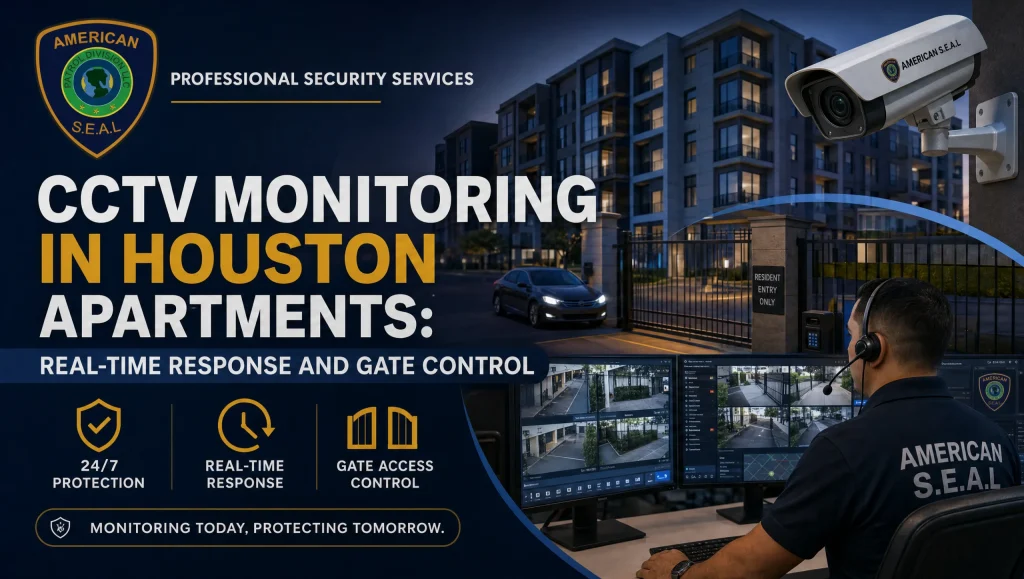
CCTV Monitoring Houston for Apartments: Real-Time Response
Moe Shariff · September 14, 2026
Local SEO — CCTV Monitoring Houston for Apartments: Real-Time Response & Gate Access Control
CCTV Monitoring Houston: Real-Time Response and Gate Access Control for Apartments
CCTV monitoring Houston apartments is more than watching cameras. It’s having a trained operator verify activity in real time, coordinate the right response, and—when needed—control gate access to keep people and property safe. For multifamily communities across Houston, pairing live camera monitoring with on-site guards and GPS-verified mobile patrols creates a layered security plan that reduces nuisance issues, speeds up response, and documents what matters.
What “CCTV Monitoring Houston” Means for Apartment Communities
Remote Monitoring vs. Recording Only: What’s the Difference?
Recording only: Cameras capture footage for later review. It’s helpful for investigations but doesn’t assist you in the moment.
Remote monitoring: Cameras send smart alerts to live operators who actively watch, verify, and intervene. That can mean speaking over an intercom, controlling a gate, calling on-site staff, or dispatching a patrol unit. It’s proactive, not reactive.
Live Dispatch and Verification: From Alert to Action
Detection: Motion analytics or set rules (for example, loitering near gates) flag activity that deserves a look.
Verification: A Houston-based operator checks the live feeds and determines whether it’s routine or a potential issue.
Intervention: If action is warranted, the operator initiates the plan—contacting on-site staff, residents (as authorized), or dispatching a patrol unit, and activating audio warnings or gate controls.
Documentation: Every step is logged with time stamps and relevant video clips for management review.
Gate Access Control: Managing Vendors, Visitors, and Deliveries
Gate access control connects your cameras and intercoms with clear policies and permissions. Operators can:
Verify after-hours visitors, vendors, and rideshares.
Open gates remotely for approved deliveries.
Deter tailgating by addressing drivers through speakers or intercom.
Coordinate with on-site teams or patrols if a gate is propped open or malfunctioning.
How Live Camera Monitoring Works, Step by Step
Smart Detection and Operator Review
Analytics flag movement patterns at garages, gates, and common areas.
Operators check multiple camera angles to distinguish residents from unknown individuals, deliveries from trespassing, and normal activity from potential threats.
Predefined rules—such as “no loitering after 11 p.m. by the mailroom”—help operators act quickly and consistently.
Real-Time Response: Contacting On-Site Staff or Patrol Units
If the event is minor, an audio warning or intercom message often resolves it on the spot.
If verification suggests higher risk, operators follow an escalation plan: notify the courtesy officer or property manager, or summon a mobile patrol unit.
American S.E.A.L. Patrol Division maintains 24/7 live dispatch staffed by real people who coordinate field units and update managers as needed.
Incident Documentation: Time-Stamped Reports and Video Clips
Every alert and operator action is recorded with exact times and clear notes.
Relevant clips are saved for property management, insurance, or law enforcement.
For clients using our mobile and foot patrols, responses also include GPS-verified arrival times and photos when applicable.
Pairing CCTV Monitoring with Patrols for Stronger Results
When to Use Mobile Vehicle Patrols vs. Foot Patrols
Mobile patrols are efficient for larger properties, garages, and perimeter roads—ideal for fast response to camera alerts across multiple areas.
Foot patrols shine in courtyards, breezeways, clubhouses, and mail/package rooms where visibility and quick engagement matter.
Most Houston communities benefit from a hybrid: live monitoring overnight with scheduled patrols and targeted foot checks during higher-risk windows.
GPS-Verified Patrol Logs and Camera Call-Outs
Operators can “call out” priority areas to patrol officers based on what the cameras see in real time.
Patrol logs include GPS time stamps to verify coverage, supporting accountability and clear service records for owners and asset managers.
For deeper detail on this approach, see our guide to GPS-verified mobile security patrols in Houston: https://www.americanspd.com/?p=3944
Courtesy Officers and Common Area Coverage
Courtesy officers (armed or unarmed) focus on resident interactions in leasing offices, pools, gyms, and mail areas.
Live monitoring strengthens courtesy coverage by notifying officers when cameras detect activity that needs attention.
With coordinated monitoring and on-site presence, issues are intercepted earlier—often with a simple, courteous conversation.
Gate Access Control in Houston Apartments: Practical Scenarios
After-Hours Deliveries, Rideshares, and Visitor Verification
A driver arrives at 1 a.m. for a scheduled appliance swap. The operator verifies the vendor list, opens the gate remotely, and alerts on-site or patrol staff to ensure entry and exit go smoothly.
A rideshare driver approaches the resident gate. The operator uses the intercom to direct them to the visitor lane and confirms the resident being picked up.
Tailgating and Propped Gate Alerts
If analytics detect tailgating, the operator delivers a polite audio warning and monitors until vehicles clear the gate.
Propped gate alerts trigger a quick camera review; if needed, a patrol unit is dispatched to secure the area and check for damage.
Temporary Codes and Vendor Lists
Short-term codes are assigned to vendors with expiration dates and limited time windows.
The operator verifies the vendor list and correlates the entry with the correct building and time—reducing confusion and deterring unauthorized access.
Benefits of CCTV Monitoring for Houston Multifamily Communities
Faster Detection and Response with Live Dispatch
Real-time verification turns camera alerts into action steps—call on-site staff, dispatch patrol, or address the person via audio.
Live dispatch can coordinate multiple resources (patrols, courtesy officers, maintenance) without bogging down the property manager’s phone.
Improved Resident Experience and Reduced Nuisance Activity
Visible engagement at the gate, pool, gym, and garages helps deter loitering and parking issues.
When residents see clear, courteous direction and faster resolution, day-to-day friction tends to decline.
In one heavily patrolled Houston zone, our team’s reports document 60%+ reductions in incidents; results vary by property and deployment model.
Accountability: Clear Records for Managers and Owners
Time-stamped operator notes and video clips clarify what happened and when.
GPS-verified patrol logs and incident reports show where coverage was delivered.
This documentation supports asset protection, budget decisions, and risk management.
Real-World Practice: What We See on Patrol and in the Monitoring Room
Live operators monitor cameras and manage gate access while patrol units respond across Houston apartment communities.
In our monitoring room, we routinely see how a simple gate alert can prevent bigger headaches. One recent week, an overnight operator spotted tailgating at a midrise in West Houston, called our patrol unit already nearby, and used the intercom to redirect the driver to the visitor lane. The officer arrived within minutes, verified the guest, and the gate returned to normal operations—no confrontation, just clear communication and documentation for the manager.
Choosing a CCTV Monitoring Partner in Houston
Licensing and Insurance (Texas DPS License #C28662701)
Work with a licensed, bonded, and insured provider. American S.E.A.L. Patrol Division is licensed by the Texas DPS Private Security Bureau (License #C28662701).
Confirm coverage for both on-site and remote monitoring operations, including any subcontracted technology partners.
Apartment Experience and Local Dispatch Capabilities
Apartments aren’t warehouses—expectations, amenities, and visitor traffic are different. Look for a provider with multifamily experience and references.
Local, Houston-based live dispatch matters. Familiarity with neighborhood patterns and fast connections with on-site teams and patrols shorten response times.
Integration with Existing Cameras and Access Systems
Many properties already have usable cameras and gate hardware. A capable partner can assess what’s in place, recommend upgrades, and integrate systems for remote monitoring.
For a practical overview, see our deep dive on CCTV monitoring and gate access control for Houston apartments: https://www.americanspd.com/?p=3947
If you’re researching camera monitoring Houston options, that guide breaks down what matters most: coverage, lighting, and response workflows.
Getting Started: Property-Specific Security Plans
Camera Placement, Coverage, and Lighting Considerations
Ensure lighting supports identification without glare. Adjust angles to capture faces at decision points (keypads, intercoms, elevator lobbies).
Defining Escalation Paths and Contact Trees
Decide in advance who gets called and when—courtesy officer, maintenance, manager-on-duty, or patrol unit.
Set thresholds for audio warnings, intercom use, and when to dispatch a vehicle.
Pilot Programs and Measuring Results
Start with a 60–90 day pilot covering gates and garages during higher-risk hours.
Track leading indicators: response times, number of successful de-escalations, tailgating incidents resolved, and maintenance issues detected via cameras.
Add patrol overlays where monitoring reveals recurring patterns. If you’re debating coverage, this guide can help: Do you need mobile patrol at your community? https://www.americanspd.com/?p=3951
Myth vs. Fact: Remote Monitoring in Apartments
Myth: “If we have cameras, we’re covered.” Fact: Recording-only systems don’t intervene in real time. Live operators can verify and act—controlling gates, speaking through audio, and dispatching patrols.
Myth: “Remote monitoring replaces guards.” Fact: The strongest results come from layered security. Remote monitoring detects and guides; patrol officers and courtesy staff provide on-the-ground deterrence and resident support.
Myth: “We must replace all hardware.” Fact: Many Houston communities integrate existing cameras and access controls with monitoring platforms. A property review can determine what to upgrade.
Why American S.E.A.L. Patrol Division for CCTV Monitoring Houston Apartments
Multifamily-Focused Coverage
15+ years on patrol across Houston, with 45+ communities protected.
A data-driven patrol model aligned with live monitoring to focus coverage where it counts.
Connected Field and Monitoring Teams
24/7 live dispatch staffed by real people in Houston.
Mobile vehicle and foot patrols with time-stamped, GPS-verified logs that tie directly to monitoring alerts.
Courtesy officers available for leasing offices and common areas, trained in de-escalation and resident-facing communication.
Transparent Documentation
Incident reports, video-linked summaries, and patrol logs you can share with owners and asset managers.
For a fuller picture of pricing inputs across the market, see security guard cost in Houston: https://www.americanspd.com/?p=3950
Practical Next Steps
1) Schedule a Property Review
We’ll walk the site, map cameras to high-value areas, and assess lighting and angles.
Together we’ll define escalation paths and contact trees for day, evening, and overnight hours.
Request a free quote or get a customized security plan: https://www.americanspd.com/free-quote/
2) Launch a Focused Pilot
Start with the most critical locations (gates, garages, mail areas).
Set response goals and reporting templates so your team sees exactly what’s being done.
3) Layer Patrols Where They Add Value
Use monitoring insights to schedule targeted mobile or foot patrols during recurring problem windows.
Explore our breakdown of mobile patrols here: https://www.americanspd.com/?p=3944
4) Review and Iterate
Meet quarterly to review incident patterns, resident feedback, and response metrics.
Adjust camera rules, patrol timing, and gate policies as the property evolves.
If you manage multiple assets, consider standardized protocols and shared vendor lists. Many of our clients coordinate with groups like Apartment Services Group: https://apartmentservicesgroup.com/
For Additional Reading and Resources
Our practical guide to camera monitoring and gate access control for multifamily: https://www.americanspd.com/?p=3947
Conclusion: The Value of CCTV Monitoring Houston with Real-Time Response and Gate Control
For Houston apartments, CCTV monitoring Houston works best when it’s live, locally dispatched, and tied directly to gate access control and patrol response. The workflow is simple but powerful: detect, verify, intervene, and document. That approach supports faster resolutions, better resident experiences, and clear accountability for managers and owners. If you’d like a straightforward assessment of your cameras, gates, and response plan, talk to a security specialist or contact our Houston dispatch team: https://www.americanspd.com/contact-us/. Or, if you’re ready to take the next step, request a free quote and a property-specific plan: https://www.americanspd.com/free-quote/. We’re licensed, bonded, and insured in Texas (DPS License #C28662701) and based here in Houston to support your community with responsive, integrated monitoring and patrols.
Suggested image alt text: “CCTV monitoring Houston apartments with live operators and gate access control”
Frequently Asked Questions
1) What does “CCTV monitoring Houston” mean for apartments?
Short answer: Live operators verify camera alerts in real time, coordinate response, and manage gate access when authorized.
Expanded answer: CCTV monitoring Houston for apartments goes beyond recording. Smart analytics flag activity, a Houston-based operator verifies what’s happening, and the operator can speak via intercom/audio, control gates per policy, contact on-site staff, or dispatch a patrol. Every step is time-stamped and documented for managers.
2) How is remote monitoring different from recording-only cameras?
Short answer: Recording-only is for after-the-fact review; remote monitoring verifies and acts in the moment.
Expanded answer: Recording-only systems store footage for investigations but don’t intervene. With remote monitoring, camera alerts go to a live operator who checks multiple angles, determines risk, and follows your escalation plan—issuing audio warnings, coordinating with courtesy officers, or dispatching a mobile patrol unit.
3) Can you integrate with our existing cameras and gate access system?
Short answer: Often yes—many Houston communities integrate current hardware with monitoring platforms.
Expanded answer: A property review maps your existing cameras, intercoms, and gate controls to monitoring workflows. Many sites only need targeted upgrades (lighting, camera angles, or an interface for gate control). For a practical overview, see our guide to CCTV monitoring and gate access control for Houston apartments: https://www.americanspd.com/?p=3947
4) How does gate access control work for visitors, vendors, and deliveries?
Short answer: Operators verify, communicate via intercom, and open gates remotely for approved entries.
Expanded answer: Policies define who can enter and when. Operators verify vendor lists or visitor authorization, provide directions (e.g., move to the visitor lane), open gates for approved access, and deter tailgating with audio. They coordinate with on-site staff or patrols if a gate is propped open or misused.
5) How do live dispatch and patrols coordinate with camera monitoring?
Short answer: Operators verify alerts and our 24/7 live dispatch guides patrol units to priority areas.
Expanded answer: After verification, the operator contacts our Houston-based dispatch, which directs mobile or foot patrols and updates the property’s contact tree. Patrol responses include GPS-verified logs and photos when applicable, creating a clear record. Learn more about GPS-verified mobile patrols: https://www.americanspd.com/?p=3944
6) Which areas and hours should we monitor first?
Short answer: Start with gates, garages, mail/package rooms, and other chokepoints during higher-risk hours.
Expanded answer: Focus on high-traffic decision points—resident/visitor gates, parking areas, elevator lobbies, and common spaces like gyms and pools. Many properties pilot evening/overnight monitoring (60–90 days), then add targeted patrols based on patterns revealed by alerts.
7) Does remote monitoring replace on-site guards or courtesy officers?
Short answer: No. The best results come from a layered approach.
Expanded answer: Live monitoring detects and guides in real time; on-the-ground officers deter, engage residents, and resolve issues that require a physical presence. Most communities pair monitoring with courtesy officers for common areas and scheduled mobile/foot patrols for coverage depth.
8) What documentation will management receive?
Short answer: Time-stamped operator notes, video clips, and GPS-verified patrol logs.
Expanded answer: Every alert and action is recorded with exact times and concise notes. Relevant video clips are saved for management, insurance, or law enforcement. When patrols respond, logs include GPS time stamps and photos when applicable, supporting accountability and budget decisions.
9) How do we start—can we run a pilot and measure results?
Short answer: Yes. Run a 60–90 day pilot and track response times, de-escalations, and resolved tailgating.
Expanded answer: We help define escalation paths, coverage hours, and reporting templates. During the pilot, measure leading indicators (e.g., response times, successful intercom/audio interventions, maintenance issues spotted via cameras). Add mobile or foot patrols where recurring patterns appear. If you’re considering patrol coverage, see: https://www.americanspd.com/?p=3951
10) Are you licensed, insured, and local to Houston?
Short answer: Yes—licensed, bonded, and insured in Texas; Houston-based 24/7 live dispatch.
Expanded answer: American S.E.A.L. Patrol Division is licensed by the Texas DPS Private Security Bureau (License #C28662701) and operates Houston-based live dispatch to coordinate monitoring with patrols and on-site teams. Explore our Houston security services: https://americanspd.com/ or contact our team: https://www.americanspd.com/contact-us/
11) What does this cost?
Short answer: Pricing depends on coverage hours, camera count, integrations, and whether patrols are included.
Expanded answer: Costs vary by property size, monitoring schedules, gate/access control needs, and patrol overlays. For a fuller picture of market pricing inputs, see Security Guard Cost in Houston: https://www.americanspd.com/?p=3950. For a property-specific plan, request a free quote: https://www.americanspd.com/free-quote/
12) A quick real-world example—what does good monitoring look like?
Short answer: Fast verification, clear audio direction, and coordinated patrol response with documentation.
Expanded answer: Recently, an overnight operator in West Houston spotted tailgating at a midrise gate, used the intercom to redirect the driver to the visitor lane, and had a nearby patrol verify entry. The issue resolved within minutes and was documented for the manager—no confrontation, just timely coordination.