CCTV Monitoring Houston Apartments: Integrated Gate Access Control and Live Dispatch
CCTV Monitoring Houston Apartments: A Practical Guide to Gate Access Control
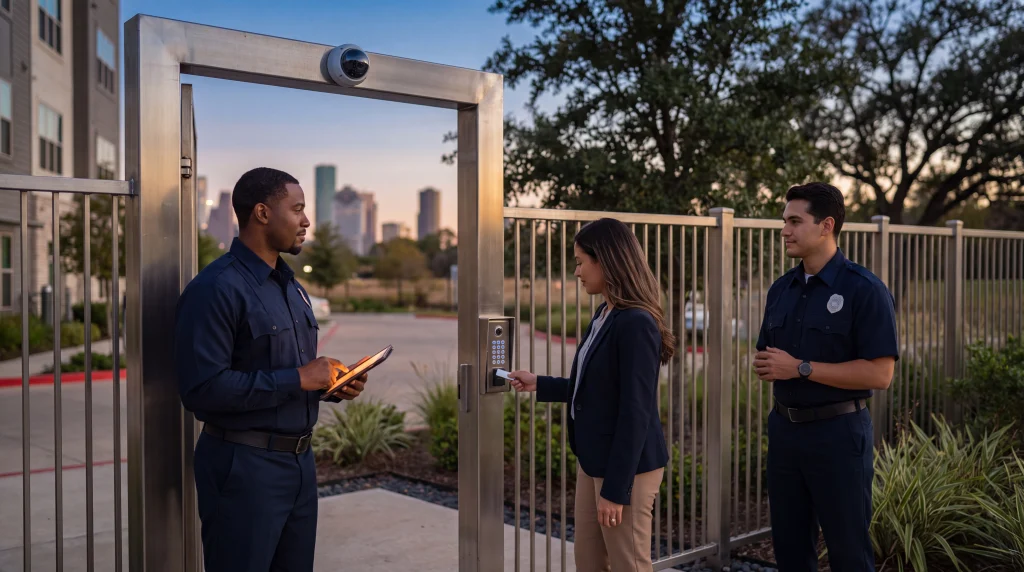
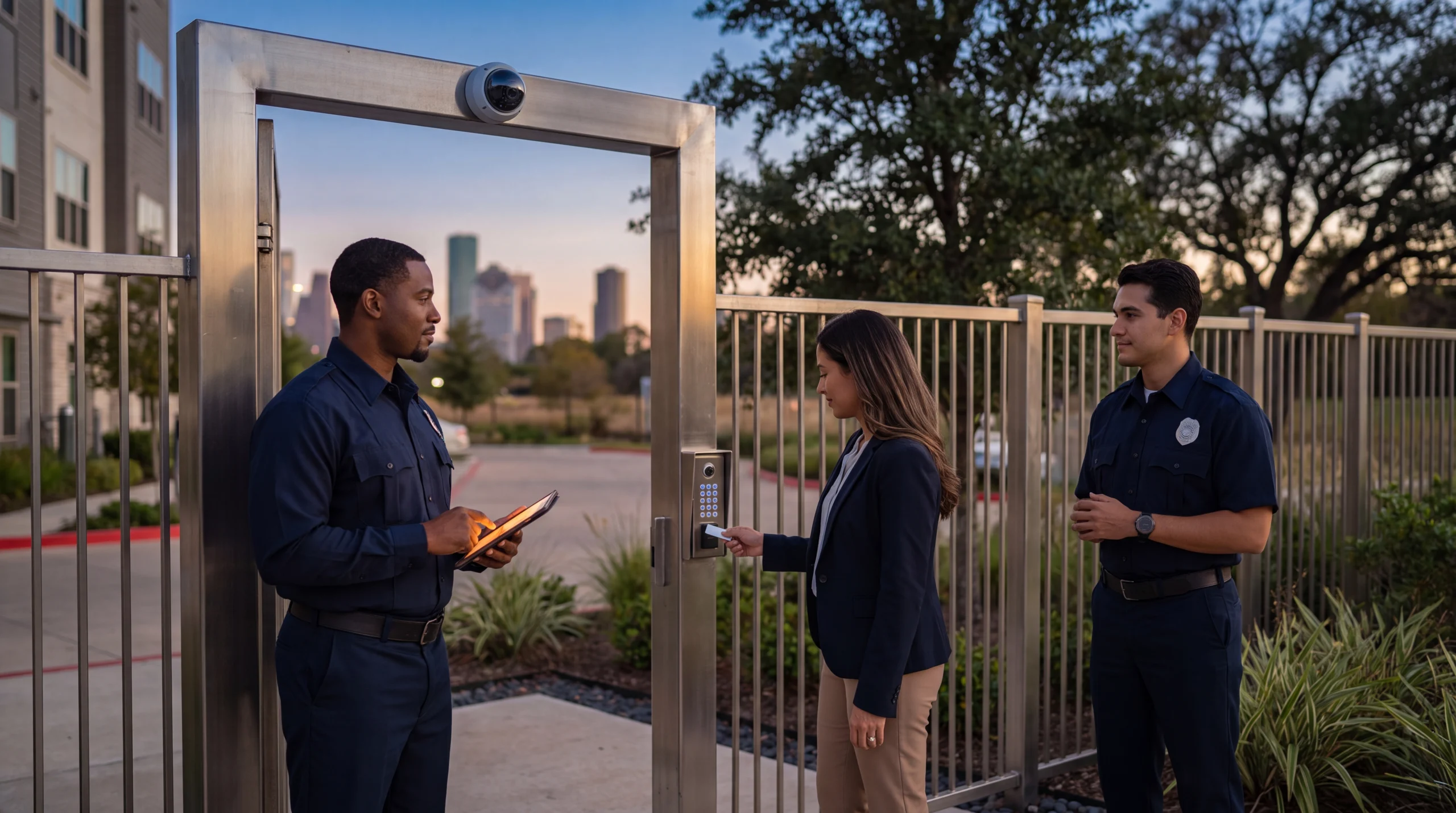
Image alt text: CCTV monitoring Houston apartments with integrated gate access control at vehicle and pedestrian gates
CCTV monitoring Houston apartments with integrated gate access control brings together live camera oversight, modern access credentials (fobs, phones, or keypads), and 24/7 live dispatch. The result is a system that verifies visitors in real time, cuts down on tailgating, and logs each entry event—so access is faster, safer, and easier to manage.
Why CCTV and Gate Access Control Matter for Houston Apartments
Houston multifamily properties see a constant mix of residents, guests, delivery drivers, rideshares, maintenance teams, and vendors—often well past business hours. When cameras, gate controls, and live dispatch operate as one, managers gain clear visibility at entries, reduce unauthorized access, and speed up response without adding friction to everyday life.
Common entry risks: tailgating, propped gates, unauthorized visitors
Tailgating at vehicle gates and pedestrian entries is the most common way outsiders ride in on resident credentials.
Propped gates—often for perceived convenience—create long-term exposure, especially around garages and loading areas.
Unauthorized visitors lean on vague “I’m with DoorDash” claims, expired codes, or piggyback behind approved guests when no one is watching.
Multifamily realities in Houston: parking gates, package rooms, pools, elevators
Parking gates and garages are frequent targets for opportunistic break-ins.
Mailrooms and package lockers see daily surges; pairing controlled access with cameras helps reduce theft.
Amenity doors (pools, gyms, clubrooms) and elevator call panels need matching controls and camera coverage to prevent passbacks and misuse.
How CCTV Monitoring and Gate Access Control Work Together
Integrated cameras, gate access control, and live dispatch help Houston apartment communities stay safer and more responsive.
When integration is done right, cameras don’t just record—they inform decisions at the gate. Access systems don’t just beep—they generate auditable events.
Camera coverage, VMS, and real-time alerts
Coverage: Aim fixed and PTZ cameras to capture the gate arm, call station, keypad/reader, license plates, and driver faces.
Video Management System (VMS): Centralizes live feeds and recordings, and ties cameras to motion and analytics rules.
Real-time alerts: Trigger when a vehicle tailgates, a gate is held open too long, or repeated access denials occur at the same reader.
Fobs and cards: Reliable for residents, with quick revocation and role-based access.
Mobile credentials: Let residents use their phones, cutting down on lost-card churn.
Keypads and visitor codes: Effective when paired with time limits and single-use PINs.
License plate recognition (LPR): Speeds entry for enrolled plates and creates a searchable event trail.
Visitor management: One-time links or QR codes for guests and vendors, logged with timestamps and camera snapshots.
Live security dispatch closes the loop for faster intervention
24/7 live operators verify alerts in context: camera view plus access event.
Operators approve or deny visitors, call residents if needed, and escalate to on-site courtesy officers or mobile patrols when behavior looks suspicious.
Every decision is documented, creating a clear chain of events for follow-up.
Core Benefits for Multifamily Communities
Fewer unauthorized entries and stronger deterrence
Visible cameras at the gate, paired with a knowledgeable dispatcher on the intercom, discourage tailgaters and opportunists.
Faster resolution with 24/7 live dispatch and incident documentation
Alerts go to real people who can act immediately—not to a voicemail or unattended inbox.
Clear audit trails: time-stamped video and access logs
When issues happen, managers can quickly pull the exact event—who requested entry, at what time, and what was seen on camera.
Better resident confidence and smoother vendor/visitor management
Residents and trusted vendors get in easily, while unverified visitors face a consistent screening process.
Components of an Integrated Setup
Cameras: fixed, PTZ, low-light; placement at gates, mailrooms, lots, lobbies
Fixed lenses cover the keypad/reader, driver window, and gate arm movement.
PTZ cameras can follow vehicles during tailgate investigations and zoom in for license plates.
Low-light or IR capability maintains visibility during Texas summer storms and after-hours traffic.
Secondary placements: mailrooms, package lockers, lobby call boxes, elevator call stations, and pool entries.
Access control hardware: readers, controllers, gate operators, intercoms
Readers and controllers should support multiple credential types (fobs, cards, mobile).
Gate operators need obstruction sensing and status feedback (open/closed) for alerting and reporting.
Intercoms with video and two-way audio help dispatch quickly verify visitors and delivery drivers.
Software: VMS, access control platform, mobile credentials
The VMS and access platform must share events: a denied read or held-open alarm should cue a video bookmark and create an alert.
Mobile credentials simplify issuance and deactivation for move-outs, turnovers, and courtesy officers.
Create code-lifetime rules (e.g., single-use or time-boxed), after-hours delivery procedures, and vendor check-in steps via intercom.
Define when dispatch verifies identity, calls residents, or denies entry outright.
Test, train, and tune: alert thresholds, response playbooks, reporting cadence
Start with conservative analytics (held-open time, tailgating distance) and refine week by week.
Train staff and courtesy officers on the response playbook: verify, deny, dispatch, document.
Set a reporting cadence with clear KPIs—exceptions, tailgate attempts, response times, and outcomes.
CCTV Monitoring Houston Apartments in Practice: Live Monitoring and Dispatch
Remote video monitoring Houston: event-based alerts vs. continuous review
Event-based monitoring focuses on defined triggers (denied entries, held-open gates, motion zones) for timely, efficient response.
Continuous review is rarely needed at gates; better results come from linking the right events to trained operators who can act.
Gate access control Houston: verifying visitors, curbing tailgating
Operators use the intercom and camera views to confirm names, units, and purpose before granting entry.
When a vehicle attempts to slip in behind another, dispatch can challenge via audio, notify on-site officers, and flag the event for management.
When to escalate: on-site courtesy officer, mobile patrol, or law enforcement
Courtesy officers handle most compliance issues quickly and calmly.
Mobile patrols respond to pattern-based alerts or multiple denied attempts within a short window.
Law enforcement is reserved for suspected crimes in progress or when resident safety is at risk; dispatch provides video context and live updates.
Compliance, Privacy, and Resident Communication
Signage, consent, retention policies
Post clear signage at gates and common entries noting CCTV monitoring and controlled access.
Work with counsel to set a retention schedule appropriate for your property and systems.
ADA and accessibility at gates and intercoms
Ensure intercoms and keypads are within reach range and offer visual and audio cues.
Provide an alternate method for access requests if a resident or visitor can’t use the primary device.
Transparent notices for residents and vendors
Communicate how visitor codes work, what to expect at the intercom, and how deliveries are handled after hours.
Share who to contact for access help—without encouraging residents to prop gates or tailgate.
Myth vs. Fact: Cameras Alone Are Enough at the Gate
Myth: Recording video deters most gate issues.
Fact: Cameras without integrated access control and live security dispatch primarily provide evidence after the fact. The real gains come when alerts, verification, and rapid on-site escalation are connected—closing the loop in real time.
Measuring Results Without Guesswork
Track entry exceptions, tailgate attempts, and response times
Count exceptions per gate per week, how often alerts fire, and how quickly dispatch verifies and responds.
Correlate incident trends with camera and access data
Compare package theft reports, garage break-ins, or nuisance activity to access-denied events and tailgate attempts.
Monthly reports residents and managers actually use
Summaries should show what changed (alert tuning, patrol emphasis) and the effect on exceptions. Simple visuals—like a chart of tailgate attempts over time—help the whole team stay aligned.
Choosing a Provider in Houston
What to look for: licensing, apartment experience, 24/7 staffing
Verify Texas licensing, insurance, and bonding, plus proven multifamily references and true round-the-clock human coverage.
Integration expertise: CCTV, gate control, and dispatch under one roof
Ask to see how video, access logs, and dispatch notes appear in a single timeline. You want fewer gaps, fewer vendors to coordinate, and faster action.
Why American S.E.A.L. Patrol Division
Licensed, bonded, and insured; Texas DPS Private Security Bureau License #C28662701
15+ years on patrol; 45+ communities protected across Houston
Mobile vehicle and foot patrols with time-stamped, GPS-verified logs and 24/7 live dispatch
CCTV monitoring with real-time response and gate access control for apartment communities
Property-specific security plans and fire watch services
Our team’s reports document incident reductions of 60%+ in a heavily patrolled Houston zone—showing how a closed-loop model can make a meaningful difference when matched to property needs
A Quick, Real-World Scenario
It’s 10:42 p.m. at a gated Houston community. The vehicle gate registers a held-open alarm after a delivery car exits. Cameras show a second vehicle inching forward. Dispatch speaks over the intercom: “Please present your resident credential.” The driver hesitates, then tries to follow through. Dispatch tags a tailgate alert, notifies the on-site courtesy officer already near the clubhouse, and keeps the vehicle on camera. The officer arrives in under three minutes, the vehicle backs out, and the gate closes. The VMS bookmarks the clip, the access system logs the attempt, and a short incident note heads to management’s morning report.
First-hand Practice Note
On recent Houston multifamily walkthroughs, our team found the biggest wins came from small changes: repositioning one camera to view the gate arm and keypad together, tightening visitor code durations, and aligning dispatch alerts with the busiest delivery windows. Those tweaks reduced nuisance tailgating attempts and sped up on-site checks—without adding new hardware.
Resident Experience: Keep It Simple and Predictable
Make the preferred credential clear: fob, card, or mobile.
Explain visitor code rules in one paragraph during move-in and reinforce them in a follow-up email.
Post a small sign at the gate: “If the gate is open, do not tailgate. Wait for it to close and present your credential.”
Offer an accessible after-hours contact method that reaches a live person.
Houston-Focused Setup Tips
Weather-aware placement: Afternoon sun and storm glare can wash out camera views; angle lenses and use WDR to maintain clarity.
Flood-prone entries: Protect low-mounted devices with rated enclosures and consider elevated conduit runs.
Peak timing: Tune alerts for morning and evening commute spikes, plus weekend move-ins and game nights near popular venues.
Neighborhood context: Coordinate with courtesy officer patrols to sweep nearby cut-through streets and alleys where tailgaters stage.
Operations Playbook Essentials
Verification rules: Define what qualifies for approval (resident confirmation, vendor list), what triggers denial, and when to call the unit.
Escalation ladder: Intercom challenge > on-site courtesy officer > mobile patrol > law enforcement.
Documentation standards: Every exception gets a short note with timestamps, camera references, and outcomes.
Maintenance cycles: Quarterly checks for camera focus/cleanliness, reader responsiveness, gate operator timing, and firmware updates.
Common Pitfalls to Avoid
Camera blind spots at the keypad or call box—if you can’t see the driver, you can’t verify.
Overly generous visitor codes that circulate on social media or get reused by third parties.
Alert fatigue from poorly tuned analytics; start small and refine.
Fragmented vendors with no single point of accountability when something breaks.
Where This Fits in a Broader Security Plan
CCTV and gate access control work best when aligned with patrols, lighting, and resident education. If you’re building a roadmap, consider reviewing apartment operations insights from Apartment Services Group and coordinating your access and camera plan with patrol coverage and community policies. An integrated approach reduces noise for managers and helps each dollar of technology work harder.
Get Hands-On: Walk Your Property with Us
American S.E.A.L. Patrol Division is based in Houston, TX, and focuses on apartment and multifamily communities. We design property-specific plans that connect CCTV monitoring, gate access control, and 24/7 live security dispatch with on-site courtesy officers and mobile patrols. If you’re weighing options or want a second set of eyes, explore our Houston security services or speak with a Houston security specialist. We’ll review your gates, policies, and patrol coverage, then suggest a practical, staged rollout that fits your budget and timeline.
Learn more about our comprehensive security solutions in Houston: Houston security services at https://americanspd.com/
Conclusion: CCTV Monitoring Houston Apartments with Integrated Gate Access Control
For Houston apartments, the most reliable path to fewer tailgates, smoother entries, and clearer accountability is an integrated model: CCTV monitoring Houston apartments tied to gate access control and backed by 24/7 live security dispatch. Start with a focused site assessment, align cameras with access events, set simple verification rules, and train your response playbook. With a closed-loop system—and a local team that can verify, dispatch, and document in real time—you’ll protect residents more effectively while keeping everyday access simple.
Frequently Asked Questions
What is an integrated CCTV monitoring and gate access control system for Houston apartments?
Short answer: It connects cameras, access readers, and 24/7 live security dispatch so entries can be verified and logged in real time.
Expanded: In practice, cameras capture the gate arm, keypad/reader, plates, and faces while the access platform creates auditable events. When an alert fires—like a held-open gate—live operators verify what’s happening and approve, deny, or escalate, with every entry attempt time-stamped for a clear audit trail.
How does live security dispatch improve gate access control?
Short answer: Real people verify alerts and act immediately.
Expanded: Operators see the camera view and access event together, challenge visitors on the intercom, call residents if needed, and dispatch on-site courtesy officers or mobile patrols when behavior looks suspicious. This closes the loop faster than unattended notifications or voicemail.
Which gate credentials work best for apartments: fobs, phone-based, keypads, or LPR?
Short answer: Use a mix—resident fobs/phones plus time-limited visitor codes, with LPR where it fits.
Expanded: Fobs/cards are reliable and easy to revoke; mobile credentials reduce lost-card churn. Visitor PINs should be single-use or time-boxed. License Plate Recognition speeds approved entries and adds searchability, but still needs camera verification at problem gates.
How do we reduce tailgating at vehicle and pedestrian gates?
Short answer: Combine camera coverage, alerting, and a clear intercom challenge.
Expanded: Aim cameras at the reader, driver window, and gate arm, then tune analytics for held-open and follow-through attempts. Dispatch challenges tailgaters via audio, documents the event, and notifies on-site officers for quick intervention, reinforcing consistent, predictable rules.
What camera types and placements work best at gates in Houston?
Short answer: Fixed views on the reader/driver window plus a PTZ for investigations—both with low-light capability.
Expanded: Cover the call box, keypad/reader, plate zone, and gate arm. Use PTZ to zoom for plates during incidents. Account for Texas sun and storms with WDR/IR, and add secondary views at mailrooms, elevators, and amenity doors to spot passbacks and misuse.
What visitor and vendor policies should we set?
Short answer: Keep codes short-lived, define after-hours procedures, and verify via intercom.
Expanded: Use single-use or time-boxed PINs, outline delivery windows, and require quick intercom verification for vendors not on the day’s list. Dispatch rules should state when to approve, deny, call a unit, or escalate to on-site officers.
How do we handle privacy, signage, and accessibility at monitored gates?
Short answer: Post clear notices, set retention with counsel, and ensure ADA-friendly devices.
Expanded: Place signage at gates and common entries, align video retention with legal guidance, and keep intercoms/keypads at reachable heights with audio/visual cues. Offer an alternate method for access requests if someone can’t use the standard device.
What does implementation look like—and how long does it take?
Short answer: Assess, integrate, train, then tune—often rolled out in stages.
Expanded: Start with a site walk and risk map, align cameras with access events, and set verification rules. Train teams on the response playbook, then refine alert thresholds week by week. Staged rollouts keep resident impact low and results measurable.
How do we measure results without guesswork?
Short answer: Track exceptions, tailgate attempts, response times, and outcomes.
Expanded: Pair access-denied and held-open alerts with bookmarked video and incident notes. Monthly summaries should show trends, what was tuned (like alert thresholds), and results in clear visuals managers actually use.
Do we still need on-site courtesy officers if we have remote video monitoring?
Short answer: Yes—live monitoring works best when it can escalate to on-site officers.
Expanded: Courtesy officers resolve most compliance issues quickly and calmly, while mobile patrols cover patterns or multi-denial windows. Law enforcement is reserved for suspected crimes or safety risks, with dispatch providing video context.
Why choose American S.E.A.L. Patrol Division for Houston apartments?
Short answer: Local, licensed, and integrated—CCTV, gate control, and 24/7 live dispatch under one roof.
Expanded: We’re licensed, bonded, and insured (Texas DPS PSB #C28662701) with 15+ years on patrol and 45+ Houston communities protected. Services include armed/unarmed guards, courtesy officers, GPS-verified patrols, real-time CCTV monitoring, and property-specific security plans. Learn more: https://americanspd.com/ or request a quote: https://www.americanspd.com/free-quote/
Any real-world wins you’ve seen at Houston gates?
Short answer: Small changes often deliver big gains.
Expanded: On recent walkthroughs, repositioning a camera to see the gate arm and keypad together, tightening visitor code durations, and timing alerts to delivery spikes reduced nuisance tailgating and sped up officer response—without adding hardware. To discuss your site, contact our team: https://www.americanspd.com/contact-us/