Commercial property security is crucial for protecting both tenants and assets. As a property manager like Sarah Thompson, you need reliable solutions that keep your buildings safe around the clock. Here’s a quick snapshot of practical steps for enhancing security:
Safeguarding commercial properties is more essential than ever. Rising crime rates and growing concerns about tenant safety make it vital to implement advanced security solutions. By investing in robust security systems, property managers like Sarah can minimize risks and ensure peace of mind for everyone involved.
American S.E.A.L. Patrol Division, with its expertise and cutting-edge technology, helps countless property managers protect their assets efficiently. With solutions ranging from traditional guards to smart monitoring systems, you can find a security strategy custom to your property’s specific needs.
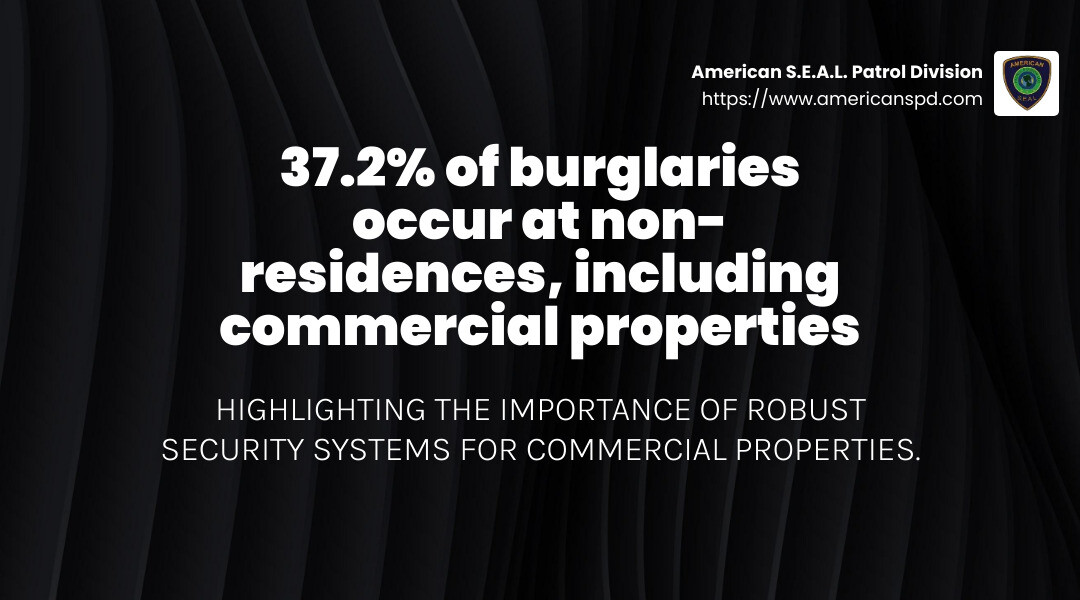
Simple commercial property security glossary:
– alarm systems for commercial
– building access control
– business security solutions
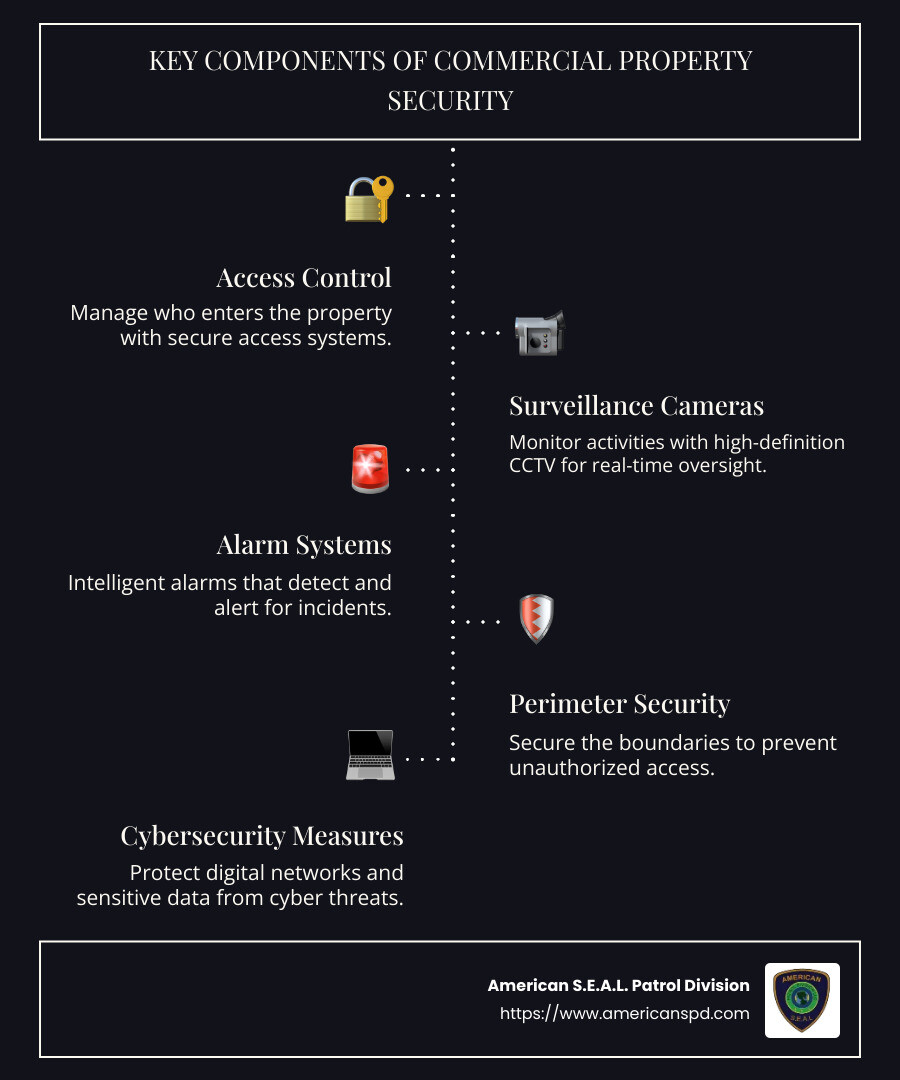
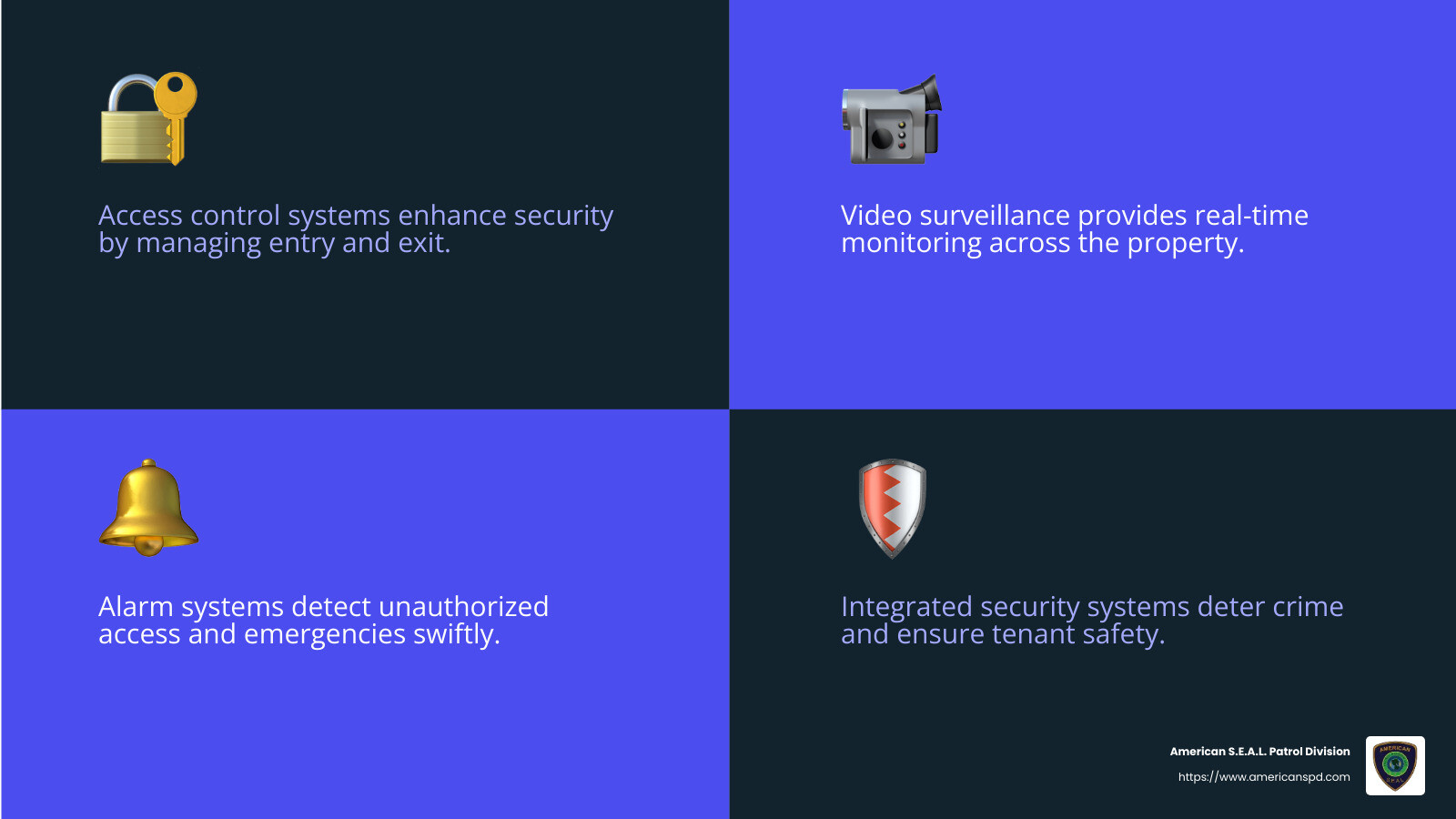
When it comes to commercial property security, there are several key components that work together to create a comprehensive defense system. Access control systems play a crucial role in managing who enters and exits the property. These systems have evolved from traditional locks and keys to modern solutions like keycard entry and biometric scanners, which offer improved security and convenience.
Video surveillance is another vital component. High-definition CCTV cameras provide real-time monitoring, allowing security teams to keep an eye on every corner of the property. This continuous oversight is essential for swiftly addressing any suspicious activity and ensuring the safety of tenants and assets.
Alarm systems are designed to detect unauthorized access or emergencies like fires. These systems can be integrated with other security measures to provide instant alerts, helping to prevent incidents before they escalate.
Implementing robust security solutions offers numerous benefits for commercial properties. Firstly, they serve as a deterrent to crime. Visible security measures like cameras and access control systems discourage potential intruders, reducing the likelihood of break-ins and vandalism.
Ensuring tenant safety is another critical advantage. A secure environment fosters trust and satisfaction among tenants, which can lead to higher retention rates. Tenants are more likely to feel safe and comfortable in a building equipped with advanced security features.
Moreover, having comprehensive security systems in place is often a requirement for insurance compliance. Insurance companies may offer lower premiums for properties with proven security measures, as they are considered lower-risk investments.
Incorporating both physical and cybersecurity measures is vital in today’s digital age. Protecting sensitive data and digital networks is just as important as securing physical assets. By integrating these systems, commercial property owners can ensure a holistic approach to security.
American S.E.A.L. Patrol Division provides a range of solutions custom to the unique needs of each property. From traditional security measures to cutting-edge technology, they help property managers create a safe and secure environment for their tenants and assets.
In the field of commercial property security, having the right features is crucial for ensuring the safety and protection of your property, tenants, and assets. Let’s explore the essential components that make up a robust security system.
Access control systems are fundamental in managing who can enter and exit a property. Modern systems have moved beyond traditional locks and keys to offer advanced solutions like keycard entry, biometric scanners, and mobile access. These technologies not only improve security but also add convenience for authorized personnel.
Smart integrations further lift access control systems by allowing users to manage access through mobile devices. This means you can open up doors or grant access remotely, providing flexibility and control at your fingertips.
Surveillance cameras serve as the eyes of your security system. High-definition cameras provide real-time monitoring and can be strategically placed to cover all vulnerable areas.
These cameras often come with AI analytics that help identify suspicious activities, such as loitering or unusual movement patterns. This technology enables security teams to respond quickly and effectively to potential threats.
Smart sensors are the unsung heroes of security systems. They detect environmental changes and unusual activities, acting as the first line of defense. Advanced sensors can monitor air quality, temperature fluctuations, and sound levels, providing a comprehensive assessment of the property’s safety.
Today’s security systems are more advanced than ever, thanks to smart integrations and AI analytics. These technologies allow for seamless communication between different components, creating a unified security network.
For example, if a sensor detects an abnormal sound, it can trigger nearby cameras to focus on the area and alert security personnel. This interconnected approach ensures a coordinated and rapid response to potential threats.
When considering a commercial security system, understanding the pricing factors is crucial. Costs can vary based on the size of your property, the number of employees, and the specific security needs.
Custom solutions are often the best approach, as they are tailored to meet the unique requirements of your property. Working with experts like American S.E.A.L. Patrol Division ensures you receive a solution that balances cost and effectiveness.
Professional installation is also a key consideration. While DIY systems are available, having professionals install your system guarantees that all components are correctly set up and integrated, providing peace of mind and reliability.
With these essential features and advanced technologies, commercial properties can achieve a level of security that protects both physical and digital assets. By investing in a comprehensive security solution, property owners can ensure a safe environment for everyone involved.
When it comes to commercial property security, understanding the key components of a security system is essential. Here’s a quick overview:
Access Control: This includes systems like keycard entry, biometric scanners, and mobile access. These tools help manage who can enter and leave your property, ensuring only authorized individuals have access.
Surveillance: High-definition cameras are crucial for monitoring activities in and around your property. They provide real-time footage and can be equipped with AI analytics to detect suspicious behavior.
Alarms: These systems alert you to unauthorized access or emergencies like fires. Alarms are a critical part of any security setup, providing immediate notifications to security personnel and authorities.
To protect your commercial property effectively, it’s important to focus on a few key areas:
Security Features: Implementing comprehensive security features such as access control systems and surveillance cameras is vital. These should be strategically placed to cover all entry points and vulnerable areas.
Technology: Leverage modern technology like smart integrations and AI analytics to improve your security system. These tools allow for better monitoring and quicker response times in case of an incident.
Professional Services: Working with a professional security service provider ensures that your system is installed and maintained correctly. They can also offer valuable insights into the best practices for securing your property.
The cost of installing a commercial security system can vary widely, depending on several factors:
Cost Factors: The size of your property, the number of employees, and the specific security needs will all influence the price. Larger properties with more complex security requirements will generally cost more to secure.
Custom Solutions: Custom solutions are often the most cost-effective, as they are designed to meet the unique needs of your property. Custom solutions can help you avoid paying for unnecessary features.
Installation: Professional installation can add to the upfront cost but ensures that your system is set up correctly. This investment can save you money in the long run by preventing potential security breaches.
By focusing on these key components and considerations, you can create a secure environment for your commercial property, ensuring the safety of your assets and peace of mind for everyone involved.
Choosing the right commercial property security solution is crucial for safeguarding your assets and ensuring peace of mind. At American S.E.A.L. Patrol Division, we bring over 15 years of expertise in the security industry, specializing in both residential and commercial protection across Texas.
Expert Personnel: Our team is made up of highly trained professionals who excel in security services. They are equipped with extensive training in de-escalation and interpersonal communication, ensuring they can handle various situations with professionalism and tact. Their presence alone acts as a deterrent to potential threats, providing a safe environment for your property.
Cutting-Edge Technology: We leverage the latest technology to improve our security services. Our systems include 24/7 monitoring, GPS-tracked officers, and advanced surveillance tools. This technology ensures rapid response times and constant oversight, making sure your property is always protected.
Peace of Mind: Our commitment is to provide you with a security solution that not only protects but also gives you peace of mind. With American S.E.A.L. Patrol Division, you can trust that your property is in good hands, allowing you to focus on what truly matters—running your business.
By choosing us, you’re not just investing in a security service; you’re partnering with a team dedicated to your safety and security. Our custom solutions and expert personnel make us a reliable choice for any commercial property owner looking to protect their investments effectively.
For a secure future, partner with American S.E.A.L. Patrol Division and experience the difference that expert personnel and cutting-edge technology can make. Contact us today to learn more about our services and how we can help protect what matters most to you.
How to become an unarmed security guard is a question many people are asking today. It’s a career path that provides protection and peace of mind to communities and businesses. Becoming an unarmed security guard involves a few key steps you should be aware of:
This path isn’t just about meeting prerequisites. It’s about starting on a career dedicated to the safety and protection of others, a role that is increasingly vital in today’s world.

How to become an unarmed security guard terminology:
Being an unarmed security guard is all about vigilance and responsibility. Your main duties focus on observing and reporting, ensuring the safety of people and property without the use of weapons.
Observation: Your eyes and ears are your best tools. You’ll keep a watchful eye on your surroundings, looking out for anything unusual or suspicious.
Reporting: If you notice something out of the ordinary, you must report it to the appropriate authorities or your supervisor. Clear and concise communication is crucial.
Deterrence: Your presence alone can deter potential threats. By being visible and approachable, you help maintain order and prevent incidents before they happen.
Assistance: Whether it’s giving directions or helping someone in distress, providing assistance is a key part of your role. You’re there to help, not just to watch.
The ability to observe and report effectively is what separates a good security guard from a great one.
Documenting Events: Write detailed reports on incidents, observations, or anything noteworthy. This documentation is vital for future reference and legal purposes.
Using Technology: From CCTV monitoring to GPS tracking, technology plays a big role in modern security. Being tech-savvy can improve your observation skills and help you respond more effectively.

Observation isn’t just about watching; it’s about understanding what you’re seeing. You need to be aware of normal patterns and behaviors so that you can spot when something is off. This requires keen attention to detail and the ability to stay focused during long shifts.

The role of an unarmed security guard is challenging yet rewarding. Your work helps create a safer environment for everyone, making it a career with purpose and impact.
If you’re considering a career as an unarmed security guard, it’s important to know what you need to get started. Here are the key requirements:
To become an unarmed security guard, you must be at least 18 years old. This is a standard requirement across most states. Education-wise, you’ll need a high school diploma or a GED. This ensures you have basic reading, writing, and communication skills, which are crucial for the job.
A clean background is essential. You will need to undergo a criminal background check and fingerprinting. This step ensures that those in security positions are trustworthy and have integrity. Most states will not license individuals with certain criminal convictions, so have a clean record.
Training is a critical part of becoming an unarmed security guard. Most states require you to complete a state-approved training program. This training usually covers topics like:
Powers to Arrest: Understanding the legalities and procedures for detaining individuals.
Conflict Resolution: Learning how to de-escalate situations safely and effectively.
Emergency Response: Knowing how to respond in emergencies, including natural disasters or security threats.
Training programs often start with an 8-hour pre-assignment course. After this, you may begin working while you complete additional training hours, typically totaling around 40 hours.
Each state has its own specific requirements. For example, in New York, you must pass a written examination and complete 16 hours of on-the-job training within 90 days of starting your role. It’s important to check the specific requirements for the state where you plan to work.
Meeting these requirements is your first step on the path to becoming an unarmed security guard. With the right preparation, you’ll be ready to start a career that plays a vital role in keeping communities safe.
To kick off your journey as an unarmed security guard, you’ll need to start with a training program. These programs are designed to teach you the essentials of the job.
State-Specific and Accredited Courses
Each state has its own rules, so it’s crucial to choose a training program that’s accredited in your state. For instance, in Texas, you can find courses that cover the basics in just 8 hours. However, you’ll need to complete a total of 40 hours of training to be fully licensed.
Online Options
If you prefer flexibility, many states offer online training courses. These can be a convenient way to fit the training into your schedule. Just make sure the online course is recognized by your state.
Once you’ve completed your training, the next step is to get licensed. This involves a few key parts:
Fingerprinting and Background Checks
You’ll need to submit your fingerprints and pass a background check. This step ensures that only those with a clean record can work as security guards. In Texas, for example, you can schedule your fingerprinting through IdentoGO, the approved vendor.
State Requirements
Each state has its own licensing process. In New York, for example, after your initial 8-hour pre-assignment training, you must complete 16 hours of on-the-job training within 90 days. Additionally, you’ll need to take an annual 8-hour refresher course to keep your license current.
Application Process
After meeting all training and background check requirements, you can apply for your security guard license. This usually involves filling out an application form and paying a fee. In Texas, applications are submitted online through the Texas Online Private Security Portal (TOPS).
By following these steps, you’ll be well on your way to becoming an unarmed security guard. This role is essential for maintaining safety in various settings, and with the right training and certification, you’ll be prepared to make a difference.
To excel as an unarmed security guard, you’ll need a set of key skills. These skills help you perform your duties effectively and ensure safety and security in various environments.
Good communication is crucial. Whether you’re reporting an incident or giving directions, clear and concise communication is a must. This skill helps in de-escalating situations, ensuring everyone stays calm and informed.
Verbal Skills: Being able to speak clearly and confidently is important. You’ll often need to explain rules or procedures to visitors or employees.
Written Skills: Writing reports is a big part of the job. You’ll need to document incidents accurately. This means using simple language and being specific about what happened.
Working as a security guard means interacting with the public. Good public relations skills help you build trust and maintain a positive image for the company you represent.
Approachability: Being friendly and approachable makes people feel safe and comfortable. It also encourages them to report any suspicious activity to you.
Non-Stereotyping: Treat everyone with respect, regardless of their background. This helps in building good relationships and prevents misunderstandings.
In an emergency, quick and effective response is vital. You’ll need to stay calm and act fast to ensure everyone’s safety.
Problem Solving: Think on your feet and come up with solutions quickly. Whether it’s a fire alarm or a medical emergency, you’ll need to assess the situation and decide on the best course of action.
Coordination: Work with law enforcement or emergency services when needed. Knowing how to communicate with these professionals ensures a smooth and efficient response to any crisis.
By honing these skills, you’ll be better equipped to handle the responsibilities of an unarmed security guard. Your role is crucial in keeping environments safe and secure, and these skills will help you succeed in your career.
To get your unarmed security license in North Carolina, you’ll need to follow a few steps:
Meet Basic Requirements: Be at least 18 years old and have a high school diploma or GED.
Training and Certification: Enroll in a state-approved training program. In NC, you’ll need to complete a minimum of 16 hours of training. This includes learning about legal issues, emergency response, and public relations.
Application Process: After training, submit your application to the North Carolina Private Protective Services Board. This includes a background check and fingerprinting.
Fees: Expect to pay fees for the application and fingerprinting. Check the NC Private Protective Services Board website for current fees.
Once you complete these steps, you’ll receive your license and can start working as an unarmed security guard.
In New York State, obtaining a security license involves several costs:
Training Costs: The mandatory 8-hour pre-assignment training course can cost around $50 to $100. The additional 16-hour on-the-job training might cost extra.
Application Fees: Expect to pay an application fee to the New York State Division of Licensing Services. This fee is typically around $36.
Fingerprinting Fees: Fingerprinting is required for a background check and costs about $88.25.
In total, getting a security license in NY can cost anywhere from $150 to $250, depending on the training provider and additional fees.
Getting started as a security guard involves a few key steps:
Education and Prerequisites: Have a high school diploma or GED. This is a basic requirement in most states.
Security License: Obtain a security license by completing the required training and passing background checks. Requirements vary by state, so check your state’s specific guidelines.
Gain Experience: While not always mandatory, having some experience in a related field can be beneficial. This could include roles in customer service or law enforcement.
Starting as a security guard is a straightforward process that opens up a path to a rewarding career. With the right training and certification, you’ll be ready to ensure safety and security in various environments.
Starting on a career as an unarmed security guard offers a pathway to stability and growth in a thriving industry. With the demand for security personnel on the rise, opportunities abound for those who are trained and ready to protect.
American S.E.A.L. Patrol Division is at the forefront of this industry, providing top-notch security services across Texas, including in busy Houston. With over 15 years of experience, we specialize in combining cutting-edge technology with expert personnel to deliver 24/7 monitoring and rapid response. Our commitment is to ensure the safety and peace of mind of our clients.
For those considering a career in security, joining a reputable company like American S.E.A.L. can be a game-changer. We offer ongoing training and support, helping you improve your skills and advance your career. Whether you’re interested in residential or commercial protection, there’s a place for you in our team.
The security industry is not just about guarding properties; it’s about making a difference. As a security guard, you’ll play a crucial role in keeping communities safe. The skills you gain, from communication to emergency response, are valuable not only in your job but in everyday life.
Ready to take the next step? Explore career opportunities with us and see how you can grow in this dynamic field. Visit our Unarmed Guards page to learn more about how we can support your journey to becoming a trusted security professional.
Join us at American S.E.A.L. Patrol Division, where your future in security begins.
Monitored CCTV security systems have become a crucial component of business security strategies. With changing technology enabling real-time surveillance and prompt response to incidents, these systems ensure comprehensive protection for businesses and peace of mind for property managers like Sarah Thompson. Here’s a quick look at why monitored CCTV should be part of your security toolkit:
CCTV monitoring is more than just a set of cameras—it’s a proactive way to safeguard your assets and ensure tenant safety. Businesses can use these systems to prevent break-ins, vandalism, and other threats, leveraging advanced technologies to offer comprehensive oversight.
For property managers, having a reliable system is crucial. Monitored CCTV security doesn’t just watch but actively manages any security incident, ensuring your properties remain safe and secure.

Monitored cctv security word list:
– live cctv monitoring services
– business surveillance camera systems
– smart home security solutions
Monitored CCTV security is not just about having cameras; it’s about creating a robust security framework that combines technology and human expertise. This approach ensures that every corner of your property is under vigilant watch.
At its core, CCTV monitoring involves using cameras to capture real-time video footage of a designated area. This footage is then transmitted to a central monitoring center where security professionals can observe and respond to any suspicious activity.

Real-time observation is a game-changer in security. It means that security professionals are watching live footage as it happens. This allows for immediate action if something unusual occurs. Imagine an intruder trying to break into a building. With real-time monitoring, security personnel can quickly verify the threat and alert the authorities, preventing potential damage or theft.
Security professionals are the backbone of monitored CCTV security. They are trained to interpret video feeds and identify potential threats. Their expertise ensures that any suspicious activity is promptly addressed. This human element is crucial because it adds a layer of judgment that technology alone cannot provide.

Monitored CCTV systems are proactive. They don’t just record events for later review; they help prevent incidents before they escalate. By combining technology with trained security personnel, these systems offer a comprehensive security solution that can adapt to various scenarios.
In Houston, TX, and beyond, businesses and property managers rely on monitored CCTV security to safeguard their assets and ensure the safety of their tenants. Whether it’s preventing break-ins or managing large crowds at events, these systems provide peace of mind through continuous surveillance and expert intervention.
Monitored CCTV security is a powerful tool for keeping your property safe. Let’s break down how it works, step by step.
The first step in setting up a monitored CCTV system is installing a network of cameras. These cameras are strategically placed around your property. Think about entrances, exits, and high-traffic areas. The goal is to cover all crucial spots without leaving any blind spots.
Modern cameras are equipped with high-resolution sensors, ensuring clear images even in low light. They can transmit video signals over the internet, making it easy to monitor from anywhere.
Once the cameras are in place, the video feed is sent to a central monitoring station. This is where the magic happens. Trained security professionals keep an eye on the live footage 24/7.
This station acts as the nerve center of the security system. If something suspicious is detected, the security team can act immediately. They can assess the situation and make quick decisions, like contacting the police or dispatching a security team.
A key feature of monitored CCTV security is alarm verification. This process helps reduce false alarms and ensures a quick response when needed.
Here’s how it works: when a camera detects unusual activity, an alert is sent to the monitoring station. Security personnel then verify the alarm by checking the live feed. If they confirm a threat, they take action. This might involve calling the authorities or using audio warnings to deter intruders.
Alarm verification is crucial because it ensures that only real threats trigger a response. This saves time and resources while keeping your property safe.
By combining a network of cameras, a central monitoring station, and alarm verification, monitored CCTV security offers a comprehensive solution. It provides peace of mind, knowing that your property is under constant watch by both technology and human expertise.
When it comes to keeping your property secure, monitored CCTV security offers several key benefits. Let’s explore them.
One of the biggest advantages is round-the-clock protection. With 24/7 coverage, your premises are always being watched. This constant surveillance means any suspicious activity is quickly spotted and addressed. Whether it’s day or night, you can rest easy knowing your property is under continuous observation by trained professionals.
This level of vigilance not only deters potential intruders but also ensures a rapid response to any incidents. Real-time monitoring allows security teams to act swiftly, reducing the risk of theft or damage.
Implementing a monitored CCTV system can also lead to significant cost savings. Traditional security measures, like hiring on-site guards, can be expensive. By opting for monitored CCTV, you can reduce the need for physical security personnel.
Monitored CCTV security systems are scalable and flexible. They offer a cost-effective alternative to maintaining a large team of security guards. Plus, the advanced technology used in these systems means fewer false alarms, saving both time and resources.
Another standout feature is remote access. With monitored CCTV, you can check in on your property from anywhere. Whether you’re at the office or on vacation, you can view live footage through your smartphone or computer.
This remote access provides added convenience and peace of mind. You can easily verify alarms or keep an eye on things without being physically present. This flexibility is especially useful for business owners who need to manage multiple locations.
In summary, monitored CCTV security offers 24/7 coverage, cost reduction, and remote access. These benefits make it a smart choice for anyone looking to improve their security measures. With technology and professional monitoring working together, you can enjoy peace of mind knowing your property is well-protected.
Setting up monitored CCTV security is crucial for safeguarding your property effectively. Here’s how to get started with the right technology, professional installation, and obtaining a unique reference number.
Choosing the right technology is the first step. Modern CCTV systems offer features like high-definition video, remote access, and smart functionalities. According to research, IP security camera systems are leading the way with ultra-high-definition quality, easy scalability, and smart features improved by artificial intelligence.
When selecting your system, consider the coverage area, resolution needs, and future expansion plans. For businesses in Houston, TX, it’s important to ensure the technology can connect to a professional Alarm Receiving Centre (ARC) for optimal monitoring.
Once you’ve selected the right technology, professional installation is essential. A skilled security installer will ensure your system is set up correctly and integrated seamlessly with existing security measures. This not only guarantees optimal performance but also compliance with industry standards.
Professional installation also means your system will be configured for efficient alarm verification and real-time monitoring. This setup allows security teams to quickly identify and respond to potential threats, enhancing overall safety.
To benefit from police response in case of an alarm, obtaining a Unique Reference Number (URN) is crucial. This number is provided by local authorities and is required for emergency services to respond to verified alarms.
Your security provider can guide you through the process of obtaining a URN. This ensures your monitored CCTV system is not only effective but also compliant with local regulations.
By focusing on the right technology, professional installation, and securing a unique reference number, you can implement a robust monitored CCTV security system. This approach provides comprehensive protection and peace of mind, knowing your property is under constant watch by experts.
Monitored CCTV security is a system where surveillance cameras are strategically placed to capture real-time video. These cameras send the footage to a central monitoring centre. Here, trained security professionals watch the live feeds to spot any suspicious activity or security breaches. This setup ensures that your property is under constant watch, providing an extra layer of protection.
Yes, CCTV monitoring involves real-time observation by security experts. The system is designed to run continuously, with an uninterrupted power supply to ensure that the cameras and monitoring equipment are always operational. This constant surveillance means there’s no need for a stationary guard on-site, as the remote monitoring centre handles the watchful eye.
Monitored CCTV security improves safety in several ways:
Alarm Verification: When an alarm is triggered, security professionals can quickly verify if it’s a real threat. This reduces false alarms and ensures that emergency services are called only when necessary.
Quicker Response Times: With real-time monitoring, any suspicious activity can be detected and addressed promptly. This leads to faster response times, minimizing potential damage or loss.
Remote Guarding Services: Security teams can perform virtual patrols and manage access remotely. This means they can control entry points and respond to incidents without needing to be physically present.
By integrating these features, monitored CCTV security offers comprehensive protection, ensuring that your property is always secure and any threats are quickly dealt with.
At American S.E.A.L. Patrol Division, we understand that securing your property is not just about installing cameras—it’s about creating peace of mind. Our monitored CCTV security services combine cutting-edge technology with expert personnel to deliver best protection for both residential and commercial properties in Texas.
With over 15 years of experience, our unique approach ensures that your security needs are met with precision and care. Our trained security professionals monitor your property 24/7, providing real-time observation and quick response to any potential threats. This constant vigilance means you can rest easy, knowing that your assets are safe and secure.
By choosing American S.E.A.L. Patrol Division, you’re not just opting for a security service; you’re investing in a comprehensive solution custom to meet your specific needs. We offer everything from alarm verification to remote guarding services, ensuring that every corner of your property is covered.
For those looking to improve their security measures, our team is ready to provide personalized solutions that fit your requirements. Whether it’s through our advanced camera technology or our expert monitoring services, we are committed to safeguarding your peace of mind.
Explore how our CCTV Monitoring Services can transform your security strategy and provide the protection you deserve. Contact us today to learn more about how we can help secure your future.
Surveillance camera system for apartments plays a crucial role in ensuring safety and peace of mind for tenants and property managers alike. In apartment complexes, the security landscape can be complex with multiple entry points, common areas, and parking facilities often leading to liftd security concerns. Here’s why surveillance is essential:
In an changing urban environment, apartment surveillance systems provide a necessary layer of protection, safeguarding both property and lives.

When it comes to securing an apartment complex, surveillance camera systems are a game-changer. These systems provide a watchful eye over various parts of the building, ensuring safety and security for everyone involved.
Closed-Circuit Television (CCTV) is a staple in apartment security. It consists of cameras that send video feeds to monitors, allowing security personnel to keep an eye on different areas. This setup is crucial for real-time monitoring and quick response to any suspicious activity.
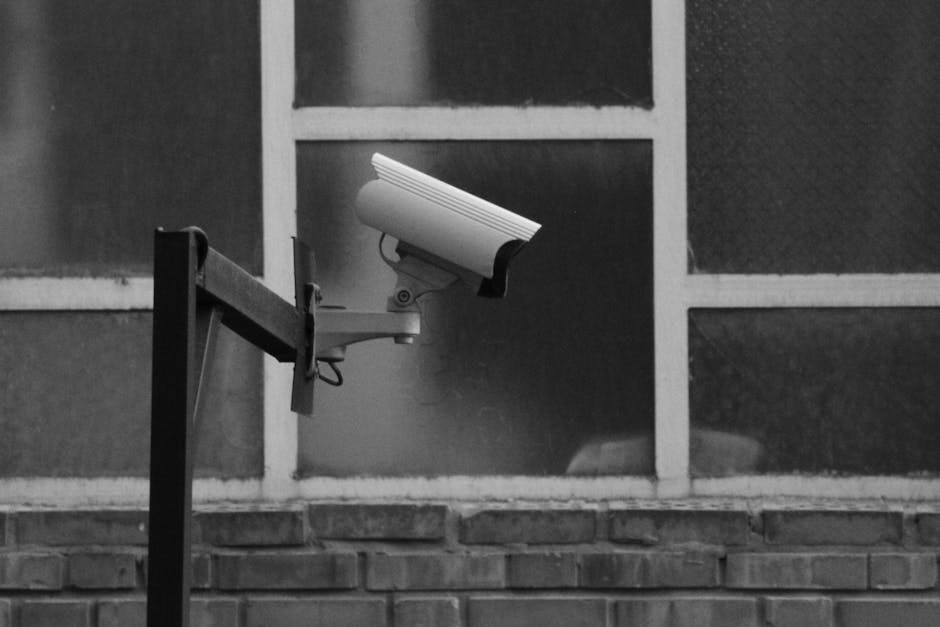
A well-placed CCTV system can cover entrances, hallways, and parking lots, providing comprehensive surveillance. This kind of monitoring not only deters criminal activity but also helps in identifying and resolving incidents quickly.
There are several types of security cameras suitable for apartment surveillance:
Each camera type has its unique benefits, and the choice depends on the specific needs of the apartment complex. For instance, dome cameras are less intrusive, while bullet cameras are more visible and can discourage potential wrongdoers.
Installing a surveillance camera system for apartments can be done in two main ways:
DIY Installation: Some systems are designed for easy setup, requiring minimal tools and expertise. This option is cost-effective and allows for flexibility in camera placement.
Professional Installation: For those looking for a more comprehensive setup, hiring professionals ensures that the system is installed correctly and covers all necessary areas. This option might be more expensive but provides peace of mind with expert placement and configuration.
Regardless of the method chosen, consider the placement of cameras. They should be positioned to cover all key areas without infringing on the privacy of tenants.
According to the FBI’s Uniform Crime Reporting (UCR) program, burglaries of residential properties accounted for 62.8% of total burglary offenses in 2019. Installing security cameras in an apartment building not only acts as a deterrent but also makes it more likely that the perpetrators will be caught and stolen goods returned to their owners.

In conclusion, understanding the components and benefits of surveillance camera systems for apartments is vital for property managers and landlords who wish to improve the safety and security of their buildings. By choosing the right cameras and installation method, they can create a secure environment that protects both property and residents.
When selecting a surveillance camera system for apartments, it’s crucial to consider certain features that ensure optimal security and functionality. Here’s what to keep an eye out for:
A camera’s resolution determines how clear and detailed the footage will be. For apartments, at least 1080p HD resolution is recommended. This level of clarity helps in identifying faces and details, which is essential for effective security. Some cameras even offer 4K resolution, providing four times the detail of standard HD.
The field of view (FOV) indicates how much area a camera can cover. A wider FOV means fewer cameras are needed to monitor a large space. Look for cameras with at least a 120-degree FOV to ensure comprehensive coverage. Cameras like fisheye models offer panoramic views, making them ideal for large open areas.
Night vision is a must-have feature for any apartment surveillance camera. It allows the camera to capture clear footage in low-light conditions. Infrared night vision is the minimum standard, but some cameras also offer color night vision, which provides more detail and reduces shadows where intruders might hide.
Person detection technology helps differentiate between people and other moving objects, such as pets or passing cars. This feature minimizes false alerts and ensures you only receive notifications when necessary. It’s especially useful in busy apartment complexes where movement is frequent.
When it comes to storing video footage, there are two main options: cloud storage and local storage. Cloud storage allows for easy access from anywhere but may come with monthly fees. Local storage, such as a microSD card or DVR, avoids ongoing costs and provides direct access to footage. Some systems offer a combination of both, giving you flexibility based on your needs.
Incorporating these features into your surveillance camera system for apartments will significantly improve security and peace of mind. By selecting cameras with high resolution, wide FOV, reliable night vision, smart person detection, and suitable storage options, you ensure a comprehensive security solution custom to the unique needs of apartment living.
Installing a surveillance camera system for apartments can be a straightforward process if you follow some best practices. Here’s how to get started:
DIY installation is a popular choice for renters. It’s cost-effective and allows you to set up your system without waiting for a professional. Most modern cameras are designed for easy installation. You might only need to turn a few screws or simply place a camera on a shelf and plug it in.
Pro Tip: Make sure the camera is within range of your Wi-Fi for smooth connectivity. Also, consider using wireless cameras to avoid the hassle of running cables.
For those who prefer a hands-off approach, professional installation is the way to go. Experts ensure that your cameras are installed correctly and in optimal locations. This service might be more expensive, but it offers peace of mind knowing everything is set up perfectly.
Fun Fact: Professional installers often have insights into the best camera placements based on your apartment’s layout, ensuring maximum coverage.
Where you place your cameras is crucial for effective surveillance. Here are some tips:
Remember: Avoid placing cameras where they might invade the privacy of others, like shared hallways or neighbor-facing windows.
Before installing any equipment, check your lease agreement and talk to your landlord. While many landlords allow security systems, get permission first. This avoids any potential conflicts and ensures compliance with building rules.
Quick Tip: Explain the benefits of the system to your landlord, highlighting how it improves security for everyone in the building.
By following these best practices, you can effectively set up a surveillance camera system for apartments that improves security and provides peace of mind, all while respecting the rules and privacy of your living environment.
Yes, you can install a surveillance camera system for apartments, but there are some things to keep in mind. As a tenant, your rights allow you to improve your apartment’s security, but it’s wise to check your lease and talk to your landlord first. Some landlords might have specific rules about drilling holes or installing cameras in shared areas.
Quick Tip: Explain to your landlord how the security system can benefit the entire building by deterring crime and enhancing safety.
Not always. Many cameras offer different recording configurations. You can choose continuous recording or set them to record only when motion is detected. This feature, known as motion-activated recording, helps save storage space and makes it easier to review important footage.
Storage Options:
Choosing the right camera depends on several features:
Pro Tip: Cameras like Ring and Arlo are popular for their ease of use and reliability, offering features like person detection and easy DIY installation.
Understanding these aspects will guide you to make informed decisions about setting up a surveillance camera system for apartments, ensuring security while respecting your rights and lease agreements.
At American S.E.A.L. Patrol Division, we understand that peace of mind is priceless. Our security solutions are designed to provide exactly that. With over 15 years of experience in residential and commercial protection, we specialize in ensuring safety for apartment complexes and their residents.
Our approach combines cutting-edge technology with expert personnel for 24/7 monitoring and rapid response. This means that whether it’s a break-in, a fire, or any other emergency, our team is ready to act swiftly to protect your property and loved ones.
Why Choose American S.E.A.L. Patrol Division?
Expertise: Our team is highly trained and experienced, providing reliable security services across Texas, including Houston.
Technology: We leverage the latest in surveillance technology to ensure comprehensive coverage and quick response times.
Community Focus: Our officers are not just security personnel; they are part of the communities they serve. This fosters trust and cooperation, enhancing overall security efforts.
Installing a surveillance camera system for apartments is a proactive step towards creating a safer living environment. It’s not just about monitoring; it’s about ensuring a secure and peaceful atmosphere for all residents.
Our Promise: Trust us to protect what matters most to you. With American S.E.A.L. Patrol Division, you can rest easy knowing that your safety is our top priority. Let’s work together to build a safer environment for everyone. Reach out to us today to explore how we can improve the security of your apartment complex.
Armed security guard training houston tx is a crucial stepping stone for those looking to protect communities and ensure safety in a busy city like Houston. If you’re keen on starting on a career in security, especially as an armed guard, here’s what you need to know right away:
Certification Levels: Start with a Level 2 license and progress to Level 3 training, which includes firearms proficiency and defensive tactics.
Training Requirements: Both classroom instruction and practical experience are necessary, including range time and handling emergency responses effectively.
Benefits: Provides career growth opportunities, comprehensive understanding of safety protocols, and the ability to make a significant impact on community safety.
Local Relevance: The high demand in Houston, driven by the need for improved safety in residential and commercial areas, offers numerous job opportunities.
For property managers like Sarah Thompson, ensuring tenant safety and reducing crime rates is paramount. Armed security personnel offer technology-driven, 24/7 monitoring services that drastically improve overall security.
Stepping into this field means you’ll join a network of dedicated professionals committed to maintaining order and safety in one of America’s most dynamic cities.

To excel as an armed security guard in Houston, you’ll need to complete Level 3 training. This advanced certification is essential for those looking to carry firearms legally and responsibly while on duty. Let’s break down what this training involves:
Firearms training is a critical component of Level 3 certification. You’ll learn how to handle and operate firearms safely and effectively. This includes:
During the training, you’ll spend time at shooting ranges, like the Full Armor Gun Range in Houston, to practice and refine these skills in a controlled environment.
In addition to firearms training, defensive tactics are equally important. This part of the training covers:
These skills are vital for handling diverse situations, from minor disturbances to serious security threats, ensuring safety for yourself and those around you.
The combination of firearms proficiency and defensive tactics equips you with the tools needed to handle real-world security challenges. This training not only prepares you for the responsibilities of an armed security guard but also improves your ability to protect people and properties effectively.

By completing Level 3 training, you can confidently step into a role that requires both vigilance and quick decision-making. This preparation is crucial for maintaining order and safety in Houston’s vibrant environment, where the demand for skilled security personnel continues to grow.
Becoming an armed security guard in Texas involves a few key steps. Let’s walk through the process:
Before you can start training, you need to meet some basic requirements:
Before pursuing Level 3 training, you need to obtain a Level 2 license, which is for unarmed security guards. This involves:
Once you have your Level 2 license, you can move on to Level 3 training. This is where you get certified to carry firearms:
Completing these steps not only prepares you for a rewarding career as an armed security guard but also ensures you have the skills and knowledge to protect yourself and others effectively.
Starting on armed security guard training in Houston, TX opens doors to a fulfilling career. Let’s explore the key benefits:
Becoming an armed security guard is more than just a job—it’s a path to career satisfaction. Many individuals find immense pride in protecting communities and businesses. Serving as a guardian offers a sense of purpose, knowing that your presence can deter potential threats and provide peace of mind to those you protect.
Training as an armed security guard instills a strong sense of accountability. You’ll learn to handle firearms responsibly and understand the weight of your duties. This training emphasizes:
This level of accountability not only improves your professional skills but also builds trust with employers and clients.
Safety is at the heart of armed security guard training. You’ll gain essential skills to protect yourself and others:

Training equips you with the knowledge to assess threats and respond effectively, ensuring a safer environment for everyone involved.
These benefits highlight why pursuing a career as an armed security guard can be both rewarding and impactful. As you continue your journey, you’ll find that the skills and experience gained through training are invaluable in creating a secure and confident presence in any setting.
When considering a career in armed security guard training in Houston, TX, understanding salary prospects is crucial. Let’s dig into what you can expect in terms of compensation.
In Houston, the salary for armed security guards varies based on experience, location, and specific responsibilities. Generally, armed security guards can expect to earn between $25,000 and $50,000 annually. Entry-level positions tend to start on the lower end of the spectrum, while those with more experience and specialized skills can command higher wages.
Top earners in the armed security field often have extensive experience and additional certifications. These professionals can earn upwards of $60,000 per year. Factors contributing to higher earnings include:
On average, armed security guards in Houston earn around $35,000 to $40,000 per year. This figure represents a balance between entry-level and more experienced positions. Salaries can fluctuate based on demand and the economic environment.

These salary insights provide a clear picture of the financial prospects for armed security guards in Houston. As you progress in your career, gaining additional skills and experience can significantly impact your earning potential, making it a worthwhile investment in your future.
To become an armed security guard in Texas, you need to complete a few important steps. First, you must be at least 21 years old and have a Level 2 Security Officer license. This is the basic requirement for anyone looking to enter the security field.
Once you have your Level 2 license, the next step is to complete Level 3 security officer training. This training is essential for those who want to carry firearms on the job. The course covers firearms proficiency, defensive tactics, and awareness skills. It is a 45-hour course that includes both classroom instruction and hands-on training, typically at a shooting range like the Full Armor Gun Range in Houston.
After completing the training, you’ll need to pass a background check and obtain your Level 3 Commissioned Security Officer license from the Texas Department of Public Safety.
Choosing a career as an armed security guard can be very rewarding. It offers the opportunity to contribute to public safety and order while enjoying a fulfilling career. Armed security guards play a crucial role in protecting people and property, which can bring a strong sense of purpose and responsibility.
Moreover, the training you receive will equip you with valuable skills, such as threat assessment and emergency response, which can be useful in various situations. The potential for career advancement and higher earnings, especially with additional certifications and experience, makes it a worthwhile pursuit for many.
The main difference between an armed guard and a security guard lies in the level of training and the responsibilities they carry. An armed guard is trained to handle firearms and is authorized to carry them while on duty. This additional responsibility requires them to manage higher threat levels and respond to more serious security situations.
In contrast, an unarmed security guard does not carry weapons and typically deals with lower threat levels. They focus on maintaining a visible presence to deter criminal activity and may handle tasks such as monitoring surveillance systems, managing access control, and conducting patrols.
The choice between becoming an armed or unarmed guard depends on your career goals and comfort level with handling weapons. Each role plays a vital part in maintaining safety and security in various environments.
As we wrap up this guide, it’s clear that American S.E.A.L. Patrol Division is a leader in providing top-notch security services in Houston, Texas. With over 15 years of experience, we specialize in both residential and commercial protection. Our unique approach combines cutting-edge technology with expert personnel to ensure 24/7 monitoring and rapid response, giving our clients peace of mind.
Our team of highly trained professionals is committed to delivering exceptional service. We focus on creating a safe environment for our clients by tailoring our security solutions to meet their specific needs. Whether it’s armed security guard training or comprehensive security services, we are dedicated to maintaining safety and order.
For those considering a career in security, our armed security guard training in Houston, TX, offers a fulfilling path. It equips you with the skills needed to protect people and property effectively. The training is rigorous but rewarding, providing opportunities for career advancement and personal growth.
American S.E.A.L. Patrol Division is here to support you every step of the way. Whether you’re looking to start a career as an armed security guard or need reliable security services, we have the expertise and resources to help you succeed.
For more information on our armed security guard services and how we can help you open up your potential, visit our Armed Security Guard Service page.
Join us in making Houston a safer place. Your safety is our priority, and we are committed to delivering the highest standard of security services.
Looking to ensure safety at your private event? Private event security near me is essential for maintaining order and peace. Whether you’re hosting a wedding, corporate gathering, or exclusive party, the right security team can make your event not only safe but also enjoyable. Here’s how to instantly understand and access private event security:
When planning an event, safety should be your top priority. Engaging professional security can help protect your guests and assets, giving you peace of mind.
Choosing a reliable security service is crucial. It’s not just about managing risks but also about ensuring a smooth and memorable experience for all involved.

When organizing any private event, understanding the nuances of private event security is vital. Let’s break down the key elements: security concerns, threat assessments, and crowd control.
Every event comes with its own set of security challenges. Whether it’s a small gathering or a large festival, potential risks like unauthorized access, theft, and disruptions can arise. Addressing security threats such as party crashers and rowdy behavior, especially when alcohol is involved, is crucial.
To mitigate these risks, partner with experienced security providers who understand how to handle these situations efficiently.
A thorough threat assessment is the cornerstone of a robust security plan. This involves identifying potential vulnerabilities and planning for them. Security companies use their expertise to evaluate the venue and event specifics to craft a bespoke security strategy.
Pre-event threat assessments are essential. This approach includes evaluating the venue’s layout, understanding the guest profile, and anticipating any potential issues. This proactive planning ensures that security measures are custom to the event’s unique needs.
Managing large groups of people is no small feat. Effective crowd control is crucial to maintaining order and ensuring safety. Security personnel are trained to handle large crowds, directing them safely and efficiently.
Placing guards at strategic locations such as entrances and exits is a key strategy. They monitor the event to ensure rules are followed and that guests behave responsibly. This not only keeps the event orderly but also improves the overall experience for attendees.
In summary, understanding and addressing security concerns, conducting thorough threat assessments, and implementing effective crowd control are essential components of successful private event security. By focusing on these elements, you can ensure a safe and enjoyable event for all your guests.
When it comes to hiring private event security near me, there are a few essential steps to ensure you get the right team for your event. Let’s explore the key aspects: certified guards, local agencies, and the hiring process.
The first step in hiring event security is ensuring that the guards are certified. Certified guards have undergone rigorous training and possess the necessary skills to handle various security situations. They are trained in areas such as crowd management, emergency response, and threat assessment. According to American S.E.A.L. Patrol Division, their security guards are not only certified but also undergo continuous performance evaluations and ongoing training to maintain their high standards.
Having certified guards at your event means you can trust them to handle any situation professionally and effectively, providing peace of mind for both you and your guests.
Choosing a local security agency can offer several advantages. Local agencies are familiar with the area and can provide insights into specific security concerns related to your event location. They also tend to have established relationships with local law enforcement, which can be beneficial in case of emergencies.
For example, American S.E.A.L. Patrol Division, with a presence in Houston, TX, understands the unique security challenges of the region. Their local expertise ensures they can tailor their services to meet your event’s specific needs.
The hiring process for event security should be straightforward yet thorough. Here’s a simple step-by-step guide:
Assess Your Needs: Determine the type and number of security personnel required based on your event’s size, location, and risk level.
Research Local Agencies: Look for agencies with positive reviews and proven track records in providing event security.
Verify Certifications: Ensure that the guards are certified and have undergone necessary training.
Request Quotes: Contact multiple agencies to get quotes and compare pricing. The cheapest option may not always be the best.
Conduct Interviews: Speak with potential agencies to understand their approach to security and ensure they align with your event’s needs.
Finalize the Contract: Once you’ve chosen an agency, ensure all terms are clearly outlined in a contract. This should include the number of guards, their roles, and the duration of their service.
By following these steps, you can hire a reliable security team that ensures the safety and success of your event. Whether it’s a corporate gathering, wedding, or concert, having a professional security team in place is crucial for a seamless and secure experience.
When planning an event, security is a top priority. Understanding the key considerations for event security can help ensure a safe and successful gathering. Let’s explore the essentials: risk management, venue security, and guest screening.
Risk management is the backbone of any successful security plan. It involves identifying potential threats and devising strategies to mitigate them. A thorough risk assessment is crucial. This involves evaluating the event’s location, size, and nature to understand potential vulnerabilities.
For instance, if your event involves high-profile guests, the risk of unwanted attention or harassment increases. In such cases, security teams must be prepared to handle paparazzi or intruders. Conducting pre-event threat assessments can help prevent common issues like altercations or gatecrashers.
Key Steps in Risk Management:
The venue itself plays a significant role in event security. Securing entry and exit points is vital to control access and prevent unauthorized entry. Security personnel should manage these points to ensure only invited guests enter.
Having uniformed or plainclothes officers at key locations ensures a visible security presence while maintaining a welcoming atmosphere for guests.
Venue Security Checklist:
Screening guests is an essential part of maintaining event security. It ensures that only authorized individuals gain access, reducing the risk of disturbances or security breaches.
Managing guest lists and verifying invitations is crucial. This step can prevent party crashers and maintain the exclusivity of the event.
Effective Guest Screening Tactics:
By focusing on these key considerations—risk management, venue security, and guest screening—you can ensure that your event runs smoothly and safely. With a professional security team and a well-thought-out plan, you can provide peace of mind for yourself and your guests, making your event a memorable success.
Hiring professional security services for your event is like having a safety net. It ensures that everything runs smoothly and everyone feels safe. Let’s break down the key benefits: trained personnel, peace of mind, and event success.
Professional security guards are not just people in uniforms. They are highly trained individuals who know how to handle various situations. They undergo rigorous training that covers everything from crowd control to emergency response. This means they can quickly and effectively manage any situation that arises.
Consider this: a security team that includes former law enforcement officers or military personnel brings a wealth of experience. They know what to look for and how to act swiftly to resolve issues. This expertise is invaluable, especially at large events where the risk of incidents is higher.
When you hire a security service, you get more than just guards; you get peace of mind. Knowing that trained professionals are on-site allows you to focus on your event without worrying about potential problems.
Imagine hosting a large corporate event. Without professional security, you might constantly worry about guests’ safety or possible disruptions. But with a security team in place, you can relax and enjoy the event, knowing that any issues will be handled efficiently.
A successful event is one where guests feel safe and enjoy themselves without interruptions. Security services play a crucial role in achieving this. They help maintain order, prevent unauthorized access, and ensure that everyone follows the event rules.
For instance, at a music festival, security guards manage crowd control and access points, ensuring that only ticket holders enter. This not only keeps the event exclusive but also minimizes the risk of overcrowding and potential accidents. The result? A smooth, enjoyable experience for everyone involved.
In summary, hiring professional security services provides trained personnel who ensure safety, give you peace of mind, and contribute to the overall success of your event. With the right team in place, you can confidently host your event, knowing that every aspect of security is covered.
The cost of hiring security for your event can vary widely. On average, expect to pay between $200 and $600 for professional event security services. Several factors influence the exact price:
It’s crucial to discuss your specific needs with the security provider to get an accurate quote.
Determining the right amount of security depends on several factors:
It’s essential to conduct a risk assessment to determine the appropriate number of guards needed for your event.
When looking to hire private event security near you, consider these steps:
Certification: Ensure the security company and its guards have the necessary licenses and certifications required by your state.
Interviews: Conduct interviews with potential security providers to assess their experience, training, and approach to event security.
Agency Selection: Choose a reputable local agency that understands the specific security needs of your event type. Look for companies that offer custom security plans based on a comprehensive risk assessment.
By following these steps, you can find the right security team to ensure a safe and successful event.
Ensuring the safety of your private event is paramount. That’s where American S.E.A.L. Patrol Division steps in. With over 15 years of experience, we specialize in providing top-notch security services across Texas, including in Houston. Our unique approach combines cutting-edge technology with expert personnel to offer you peace of mind.
Our team is dedicated to delivering exceptional security solutions custom to your specific needs. Whether it’s residential or commercial events, we ensure a safe environment for you and your guests. Our 24/7 monitoring and rapid response capabilities mean that you can focus on hosting your event while we handle the security.
When you choose American S.E.A.L. Patrol Division, you’re opting for professionalism, reliability, and a commitment to safety. So, if you’re searching for private event security near me, look no further. Trust us to protect what matters most to you.
For more information on how we can assist with your event security needs, visit our Event Security Guards in Houston, TX page. Let us provide the security solutions you need for a successful event.
Mobile patrol security duties are critical for maintaining safety and securing assets across diverse settings, especially in busy cities like Houston, TX. If you’re looking to understand these duties quickly, here’s what you need to know about the essential functions of mobile patrol officers:
In today’s changing security landscape, mobile patrol officers play a pivotal role. They merge technology with their expertise to offer peace of mind to property managers like Sarah Thompson, ensuring her residents and assets remain secure and well-protected. With their flexible scheduling and presence, mobile patrol officers assure that safety is always the top priority.

Mobile patrol security is a dynamic and effective security service that involves trained officers using vehicles to regularly check and secure specific areas. This approach is especially useful for locations that don’t need a full-time, on-site security presence but still require oversight.
Mobile patrols involve officers driving through designated areas, such as business districts or residential neighborhoods, to ensure everything is in order. These patrols can be scheduled at random or specific intervals, making it hard for potential wrongdoers to predict when security will be present. This unpredictability is a key factor in deterring crime.
Mobile patrol security officers use a combination of on-foot and vehicle patrols to maintain a watchful eye over properties. They inspect doors, windows, and other access points to ensure they are secure. In addition, they monitor surveillance equipment to capture any suspicious activity.
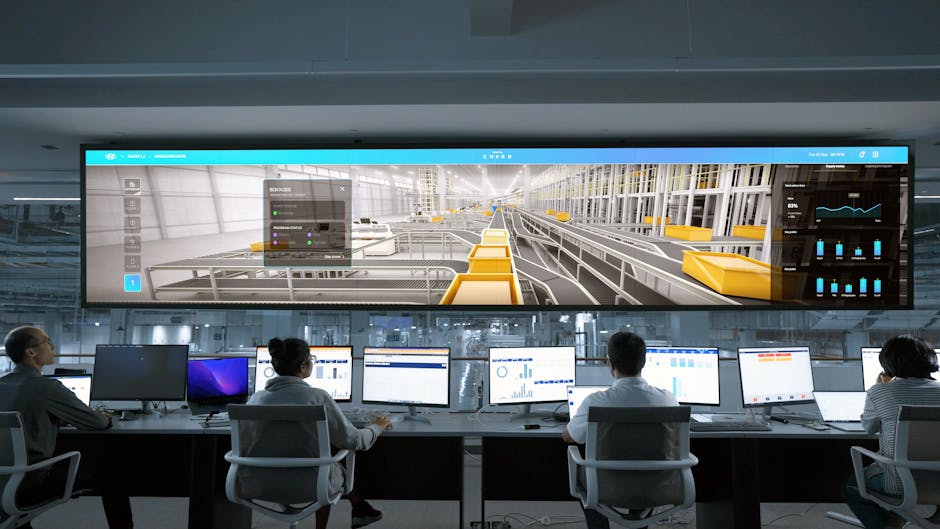
The visible presence of a mobile patrol unit acts as a powerful deterrent to crime. Marked patrol vehicles and uniformed officers serve as a constant reminder that security is active and vigilant. This presence alone can significantly reduce the likelihood of illegal activities, as potential criminals are aware they are being watched.
A study highlighted in the research showed that increasing security patrols at train stations led to a 16% reduction in victim-reported crimes. This underscores the value of a visible security presence in preventing crime.
Mobile patrol security offers a flexible and highly visible solution that is both effective and efficient. It combines the benefits of mobility, surveillance, and deterrence to create a robust security strategy that can adapt to the unique needs of different environments.
Mobile patrol security officers play a vital role in maintaining safety and security through patrol checks, emergency response, and access control. Each of these duties contributes to a comprehensive security strategy that keeps properties and people safe.
Patrol checks are the backbone of mobile security. Officers conduct regular inspections of the premises, checking doors, windows, and access points for signs of tampering or unauthorized entry. This proactive approach helps identify potential issues before they escalate into serious problems.
Patrols can be both scheduled and random, adding an element of unpredictability that makes it difficult for potential wrongdoers to anticipate security routines. This unpredictability is a strong deterrent against criminal activities.
In the event of an emergency, mobile patrol officers are trained to respond quickly and efficiently. Whether it’s a fire alarm, a medical emergency, or a security breach, these officers are prepared to take immediate action to mitigate risks and ensure everyone’s safety.
A case study from the research highlights the effectiveness of rapid response. Alvin Thomas, a mobile security officer, noted that “Every time you showed up to a scene, you improved your decision-making skills and got to learn something new.” This hands-on experience is invaluable in emergency situations, allowing officers to make smart decisions under pressure.
Access control is another critical duty of mobile patrol officers. They ensure that only authorized individuals are allowed entry to secure areas. This involves checking IDs, monitoring entry points, and sometimes escorting visitors to their destinations.
By maintaining strict access control, mobile patrol officers help protect sensitive areas from unauthorized access and potential threats. This is especially important in environments where sensitive information or valuable assets are present.
Mobile patrol security offers a versatile and effective solution for maintaining safety and security across various settings. By combining patrol checks, emergency response, and access control, officers create a robust security framework that adapts to the unique needs of each environment.
Mobile patrol security officers are the frontline defenders of safety and security. Their roles encompass incident management, alarm response, and site inspections, all of which are crucial in maintaining a secure environment.
Incident management is a core responsibility of mobile patrol security officers. When an incident occurs, whether it’s a security breach or a minor disturbance, officers are trained to manage the situation effectively. This involves assessing the situation, taking necessary action, and documenting the incident for future reference.
A real-world example from our research is Alvin Thomas, who gained valuable experience in incident management during his tenure as a mobile security officer. His ability to make quick, informed decisions in high-pressure situations highlights the importance of effective incident management.
Alarm response is another critical duty. When an alarm is triggered, mobile patrol officers must respond swiftly. Their ability to arrive quickly can prevent potential threats from escalating. Officers are trained to handle various alarm scenarios, from fire alarms to security breaches, ensuring a rapid and effective response.
Alvin Thomas shared his experience with alarm response, stating, “Every time you showed up to a scene, you improved your decision-making skills and got to learn something new.” This highlights the continuous learning and adaptability required in this role.
Regular site inspections are essential in maintaining a secure environment. Mobile patrol officers conduct these inspections to identify potential security vulnerabilities. This includes checking perimeter fences, lighting, and access points for any signs of tampering or damage.
The unpredictability of these inspections adds a layer of deterrence, making it difficult for potential wrongdoers to anticipate security routines. This proactive approach is vital for preventing incidents before they occur.

By fulfilling these roles, mobile patrol security officers create a robust security framework that adapts to the unique needs of each environment. Their presence not only deters criminal activities but also provides peace of mind to property owners and residents alike.
Mobile patrol security offers several key benefits that make it an attractive option for businesses and communities seeking to improve their security measures.
One of the biggest advantages of mobile patrol security is its cost-effectiveness. Unlike static guards who need to be stationed at a single location, mobile patrol officers can cover large areas efficiently. This means fewer personnel are needed to monitor multiple sites, reducing overall labor costs. Additionally, with automated scheduling and dispatch, administrative tasks are minimized, freeing up resources for strategic planning.
Flexible scheduling is another significant benefit. Mobile patrols can be scheduled at random or specific intervals, depending on the client’s needs. This adaptability allows for custom security plans that address unique risks and requirements. Whether it’s increased patrols during high-risk periods or 24/7 coverage, mobile patrol security can be customized to provide the right level of protection.
The visibility of mobile patrols acts as a powerful deterrent to criminal activity. Marked patrol vehicles serve as a constant reminder that the area is under surveillance. According to a study mentioned in the research, increasing security patrols can lead to a significant reduction in crime, as seen in train stations where victim-reported crimes dropped by 16%.
The unpredictable nature of mobile patrols adds an extra layer of deterrence. Potential wrongdoers cannot easily predict when or where patrols will occur, making it difficult for them to plan illegal activities. This unpredictability improves the overall security of the area.
By leveraging these benefits, mobile patrol security provides a comprehensive and adaptable security solution that meets the diverse needs of clients. Whether it’s cost savings, flexibility, or improved deterrence, mobile patrols offer a robust approach to maintaining safety and peace of mind.
To become a mobile patrol security officer, certain qualifications are essential. A valid security license is a must. This ensures that the officer has undergone the necessary training and background checks. Additionally, a clean driving record is crucial since officers need to drive to various locations during their shifts. This ensures safety on the road and reliability in reaching different sites promptly.
Mobile patrols improve security by providing deterrence and rapid response. The presence of marked patrol vehicles makes potential criminals think twice before committing any illegal acts. It’s like having a watchful eye that moves around, making it hard for anyone to predict where it will be next. This unpredictability is a key factor in preventing crime.
Moreover, mobile patrols are equipped to respond quickly to emergencies. Whether it’s a triggered alarm or a suspicious activity report, mobile patrols can reach the scene faster than static security measures. This swift action helps in mitigating potential threats before they escalate.
Mobile patrol officers have a range of duties aimed at ensuring the security of the premises. Door checks and perimeter checks are routine tasks. Officers ensure that all entry points are secure and that there are no breaches in the perimeter. This routine vigilance helps in maintaining the integrity of the property.
In addition to these checks, officers respond to alarms, provide safe escorts for individuals, and remove unauthorized persons from the premises. They also document any irregularities they observe, ensuring that clients are informed and can take necessary actions if needed.
These duties, combined with their mobility, make mobile patrol officers an essential part of a comprehensive security strategy. Their ability to adapt to different situations and locations makes them invaluable in maintaining safety and peace of mind for clients.
At American S.E.A.L. Patrol Division, we pride ourselves on delivering top-notch security services that ensure peace of mind for our clients. Our expert personnel are at the heart of our operations, combining over 15 years of experience with cutting-edge technology to provide unparalleled security solutions.
Our mobile patrol security officers are not just guards; they are highly trained professionals equipped to handle any situation with precision and care. They conduct regular patrols, both on foot and in vehicles, ensuring that every corner of your property is secure. Their presence serves as a powerful deterrent to potential wrongdoers, and their quick response capabilities mean that any security breaches are addressed swiftly and effectively.
One of the standout features of our service is our 24/7 monitoring. We understand that threats can arise at any time, which is why our team is always on alert. Our dedicated call center, equipped with state-of-the-art technology, ensures that we can respond to incidents promptly and efficiently, providing our clients with the security they deserve.
Choosing American S.E.A.L. Patrol Division means investing in a comprehensive security strategy custom to your needs. Our commitment to excellence and our proactive approach to security make us the ideal partner for safeguarding your assets, residents, and properties.
For more information on how our mobile patrol security services can protect your property, visit our Mobile Security Patrols page. Let us help you create a safer environment today.
Alarm companies in houston texas provide an essential service, offering safety and peace of mind through a variety of security solutions.
Whether you’re Sarah Thompson, a property manager concerned about tenant safety, or simply a homeowner looking to improve protection, these companies offer robust residential and commercial security services custom to your needs. Here’s a quick overview of a leading alarm company in Houston that meets these requirements:
In a city like Houston, where there’s a significant chance of being a victim of property crime, solid security solutions are essential. This company not only offers residential protection through advanced smart home systems but also extends its services to commercial properties with custom surveillance and alarm systems.
When selecting a security provider, consider the technology, customer service, and additional features that the company offers. This helps you find a solution that ensures the safety of your assets and peace of mind for both you and your tenants.

Alarm companies in houston texas vocab explained:
– Houston security camera installation
– houston live security monitoring
– houston monitoring surveillance
When it comes to home security systems in Houston, residents have a variety of options custom to meet both residential and commercial needs. With crime rates on the rise, many homeowners and businesses are turning to advanced security solutions to safeguard their properties.
Modern home security systems in Houston offer a range of features designed to protect against intrusions and other emergencies. These systems often include:
Alarm companies in Houston emphasize robust monitoring services to ensure rapid response in case of emergencies. These services typically include:
Installation is a critical aspect of any security system. In Houston, companies offer flexible installation options to suit different needs:
In summary, Houston’s alarm companies present a wide array of options for securing your home or business. Whether you prioritize advanced technology, reliable monitoring, or flexible installation, there’s a solution available that meets your specific needs.
Having a reliable security system is more important than ever. Alarm companies in Houston Texas offer a variety of features to ensure your home or business stays protected. Let’s explore some of the top features that these systems provide.
Wireless sensors are a game-changer in home security. They are easy to install and can be placed on doors, windows, and other entry points. These sensors detect motion, glass breaks, and unauthorized entries, creating a comprehensive safety net around your property.
Control your security system right from your smartphone. This feature provides convenience and peace of mind, allowing you to manage your security settings from anywhere in the world.
Video surveillance is a critical component of modern security systems. With HD cameras, you can monitor your property 24/7, whether it’s day or night.

These features not only improve security but also provide a seamless and user-friendly experience. With wireless sensors, smartphone control, and video surveillance, you’re always in control and can rest easy knowing your property is safe.
When choosing a security system, flexibility is key. No-contract plans offer just that. They let you opt in or out without being tied down. Imagine not being stuck in a long-term deal. If you’re not happy with the service, you can simply walk away. This freedom is a game-changer, especially for those who value adaptability.
Customer loyalty is another perk of no-contract plans. Companies that offer these plans rely on great service to keep you. This approach creates a loyal customer base that stays by choice, not obligation.

Transparent pricing is a hallmark of no-contract security plans. You know exactly what you’re paying for, with no hidden fees. This clarity helps build trust between you and the provider, showcasing their commitment to honest pricing.
In summary, no-contract security plans offer flexibility, foster customer loyalty, and ensure transparent pricing. These benefits make them an attractive choice for anyone looking for a reliable and straightforward security solution.
When it comes to home security systems, advanced technology plays a crucial role in keeping your home safe and connected. Let’s explore some of the cutting-edge features that are changing security systems today.
Imagine controlling your entire home from a single app. With smart home integration, you can connect devices like lights, locks, thermostats, and garage doors into one seamless system. This not only improves security but also adds convenience to your daily life. For example, you can set your lights to turn on automatically when you open up your front door.
Dual path connectivity ensures that your security system stays online, no matter what. It uses both LTE cellular wireless and WiFi to keep your system connected. This means faster response times and more reliable communication with your smartphone app. Whether you’re at home or away, you can rest easy knowing your security system is always connected.
Power G sensors are a game-changer in home security. These sensors offer a 1-mile range and use military-grade 128-bit AES encryption. This ensures that your signals are secure and can’t be easily intercepted. Moreover, Power G sensors automatically adjust their signal strength to save battery life and avoid interference from other wireless devices. This makes them a reliable choice for protecting your home.
By integrating these technologies, modern alarm companies in Houston Texas are elevating home security to new heights. With features like smart home integration, dual path connectivity, and Power G sensors, you get a robust and reliable security system that keeps your home safe and connected.
When considering alarm companies in Houston Texas, it’s important to understand the costs involved. Typically, the pricing includes equipment costs, installation fees, and monthly monitoring charges.
Equipment Costs: These can range from a few hundred to several thousand dollars, depending on the complexity and features of the system you choose. Basic systems might include door and window sensors, while more advanced setups could feature high-resolution cameras and smart home integration.
Monitoring Fees: Monthly fees for professional monitoring services in Houston can start as low as $19.95 and go up to $70 or more, depending on the level of service and features included.
Installation Fees: Some companies offer free installation, while others may charge based on the system’s complexity.
Selecting the right alarm company involves evaluating several factors:
Customer Reviews: Look for companies with high ratings and positive feedback. High customer satisfaction is a good indicator of reliable service.
Service Quality: Consider companies known for their excellent service. A strong local presence and commitment to customer service can be significant advantages.
Technology Features: Evaluate the technology offered. Advanced features like smart home integration, dual path connectivity, and Power G sensors can provide improved security and convenience.
Hidden fees can be a concern with some alarm companies in Houston Texas. Here’s what to watch for:
Contracts: Some companies may lock you into long-term contracts with high cancellation fees. Opting for no-contract plans can provide more flexibility.
Equipment Fees: Be wary of “free” alarm systems, which might have hidden equipment costs rolled into the monthly fees. It’s crucial to understand the full cost of ownership before committing.
Monitoring Rates: Ensure that the quoted monitoring rates include all necessary services. Some companies might have tiered pricing, with higher rates for additional features like video surveillance or smart home integration.
By considering these factors, you can make an informed decision and choose a security system that fits your needs and budget.
In the busy city of Houston, security is a top priority for both residential and commercial properties. Among the many alarm companies in Houston Texas, American S.E.A.L. Patrol Division stands out with its unique blend of cutting-edge technology and expert personnel.
Why Choose American S.E.A.L. Patrol Division?
Advanced Technology: We incorporate state-of-the-art security solutions, ensuring your property is protected with the latest innovations. From smart home integration to dual path connectivity, our systems are designed to provide maximum security and convenience.
Expert Personnel: Our team of highly trained professionals brings over 15 years of experience to the table. This expertise, combined with our dedication to excellence, ensures that your safety is always our top priority.
24/7 Monitoring and Rapid Response: With our round-the-clock monitoring services, you can rest easy knowing that your property is under constant watch. Our rapid response team is always ready to act swiftly in case of any security threats.
At American S.E.A.L. Patrol Division, we understand the importance of feeling safe and secure in your environment. Whether you need protection for your home or business, our comprehensive security services are custom to meet your specific needs.
For more information on how we can help protect what matters most to you, visit our 24/7 Security Monitoring page. Let us be your trusted partner in security, ensuring peace of mind for you and your loved ones.
Finding business security solutions that effectively protect your assets is crucial for property managers like Sarah Thompson. With the increasing risks of break-ins, theft, and other security challenges, it is vital to have reliable systems in place.
Key elements of business security solutions:
– Video Surveillance: Monitor activities in real-time and deter criminal behavior.
– Access Control: Manage who enters your premises to ensure safety.
– Intrusion Detection: Identify unauthorized entry instantly.
– Fire Protection: Safeguard against fire hazards with alarm systems.
Security solutions provide peace of mind by ensuring tenant safety and protecting valuable assets. Investing in comprehensive systems custom to your unique needs not only improves safety but can also reduce costs related to theft or false claims, much like the incident witnessed by Gene Petrino, a retired SWAT Commander, where video evidence disproved a fraudulent slip-and-fall claim.
Stay ahead with technology-driven security designed to protect your business 24/7.

Must-know business security solutions terms:
– alarm systems for commercial
– building access control systems
– security systems for businesses
Business security solutions are more than just a luxury—they are a necessity. As businesses face increasing threats from theft, vandalism, and other security risks, having a robust security system in place is crucial for protection and peace of mind.
Security systems are the backbone of any effective commercial security strategy. These systems are designed to protect businesses by monitoring activities, controlling access, and detecting intrusions. They encompass a range of technologies and services, each playing a critical role in ensuring the safety of your premises.
Video Surveillance: This is a powerful tool for monitoring real-time activities within your business. High-definition cameras can deter criminal behavior and provide valuable evidence in case of incidents. For example, a car dealership in Illinois drastically reduced false claims of damage by installing high-definition cameras, saving thousands of dollars monthly.
Access Control: This component allows you to manage who enters and exits your business premises, ensuring only authorized personnel have access. This not only improves security but also helps maintain a safe environment for employees and visitors.
Intrusion Detection: These systems are designed to detect unauthorized entry into your premises. With features like door and window sensors, motion detectors, and glass-break sensors, you can quickly identify and respond to potential threats.
Fire Protection: Protecting your business from fire hazards is vital. Fire detection systems, including smoke alarms and carbon monoxide detectors, provide early warnings, helping to prevent significant damage and ensure the safety of everyone on the premises.
Business security solutions go beyond physical protection. They also help in reducing insurance premiums, minimizing employee theft, and protecting against fraudulent claims. As illustrated by Gene Petrino, a retired SWAT Commander, video evidence can be crucial in disproving false claims, such as fraudulent slip-and-fall incidents.
By investing in comprehensive security systems, businesses not only protect their assets but also improve overall safety. Custom solutions ensure that each unique need is met, providing a sense of security 24/7.

In the next section, we will explore how to customize these solutions to address your specific business needs and challenges.
When it comes to safeguarding your business, understanding the key components of business security systems is essential. These components work together to create a comprehensive security strategy that protects your assets and ensures the safety of everyone on your premises.
Intrusion detection systems are your first line of defense against unauthorized access. They use a combination of sensors, such as door and window sensors, motion detectors, and glass-break sensors, to identify potential threats. These systems alert you immediately when an intrusion is detected, allowing for a swift response.
Video surveillance is a powerful tool for monitoring and recording activities in and around your business. High-definition cameras not only deter criminal behavior but also provide valuable evidence if an incident occurs.
Access control systems help manage who can enter specific areas of your business. By using key cards, biometric scanners, or mobile apps, you can ensure that only authorized personnel have access to sensitive areas.
Protecting your business from fire hazards is non-negotiable. Fire protection systems include smoke alarms, carbon monoxide detectors, and fire suppression systems that provide early warnings and help prevent significant damage.
Investing in these business security solutions not only protects your physical assets but also reduces risks like insurance premiums and employee theft. As Gene Petrino, a retired SWAT Commander, noted, having a reliable security system can also protect against false claims, like slip-and-fall incidents, by providing indisputable video evidence.
In the next section, we will explore how to customize these solutions to address your specific business needs and challenges.
Every business is unique, and so are its security needs. Whether you’re running a small boutique or a large industrial facility, customizing security solutions to fit your specific requirements is crucial. Here’s how you can tailor a security system that aligns with your business’s unique needs and challenges.
Start by assessing your business environment. What are your most valuable assets? What areas are most vulnerable? Perhaps you’re a retailer concerned about shoplifting, or a tech company worried about data breaches. Understanding these factors will guide you in choosing the right components for your security system.
Businesses face a variety of security challenges. A one-size-fits-all approach won’t suffice. Instead, consider a system that can adapt to your specific obstacles. For example, a seasonal business might only need improved security during peak periods, while a 24/7 operation requires constant monitoring.
As your business grows, your security needs will evolve. It’s important to choose a system that is flexible and can expand with you. This might mean adding more cameras, integrating advanced sensors, or upgrading to more sophisticated access control systems.
Custom security solutions help address specific challenges. For example, a company in Houston, TX, faced frequent unauthorized access due to its open layout. By installing a customized access control system, they reduced incidents by 75% within six months.
By focusing on custom solutions that address your business’s unique needs, you can create a security system that not only protects your assets but also adapts to the ever-changing landscape of business security challenges.
In today’s world, advanced security technology is a game-changer for businesses. It offers peace of mind by providing robust protection through innovative features like remote monitoring, AI-driven detection, and real-time alerts. Let’s explore how these technologies can benefit your business.
Remote monitoring allows you to keep an eye on your business from anywhere, at any time. This means you can monitor your premises using a smartphone or computer, even when you’re miles away. For example, American S.E.A.L offers 24/7 CCTV monitoring, ensuring that any potential threats are quickly identified and addressed.
Artificial Intelligence (AI) is changing security systems by making them smarter and more efficient. AI-driven detection can identify unusual activities and potential threats much faster than traditional systems. This technology uses advanced algorithms to analyze video footage, detect anomalies, and minimize false alarms.
Real-time alerts are crucial in responding quickly to security incidents. They ensure that you and your security team are immediately informed of any breaches or emergencies. For instance, businesses with AI-improved systems can receive alerts in less than 10 seconds, allowing for rapid response.
Advanced security technology not only protects your business but also improves overall efficiency. By leveraging these innovations, you can ensure a safer environment for your employees and customers, ultimately leading to a more secure and successful business.
Next, we’ll explore some frequently asked questions about business security solutions to help you make informed decisions.
Choosing the best business security solutions depends on the unique needs of your business. A reliable system should include intrusion detection, video surveillance, and access control. These systems help protect against break-ins, theft, and unauthorized access.
Key Features to Consider:
– Intrusion Detection: Detects unauthorized entry.
– Video Surveillance: Monitors activities with cameras.
– Access Control: Limits access to sensitive areas.
For custom recommendations, assess your business’s specific security challenges and goals. Consulting with experts like American S.E.A.L can help you find the right solution.
The cost of business security solutions can vary widely based on several factors. These include the size of your premises, the type of equipment, and the level of monitoring services you choose.
Cost Factors:
– Equipment: Cameras, sensors, and alarms.
– Installation: Professional vs. DIY setup.
– Monitoring: Monthly fees for 24/7 surveillance.
Pro Tip: Always get multiple quotes and consider the long-term benefits of investing in a robust security system. A well-protected business can save money by reducing theft and vandalism costs.
Scalability is crucial for businesses that plan to expand. A flexible security system allows you to add new components as your business grows, ensuring continuous protection.
Tips for System Expansion:
– Modular Design: Choose systems that allow easy addition of new devices.
– Cloud Integration: Use cloud-based systems for effortless updates and scalability.
– Professional Advice: Work with security experts like American S.E.A.L to plan future expansions.
By planning for scalability, you can ensure your security system evolves with your business, maintaining protection and peace of mind.
With these insights, you’re now better equipped to make informed decisions about business security solutions. Up next, we will dig into the conclusion, highlighting how American S.E.A.L. Patrol Division can be your trusted partner in safeguarding your business.
Protecting your business is not just about preventing theft or vandalism; it’s about ensuring peace of mind. At American S.E.A.L. Patrol Division, we understand the unique security challenges businesses face. With over 15 years of experience in Texas, we have honed our expertise in delivering custom security solutions that fit your needs.
Our approach combines cutting-edge technology with highly trained personnel. This ensures 24/7 monitoring and rapid response, keeping your business safe around the clock. Whether it’s intrusion detection, video surveillance, or access control, our solutions are designed to provide comprehensive protection.
Why Choose American S.E.A.L. Patrol Division?
We believe that every business deserves a security system that offers reliability and peace of mind. By partnering with us, you’re not just getting a security provider; you’re gaining a trusted ally dedicated to safeguarding your business.
Ready to improve your business security? Explore our Texas Property Security solutions to see how we can help protect your assets today.
If you’re wondering how do i get my unarmed security guard license, here’s a quick guide:
When it comes to protecting properties and ensuring tenant safety, an unarmed security guard plays a crucial role. But how do you make the leap from being a concerned property manager to a security professional? With American S.E.A.L. Patrol Division in your corner, the process is straightforward and fulfilling.
To start on this path, understand the few key steps involved in obtaining your unarmed security guard license. It starts with meeting basic requirements like age and education, followed by state-approved training programs that arm you with essential skills. Once you’ve completed your training, submitting an application and passing background checks are your final steps toward receiving your license.
The journey might seem daunting, but it’s designed to ensure that guards like you are well-prepared to handle the challenges of modern security with professionalism and calm authority. By taking these steps, you’re not just meeting the state requirements but also stepping up to be a protector of community peace and safety.

Handy how do i get my unarmed security guard license terms:
– unarmed security guards
– average pay for unarmed security guard
– what do unarmed security guards do
Before you can step into security, there are some basic requirements you need to meet. These ensure that you’re ready to handle the responsibilities of keeping people and places safe. Let’s break down these key criteria.
First things first, you must be at least 18 years old. This is a common requirement across all states and ensures that you’re mature enough to handle the duties that come with being a security guard.
A clean criminal record is essential. States require that you have no felony convictions or violent misdemeanors. This means if you’ve been involved in serious crimes, you might face challenges in getting your license. For instance, convictions involving firearms, theft, or violence could disqualify you unless you’ve completed any sentences or probation at least five years before applying. Being free of habitual drunkenness or drug dependence is also part of this requirement.
A high school diploma or GED is typically required. This ensures that you have the basic educational foundation needed to understand the training and responsibilities of a security guard.

These requirements set the stage for your journey into the security industry. Meeting them shows that you’re ready to take on the training and responsibilities that come next in the process of becoming an unarmed security guard.
Before you can become an unarmed security guard, you need to complete some training programs. These programs are designed to prepare you for the various situations you might face on the job.
Pre-Assignment Training: This is usually a short course that covers the basics of being a security guard. You’ll learn about your role, legal powers, and limitations. This typically includes emergency procedures and general duties. Many states require at least four hours of this training before you start working.
On-the-Job Training: Once you begin working, your training doesn’t stop. You’ll often need to complete additional hours of training while on the job. This helps you learn the specifics of your work environment and the particular needs of your employer.
Some states, like Alaska, require up to 40 hours of on-the-job training within the first 180 days of employment. This ensures that you are well-prepared to handle real-world situations.
Once you’ve completed your training, it’s time to move on to the application process. This involves a few key steps:
Application Form: You need to fill out an application form for your security guard license. This form will ask for your personal information, details about your training, and any previous employment in security.
Fees: There is usually a fee associated with your license application. This fee can vary by state, so it’s important to check the specific requirements for your location.
Fingerprinting: A crucial part of the process is submitting your fingerprints. These are used for state and national background checks to ensure you have no disqualifying criminal history. In Washington, for example, you can schedule an appointment through Identogo, an electronic fingerprinting vendor.
Background Check: Your fingerprints will be used to conduct a background check. This step is essential to confirm that you meet the legal requirements to work as a security guard. You’ll need to be free from felony convictions and other serious offenses.
Completing these steps successfully will bring you closer to obtaining your unarmed security guard license. Each state may have slightly different requirements, so always check the specific guidelines for your area.
This process ensures that only qualified individuals are entrusted with the responsibility of maintaining safety and security. Now, let’s look at how these requirements might vary from state to state.
Understanding the requirements for obtaining an unarmed security guard license can vary based on where you live. Let’s explore what you need to know for New York, Kentucky, and Washington State, which are relevant to many aspiring security professionals.
In New York, becoming an unarmed security guard involves a few clear steps. Training courses are mandatory, starting with an 8-hour pre-assignment training class. This is followed by a 16-hour on-the-job training course completed within 90 days of employment.
You’ll also need to budget for application fees. The initial application fee is $36, and there’s a $102.50 fee for fingerprinting. These fingerprints are crucial for a thorough background check to ensure you meet the state’s eligibility criteria.
Fingerprinting is an essential part of the process, and it’s handled through IDEMIA, a vendor that manages electronic fingerprinting.
Kentucky takes a more relaxed approach. As of 2015, there’s no state license requirement for unarmed security guards. However, your employer must register your name with the state once you’re hired.
While there’s no mandatory training or licensing, undergoing training can improve your job prospects and salary potential. Some cities might have their own requirements, so it’s wise to check with local authorities.
In Washington, the process is more structured. You’ll need to complete pre-assignment training, similar to New York. The application process involves submitting an application form and paying a license fee.
Fingerprinting is required, and you can handle this through Identogo, Washington’s electronic fingerprinting vendor. This is part of the background check to ensure you meet the state’s standards for good moral character and legal eligibility.
The license fees include a specific charge for the fingerprinting service. It’s crucial to follow these steps carefully to ensure a smooth application process.
Each of these states has its own set of rules and fees, but they all share the common goal of ensuring that security guards are well-prepared and trustworthy. Understanding these requirements is the first step toward a successful career in security.
The cost of getting a security guard license varies widely depending on the state. For example, in New York, you can expect to pay an initial application fee of $36, plus $102.50 for fingerprinting. In contrast, states like Kentucky do not require a state license, which can save you money. However, other costs may include training fees, which are necessary in states like California, where a 40-hour training program is required. Always check with your state’s specific requirements to get the most accurate cost estimate.

Not every state requires a license to work as an unarmed security guard. For instance, Kentucky does not have a state-level licensing requirement, although some cities might have their own regulations. On the other hand, states like Washington mandate a license, which involves completing pre-assignment training and undergoing a background check. Each state’s approach can be different, so verify the specific requirements where you plan to work.
To become an unarmed security guard, you generally need to meet some basic requirements across all states:
These requirements ensure that candidates have a foundational level of maturity and education, which is crucial for the responsibilities that come with a security guard position. Always double-check your state’s specific requirements, as some might have additional criteria.
Starting on a career as an unarmed security guard offers a pathway filled with opportunities and the potential to make a real difference in your community. At American S.E.A.L. Patrol Division, we understand the importance of feeling safe and secure, whether it’s in your home or your business. Our commitment to providing top-notch security services in Texas, especially in busy areas like Houston, ensures that we are always ready to meet your safety needs.
Career Opportunities: Working in the security industry can be incredibly rewarding. It offers flexible roles, from part-time positions to full-time careers with room for advancement. Whether you are just starting out or looking to transition into a new field, obtaining your unarmed security guard license is a key step. It opens doors to a variety of roles where you can use your skills to protect and serve.
Community Safety: Being a security guard is not just about watching over a property; it’s about being a pillar of safety in your community. Our team at American S.E.A.L. Patrol Division is equipped with the latest technology and expert training, ensuring rapid response and 24/7 monitoring. This not only provides peace of mind to our clients but also contributes to a safer environment for everyone.
If you’re ready to take the next step in your career and are interested in learning more about how to get your unarmed security guard license, explore our services here. Join us in our mission to provide exceptional security services and make a positive impact in your community.