Apartment CCTV cameras offer critical benefits for property managers like Sarah Thompson. These security tools improve tenant safety in multifamily residential complexes by deterring criminals, monitoring common areas, and providing valuable evidence if incidents occur. With burglary accounting for a significant portion of residential crime, proactive security measures are essential.
Quick Answer: Why Apartment CCTV Cameras Matter
Installing apartment CCTV cameras not only works as a deterrent for potential wrongdoers but also empowers security staff to act swiftly, ensuring a safe and secure environment for tenants. Cameras in strategic locations, like entry points and parking areas, offer comprehensive monitoring and peace of mind for property managers and residents alike.

Apartment CCTV cameras are a vital component of modern security systems, especially in multifamily residential complexes. They play a crucial role in deterring crime, monitoring activities, and ensuring the safety and security of residents.
Visible cameras can significantly reduce the likelihood of criminal activities. According to the FBI’s Uniform Crime Reporting program, burglaries of residential properties accounted for 62.8% of total burglary offenses in 2019. The presence of CCTV cameras acts as a powerful deterrent to potential criminals who might otherwise target these areas.
Monitoring is another critical function of apartment CCTV cameras. They allow property managers and security personnel to keep an eye on various parts of the complex, from entrances to parking lots.

Beyond deterrence and monitoring, apartment CCTV cameras provide several other advantages:
By strategically placing these cameras at entry points and in shared spaces, property managers can ensure a comprehensive security strategy. This not only helps in deterring crime but also in maintaining a safe living environment for all residents.

In the next section, we’ll explore the different types of apartment CCTV cameras and how they cater to varying security needs.
When it comes to apartment CCTV cameras, choosing the right type is crucial for effective security. Let’s explore the three main types: dome cameras, bullet cameras, and fisheye cameras. Each serves a unique purpose and offers distinct benefits.
Dome cameras are a popular choice for apartment buildings due to their sleek and discreet design. These cameras are typically mounted on ceilings and are encased in a dome-shaped cover, making it difficult for potential intruders to see which direction the camera is facing.
Bullet cameras are more noticeable than dome cameras, making them a strong visual deterrent. These cameras are shaped like a bullet or cylinder and are often used to monitor specific areas.
Fisheye cameras are known for their ultra-wide-angle lens that provides a panoramic view, capturing everything in a single shot. This makes them ideal for overseeing large open areas without the need for multiple cameras.
Each type of camera has its strengths, and the choice depends on the specific needs of the apartment complex. In the next section, we’ll discuss key features to consider when selecting an apartment CCTV camera system.
When selecting apartment CCTV cameras, certain features can significantly improve security and usability. Let’s explore three key features: video analytics, cloud storage, and tamper resistance.
Video analytics transform passive cameras into powerful security tools. These smart features analyze video feeds in real-time to detect unusual activities or potential threats.
Implementing video analytics helps security teams respond quickly to incidents and improves overall surveillance efficiency.
Choosing cloud storage for your CCTV system offers several advantages over traditional local storage methods.
However, it’s important to consider ongoing subscription costs for cloud services, as these can add up over time.
Ensuring that your CCTV cameras are tamper-resistant is crucial for maintaining uninterrupted surveillance and preventing vandalism.
Investing in tamper-resistant cameras helps protect your surveillance system from being compromised, ensuring continuous monitoring of your property.
By focusing on these features, you can improve the effectiveness and reliability of your apartment CCTV cameras. Next, we’ll provide tips on how to install and place your cameras for optimal coverage.
Setting up apartment CCTV cameras the right way can make a big difference in keeping your building secure. Let’s break down some important tips for placing cameras at entrances and exits, shared spaces, and under various lighting conditions.
Entrances and exits are critical points for monitoring. Placing cameras here helps track who comes and goes, capturing clear images of faces and activities.
Shared spaces like hallways, stairwells, and lobbies are high-traffic areas that benefit from surveillance.
Lighting can greatly affect camera performance. Here’s how to handle different conditions:
By carefully considering these factors, you can optimize the placement of your apartment CCTV cameras for better security coverage and effectiveness. Now, let’s tackle some frequently asked questions about these cameras.
When choosing a security camera for an apartment, look for features that suit your specific needs. Here are some important factors to consider:
Recording configurations can vary based on your needs and the camera’s capabilities. Here are the common options:
Yes, you can install security cameras in your apartment, but there are a few things to consider:
By understanding these aspects, you can make informed decisions about using apartment CCTV cameras effectively and responsibly.
Investing in apartment CCTV cameras is a smart move for any property owner or manager. At American S.E.A.L. Patrol Division, we understand that safety and peace of mind are top priorities for residents. Our comprehensive security solutions are designed to provide just that. With over 15 years of experience in Texas, we offer cutting-edge technology combined with expert personnel to ensure 24/7 monitoring and rapid response.
Peace of mind is invaluable. Knowing that your property is under constant surveillance allows residents to feel secure in their homes. Our security systems are custom to meet the unique needs of multifamily residences, providing detailed imagery and real-time alerts to potential threats. Whether it’s monitoring entrances and exits or shared spaces, our systems are designed to keep your property safe.
Rapid response is crucial when it comes to security. Our team is always ready to act swiftly in case of an incident. We use advanced technology to ensure that any suspicious activity is addressed promptly, minimizing risks and enhancing the safety of your community.
By choosing American S.E.A.L. Patrol Division, you’re not just investing in security; you’re investing in a sense of community and trust. Our commitment to excellence ensures that your property is protected around the clock, giving you and your residents the peace of mind you deserve.
For more information on how we can help secure your apartment complex, visit our Apartment Security Camera Systems page and find the benefits of partnering with American S.E.A.L. Patrol Division. Let’s work together to create a safer environment for everyone.
Armed patrol security is a robust solution for individuals and businesses seeking improved protection and peace of mind. As crime rates rise, having a visible and capable deterrent becomes crucial. Armed patrol security provides:
Ensuring the security of your premises is more vital than ever. Many property managers, like Sarah Thompson, are turning to armed patrol security to meet this need. By incorporating advanced technology and experienced personnel, security services like American S.E.A.L. Patrol Division offer custom solutions to protect both residential and commercial properties effectively.

Armed patrol security plays a crucial role in safeguarding communities and businesses. These officers perform a variety of duties to ensure safety and security, acting as a visible deterrent to crime. Here’s how they do it:
Armed patrol officers conduct regular, randomized patrols both on foot and in vehicles. This unpredictability makes it difficult for potential wrongdoers to anticipate their movements. Officers check entry points like doors and windows to ensure they are secure, and they keep a detailed log of their patrol activities. This vigilance helps identify and address security vulnerabilities before they escalate.
The presence of armed patrol security acts as a strong deterrent to criminal activities. Potential criminals are less likely to target properties that are visibly protected by armed guards. In fact, many organizations have noted a decrease in incidents following the deployment of armed patrols. The trained eyes of these officers can spot suspicious behavior early, preventing crimes before they occur.

In case of emergencies, armed patrol officers are trained to respond quickly and effectively. They coordinate with local law enforcement and emergency services, ensuring that incidents are managed professionally. Whether it’s a fire alarm, a break-in, or any other urgent situation, these officers are equipped to handle it, minimizing potential risks and damages.

Consider the case of Fernando Rivera Jr., who turned to armed patrol security in his border community. With armed patrols in place, he noticed a significant reduction in disturbances, allowing him to sleep peacefully at night. This real-world example highlights the impact and peace of mind that armed patrol security can provide.
By fulfilling these roles, armed patrol security ensures a safer environment for everyone involved. Their presence not only deters crime but also provides a swift response to emergencies, making them an invaluable asset to any security strategy.
Armed patrol security offers numerous advantages that go beyond just having a visible security presence. Let’s explore some of these key benefits:
One of the primary benefits of armed patrol security is its ability to deter crime. The mere presence of armed officers can make potential criminals think twice before attempting any wrongdoing. For instance, regular patrols around commercial properties have been shown to reduce incidents of theft and vandalism. According to research, thieves and vandals are less likely to target areas with visible security, knowing there’s a higher chance of getting caught.
Feeling safe at work is crucial for employee satisfaction and productivity. When employees know there are armed patrols ensuring their safety, it boosts their confidence and morale. This sense of security allows them to focus on their tasks without worrying about potential threats. As a result, workplaces with armed patrol security often experience higher job satisfaction and lower turnover rates.
For businesses, customer safety is paramount. Clients are more likely to visit and return to establishments where they feel secure. Armed patrol security provides that sense of safety, reassuring customers that they are protected while on the premises. This is especially important for businesses that operate late at night or are located in high-risk areas. A secure environment encourages more foot traffic, ultimately benefiting the business.
A real-world example of the positive impact of armed patrol security is seen in communities like those near the Texas border. Residents have reported feeling more at ease with armed patrols in place, experiencing fewer disturbances and a greater sense of peace. This demonstrates how armed security can transform a community’s sense of safety and well-being.
In summary, the benefits of armed patrol security extend to crime deterrence, improved employee morale, and increased customer safety. These advantages make it a valuable investment for any business or community looking to improve its security measures.
Next, let’s dig into how armed patrol security operates, including the use of patrol vehicles, rapid response capabilities, and technology integration.
Armed patrol security is not just about having guards on-site; it’s about a well-coordinated system that ensures safety and quick response to any situation. Let’s break down how it works:
Patrol vehicles are a key component of armed patrol security. These vehicles are equipped with the latest technology and are highly visible, acting as a deterrent to potential criminals. The presence of these marked vehicles patrolling an area can significantly reduce the likelihood of crime. In areas where American S.E.A.L. Patrol Division operates, the high presence of patrol vehicles has been shown to prevent vandalism before it starts.
Patrol vehicles allow security officers to cover large areas quickly and efficiently. They are often equipped with advanced communication systems, enabling officers to stay in constant contact with their teams and local law enforcement. This connectivity ensures that any situation is addressed promptly.
When an incident occurs, the speed of the response can make all the difference. Armed patrol security officers are trained to react swiftly to any emergency, whether it’s a break-in, a fire, or a medical situation. Their training enables them to handle high-pressure situations calmly and effectively, providing immediate support where it’s needed most.
For instance, in regions served by American S.E.A.L. Patrol Division, armed security officers are highly sought after for their ability to provide a rapid response. Their presence and quick actions can prevent incidents from escalating, ensuring the safety of everyone involved.
Technology plays a crucial role in enhancing the effectiveness of armed patrol security. Many security companies use advanced systems like Computer Aided Dispatch (CAD) to manage their operations. This technology allows officers to identify unauthorized activities and vehicles in real-time, ensuring that they can respond appropriately.
Additionally, real-time GPS tracking is often used to monitor the position and activities of patrol officers, ensuring accountability and safety. Reports from each shift are submitted electronically, providing a detailed log of all activities and incidents. This information is invaluable for tracking recurring issues and improving security measures.
Integration of technology also extends to tools like License Plate Recognition (LPR) software, which helps control vehicle access and enforce parking regulations. These technologies not only improve security but also streamline operations, making the entire process more efficient.
Armed patrol security is a comprehensive system that combines patrol vehicles, rapid response capabilities, and cutting-edge technology to provide the best protection. This approach ensures that properties and communities are safeguarded effectively, allowing residents and businesses to focus on their daily activities without security concerns.
Next, we’ll address some frequently asked questions about armed patrol security, including the roles and responsibilities of armed security officers and the requirements for becoming one.
An armed security officer is responsible for maintaining safety and security in various environments. Their primary duty is patrolling designated areas to deter crime and ensure a visible security presence. This can involve walking or driving through neighborhoods, business districts, or event venues.
In addition to patrolling, these officers are trained to respond to incidents swiftly. This can include handling emergencies like break-ins, fires, or medical situations. They are equipped to manage high-pressure scenarios calmly and efficiently, providing immediate support and coordinating with local law enforcement if needed.
The salary of armed security guards can vary based on experience, location, and the specific duties they perform. On average, armed security guards earn between $15 to $25 per hour. According to industry data, this translates to an annual salary range of approximately $31,200 to $52,000, depending on overtime and additional responsibilities.
To become an armed security guard, there are several key requirements:
These requirements ensure that armed security officers are well-prepared to protect and serve their communities effectively.
In the next section, we’ll wrap up by discussing how American S.E.A.L. Patrol Division offers custom security solutions to provide peace of mind for its clients.
At American S.E.A.L. Patrol Division, our mission is simple: to provide comprehensive security solutions that give you peace of mind. We understand that feeling safe and secure in your environment is crucial. That’s why we combine cutting-edge technology with expert personnel to deliver top-notch security services.
Our approach is designed to meet the unique needs of both residential and commercial properties. With over 15 years of experience, we have honed our skills in armed patrol security to ensure that our clients feel protected at all times. This commitment to excellence has allowed us to secure over 65 properties, providing a safe environment for countless individuals and businesses.
We believe that security is not just about responding to incidents but also about preventing them. Our proactive patrols and rapid response teams are always ready to act, ensuring that potential threats are addressed swiftly and effectively. This dedication to safety means you can focus on what truly matters, knowing that we’ve got your back.
In choosing American S.E.A.L. Patrol Division, you’re not just getting a security service; you’re gaining a partner in protection. We work tirelessly to tailor our services to fit your specific needs, ensuring that you receive the highest level of security possible. Trust us to safeguard your world, so you can have the peace of mind you deserve.
Mobile patrolling is a dynamic security solution offering a robust deterrent to crime and enhancing community safety. It’s designed to protect properties by providing a flexible, cost-effective alternative to traditional stationary guards.
Mobile patrolling serves as a crucial element in modern security strategies. For property managers like Sarah Thompson, implementing this approach can significantly improve tenant safety and mitigate risks. Not only does it offer peace of mind, but it also demonstrates a proactive commitment to addressing security challenges effectively.
Mobile patrolling definitions:
– guarding and patrolling
Mobile patrolling is a proactive security technique that employs a visible presence to deter crime and ensure swift responses to incidents. This approach involves security personnel patrolling designated areas using vehicles, bikes, or on foot, enhancing the overall safety of the community.

Mobile patrolling is about being dynamic and adaptable. Instead of staying in one spot, patrol officers move through various locations, keeping a watchful eye on any unusual activities. This mobility allows them to cover larger areas compared to static guards, making it a cost-effective security solution.
The presence of mobile patrols is a powerful deterrent. Criminals are less likely to target areas where they see regular patrols. A story from a business district highlights this effect: crime rates dropped significantly after implementing regular mobile patrols, as potential wrongdoers were discouraged by the constant movement of security personnel.
When incidents occur, time is of the essence. Mobile patrols can respond quickly to emergencies, often arriving before other emergency services. This rapid response capability is crucial in minimizing damage and ensuring safety. For instance, deploying mobile patrols has been shown to reduce alarm response time, showcasing their efficiency in handling security breaches.
In summary, mobile patrolling combines strategic movement, a strong security presence, and quick reaction times to improve safety and deter crime effectively. This approach not only protects properties but also builds a safer environment for everyone involved.
Let’s explore the different types of mobile patrolling and how each serves unique security needs.
Mobile patrolling comes in various forms, each custom to meet specific security needs and environments. Let’s explore the three main types: foot patrol, vehicle patrol, and bike patrol.
Foot patrols are all about getting up close and personal with the environment. Officers walk through areas like residential neighborhoods, shopping centers, or business districts, providing a visible and approachable presence.
Vehicle patrols involve security personnel using cars or trucks to cover larger areas efficiently. This type of patrol is ideal for expansive properties like industrial sites or large residential complexes.
Bike patrols offer a blend of the benefits of foot and vehicle patrols. Officers on bicycles can steer quickly through various terrains while maintaining a personal connection with the community.
Each type of mobile patrolling—foot, vehicle, and bike—provides unique advantages and can be customized to fit the specific security needs of a location. This versatility makes mobile patrolling a powerful tool in maintaining safety and deterring crime.
Next, we’ll dig into the benefits of mobile patrolling and why it’s a preferred choice for many security strategies.
Mobile patrolling offers a range of benefits that make it an attractive choice for security solutions. Let’s explore why it’s a preferred option for many businesses and communities.
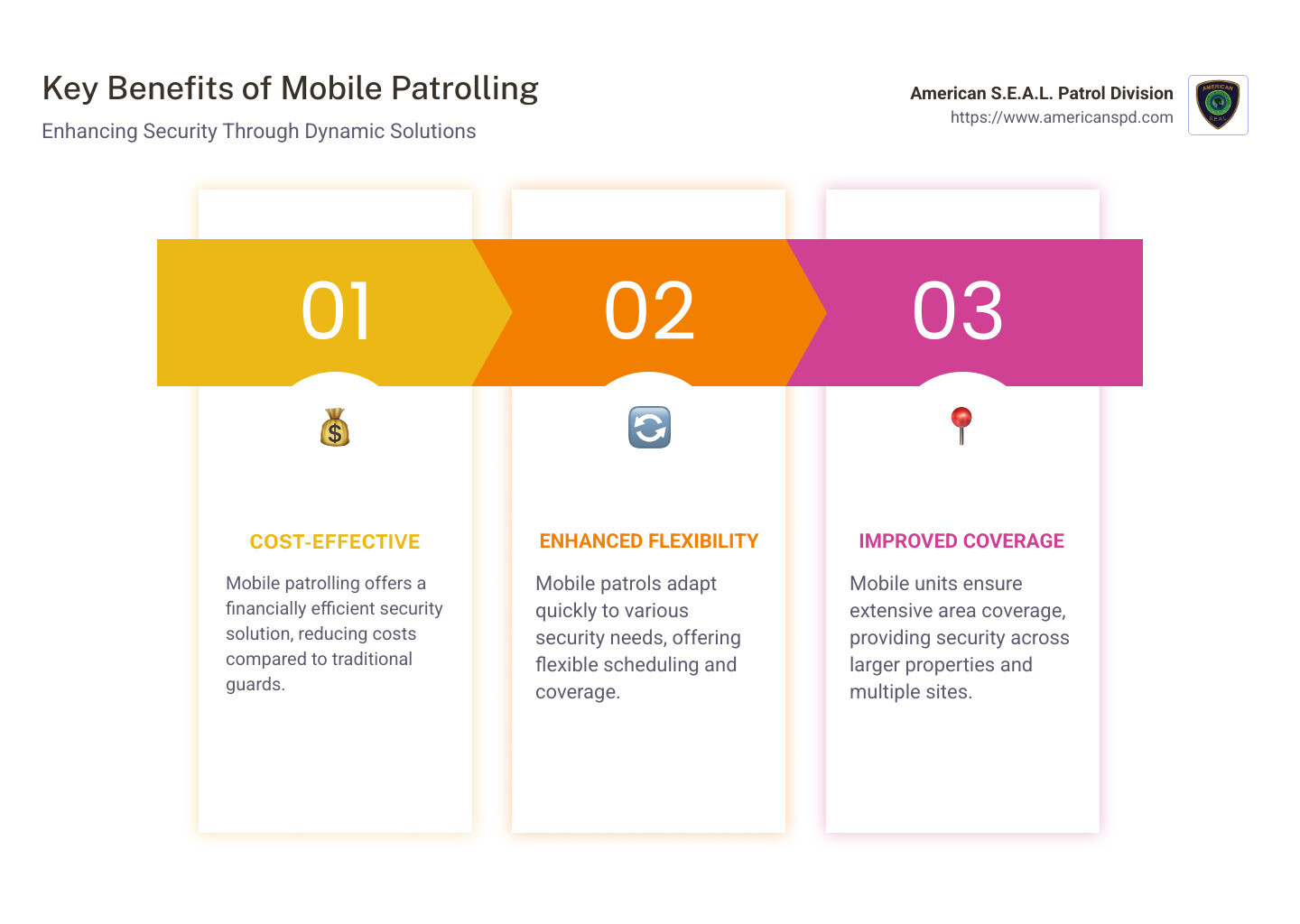
One of the biggest advantages of mobile patrolling is its cost-effectiveness. Unlike static guards, mobile patrols allow fewer officers to cover more ground. This means you can provide robust security without the high costs associated with placing guards at every location.
Mobile patrols offer best flexibility. They can adapt to various environments and conditions, making them suitable for diverse security needs.
Mobile patrols extend security coverage beyond the limitations of static guards. They can cover larger areas and respond to incidents across multiple locations.
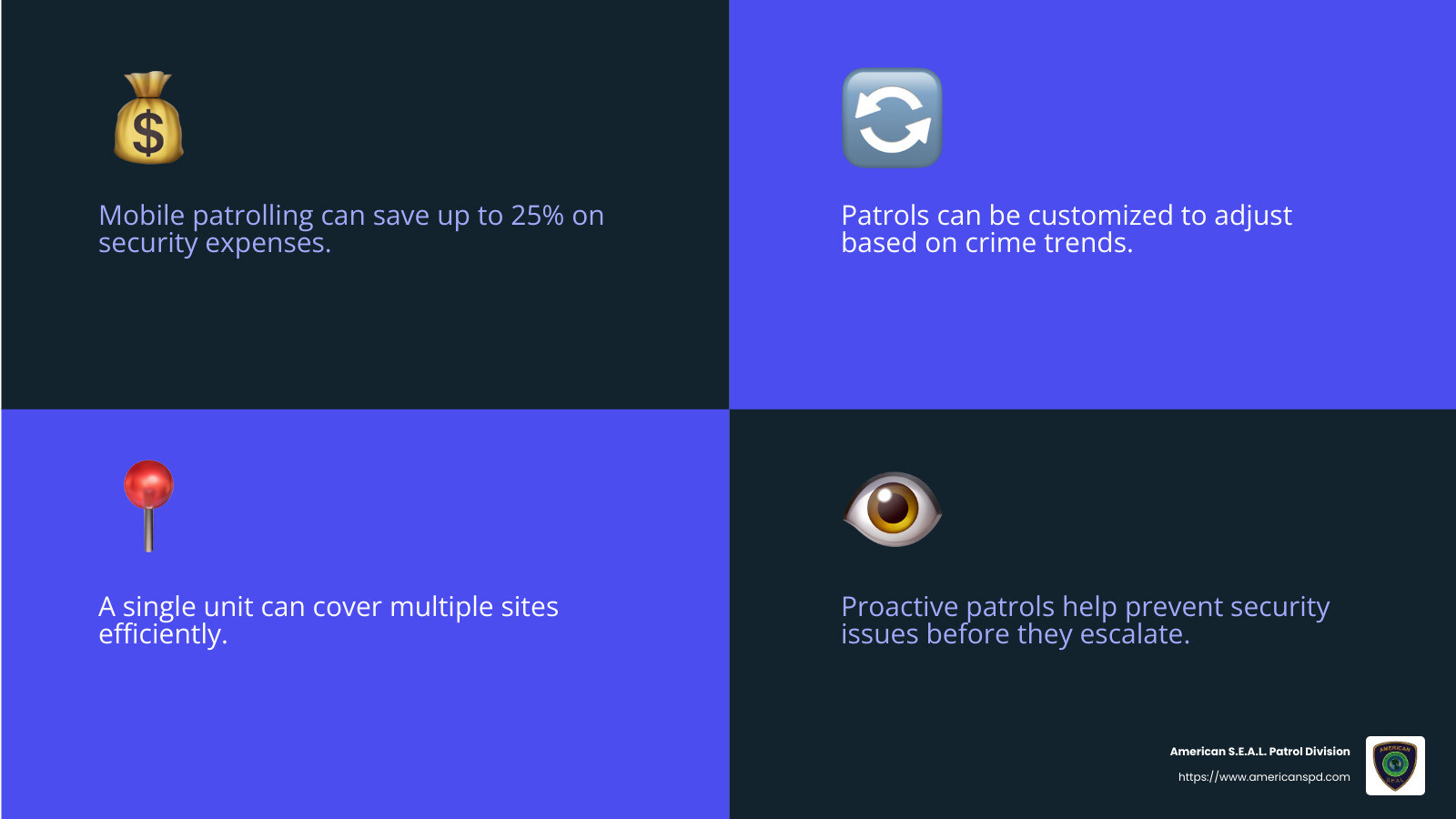
In summary, the benefits of mobile patrolling—cost-effectiveness, flexibility, and improved coverage—make it a powerful tool in any security strategy. Next, we’ll explore how mobile patrolling works and the key features that make it so effective.
Mobile patrolling is more than just driving around. It’s a dynamic security process designed to keep areas safe through surveillance, random intervals, and rapid response.
Surveillance is a critical part of mobile patrolling. Patrol officers use technology like cameras and radios to monitor areas effectively. This helps them spot unusual activities or potential threats quickly.
One of the strengths of mobile patrolling is the use of random intervals. Unlike static guards, who remain in one place, mobile patrols are unpredictable. This unpredictability makes it hard for wrongdoers to know when and where patrols will appear.
Rapid response is another key feature of mobile patrolling. Officers are always ready to act quickly if they spot a problem. This quick action can stop incidents from getting worse and help keep the community safe.
Mobile patrolling combines technology, unpredictability, and speed to provide effective security coverage. These elements work together to create a robust security system that keeps areas safe and secure. Next, we’ll dive into the key features that make mobile patrolling so effective.
Mobile patrolling stands out because of its mobility, visibility, and flexibility. These features make it an effective security solution that can adapt to different needs and environments.
Mobility is at the heart of mobile patrolling. Unlike static security guards, mobile patrol officers can cover a wide area quickly. This allows them to respond to incidents across multiple locations without delay.
The visible presence of mobile patrols acts as a strong deterrent against crime. Marked patrol vehicles serve as a constant reminder that security is on the job, discouraging potential wrongdoers from acting.
Flexibility is another key feature of mobile patrolling. Patrol schedules can be customized to meet the specific needs of each client. Whether it’s random checks throughout the night or scheduled patrols during high-risk periods, mobile patrols can adapt to any situation.
By combining mobility, visibility, and flexibility, mobile patrolling offers a comprehensive security solution that is both proactive and responsive. These features enable mobile patrols to effectively protect properties and communities, creating a safer environment for everyone involved.
Next, we’ll address some frequently asked questions about mobile patrolling to further clarify its role and benefits.
A mobile patrol security officer plays a crucial role in maintaining safety. They operate within a designated area, using vehicles or other forms of transportation. Their main tasks include:
Mobile patrols offer several advantages compared to static guards:
Mobile patrolling acts as a powerful deterrent to crime through various means:
Mobile patrolling combines these elements to create a robust security strategy that protects properties and communities effectively. Next, we’ll explore how American S.E.A.L. Patrol Division leverages its expertise and technology to deliver top-notch mobile patrolling services.
At American S.E.A.L. Patrol Division, we pride ourselves on delivering superior security services that blend expert personnel with cutting-edge technology. Our approach to mobile patrolling ensures that our clients in Texas receive not only protection but also peace of mind.
Our team of highly trained professionals is equipped with the latest communication tools and security systems, enabling them to respond swiftly and effectively to any situation. This commitment to excellence has allowed us to reduce crime by over 60% in some of the largest communities we serve.
By leveraging state-of-the-art technology, we improve our patrol officers’ ability to monitor, report, and act on security threats. Our use of GPS tracking and real-time communication ensures that our officers are always in the right place at the right time, providing a visible and active deterrent to potential wrongdoers.
Whether it’s protecting residential or commercial properties, our mobile patrol services are custom to meet the specific needs of each client. This flexibility, combined with our dedication to safety and security, makes us a trusted partner in safeguarding what matters most to you.
For more information on how our mobile patrolling services can benefit you, visit our Mobile Security Patrols page. Let us help you create a safer environment today.
Security monitoring houston is crucial for safeguarding properties, whether they are residential complexes or busy commercial spaces. As the vibrant city continues to grow, so do the unique challenges it faces in terms of safety and security. With crime rates being a concern for many, implementing effective security solutions becomes indispensable.
In the sprawling urban landscape of Houston, security monitoring presents a solution to the increasing concerns of property crime, with a reported 1 in 22 chance of becoming a victim. Companies like American S.E.A.L. Patrol Division are leveraging advanced technology to provide personalized and robust security systems custom to the needs of Houstonians.
With a focus on customer satisfaction and reliability, these services offer features like smart home integration, dual-path connectivity, and bank-level encryption. They cater to Sarah Thompson and others like her, who are seeking peace of mind through comprehensive security measures that ensure the safety of their tenants and properties.
Related content about security monitoring houston:
– Houston security camera installation
– alarm companies in houston texas
– construction live monitoring security houston
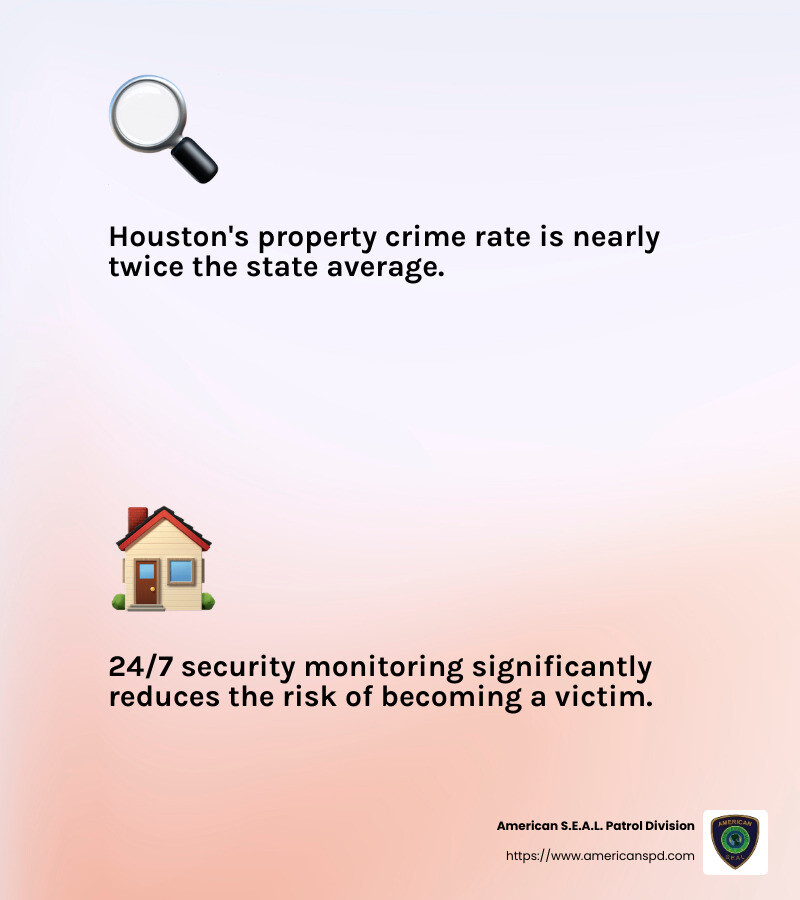
Security monitoring in Houston is essential for both residential and commercial properties. With the city’s vibrant growth and increasing crime rates, having a robust security system is more important than ever.
Homeowners in Houston face a higher risk of property crime than the state average. Having a security system in place can significantly reduce this risk. Residential security systems often include:
These systems not only protect valuable assets but also offer peace of mind to residents by ensuring their homes are safe, whether they’re inside or away.
For businesses, security monitoring is crucial to protect assets, employees, and customers. Commercial properties can benefit from:
Businesses in Houston, like those in the busy downtown area, can leverage these systems to guard against the almost double risk of property crime compared to the state average.
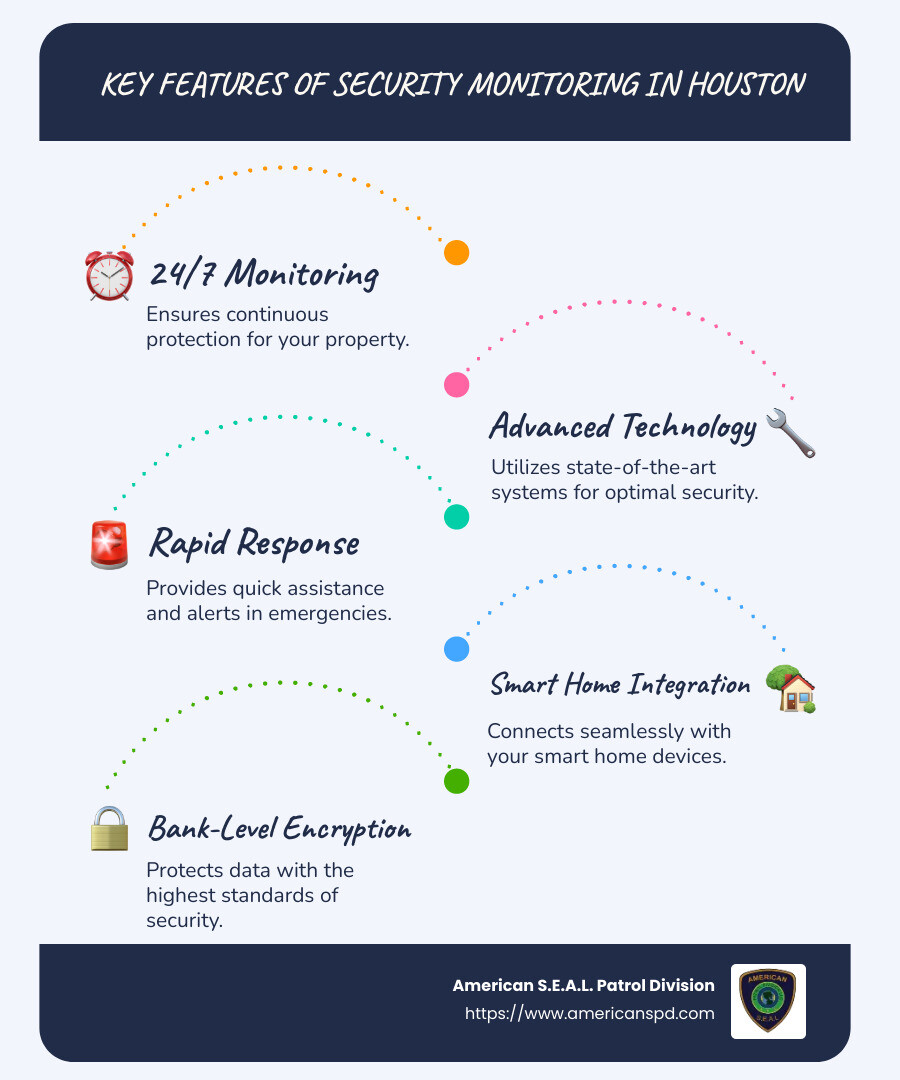
A key feature of effective security monitoring is 24/7 monitoring. This ensures that properties are protected at all times, day or night. In case of an emergency, rapid response teams can be dispatched quickly to address the situation.
With companies like American S.E.A.L. Patrol Division, property owners can rest easy knowing their security systems are actively monitored and ready to respond to any threats.
Security monitoring in Houston is a necessary investment for anyone looking to protect their home or business. The combination of advanced technology, 24/7 monitoring, and rapid response ensures comprehensive coverage and peace of mind.
Choosing the right security monitoring system in Houston involves understanding key features that improve safety and convenience. Let’s explore some of these essential features.
High-quality camera footage is crucial for effective security monitoring. HD cameras offer clear, detailed images that can be vital in identifying intruders or suspicious activities. Many modern systems provide:
With these features, you can be confident that your property is under watchful eyes at all times.
Self-monitoring gives property owners direct control over their security systems. Through smartphone apps, users can:
This hands-on approach provides flexibility and peace of mind, knowing you can keep an eye on your property even when you’re away.
Glass-break sensors are designed to detect the sound of breaking glass, a common point of entry for intruders. These sensors:
Installing glass-break sensors adds an extra layer of protection, ensuring that any attempt to breach your property is quickly detected.
Integrating smart home automation with your security system improves convenience and control. Features include:
Smart home automation not only boosts security but also improves energy efficiency and lifestyle convenience.
These features make security monitoring in Houston a robust solution for protecting homes and businesses. By leveraging advanced technology and smart features, property owners can ensure their environments are safe and secure, providing peace of mind at all times.
Security monitoring in Houston offers numerous advantages that go beyond just keeping an eye on your property. Here’s why investing in a security monitoring system is a smart move:
In Houston, protecting your valuable assets is crucial. With a reliable security monitoring service, you can safeguard your property against theft and vandalism. High-quality cameras and sensors ensure that any suspicious activity is quickly detected and addressed.
Houston, with its vast population and vibrant economy, has areas with higher crime rates. Security monitoring helps mitigate these risks by providing constant surveillance and rapid response.
Investing in a monitored security system can lead to significant savings on insurance premiums. Many insurance companies offer discounts for properties with robust security measures in place.
Perhaps the most significant benefit of security monitoring is the peace of mind it provides. Knowing that your home or business is under constant watch allows you to focus on what truly matters.
Investing in security monitoring in Houston is not just about preventing crime; it’s about enhancing your quality of life. With advanced technology and professional services, you can protect what matters most and enjoy peace of mind every day.
Absolutely. In a city like Houston, where crime rates can be higher in certain areas, investing in security monitoring is a wise decision. Protecting your valuable assets, whether at home or in a business, is crucial.
The cost of security monitoring in Houston can vary based on the services and features you choose. Here’s a general idea:
When choosing the best security monitoring service in Houston, consider the following factors:
By considering these factors, you can find a security monitoring service in Houston that meets your needs and provides peace of mind. Investing in a reliable system not only protects your assets but also ensures you have the support you need when it matters most.
Choosing the right security monitoring service in Houston is critical for ensuring the safety and peace of mind you deserve. At American S.E.A.L. Patrol Division, we combine cutting-edge technology with expert personnel to deliver top-notch security solutions custom to your needs. Our commitment to excellence and 24/7 monitoring ensures that your home or business is always protected.
We understand that safety is a top priority, especially in a busy city like Houston where crime rates can be a concern. Our advanced security systems are designed to deter potential threats and respond swiftly to any incidents. With over 15 years of experience, we pride ourselves on providing reliable and professional services that our clients can trust.
Our approach is simple: integrate the latest technology with personalized security plans to offer comprehensive protection. Whether you need surveillance for a residential property or a commercial complex, we have the expertise and resources to keep you secure. Our GPS-tracked officers, state-of-the-art CCTV systems, and rapid response teams work tirelessly to protect what matters most to you.
By choosing American S.E.A.L. Patrol Division, you are not only investing in a security system but also in peace of mind. We are dedicated to safeguarding your assets and ensuring a safe environment for you and your loved ones. Let us be your trusted partner in security monitoring in Houston, providing the protection you need with the reliability you can count on.
For more information on our services or to get a personalized quote, contact us today. Secure your world with confidence and experience the unparalleled peace of mind that comes with knowing your security is in expert hands.
Commercial property security is crucial for protecting both tenants and assets. As a property manager like Sarah Thompson, you need reliable solutions that keep your buildings safe around the clock. Here’s a quick snapshot of practical steps for enhancing security:
Safeguarding commercial properties is more essential than ever. Rising crime rates and growing concerns about tenant safety make it vital to implement advanced security solutions. By investing in robust security systems, property managers like Sarah can minimize risks and ensure peace of mind for everyone involved.
American S.E.A.L. Patrol Division, with its expertise and cutting-edge technology, helps countless property managers protect their assets efficiently. With solutions ranging from traditional guards to smart monitoring systems, you can find a security strategy custom to your property’s specific needs.
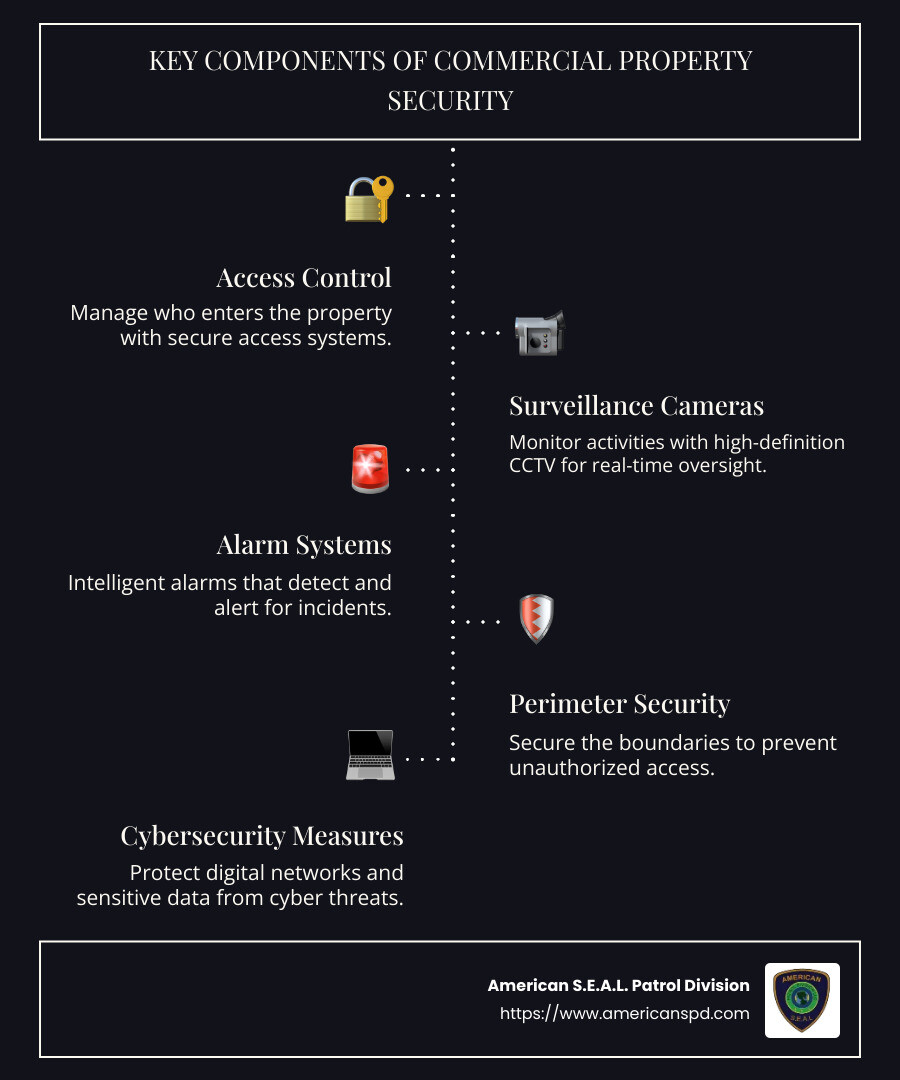
Simple commercial property security glossary:
– alarm systems for commercial
– building access control
– business security solutions
When it comes to commercial property security, there are several key components that work together to create a comprehensive defense system. Access control systems play a crucial role in managing who enters and exits the property. These systems have evolved from traditional locks and keys to modern solutions like keycard entry and biometric scanners, which offer improved security and convenience.
Video surveillance is another vital component. High-definition CCTV cameras provide real-time monitoring, allowing security teams to keep an eye on every corner of the property. This continuous oversight is essential for swiftly addressing any suspicious activity and ensuring the safety of tenants and assets.
Alarm systems are designed to detect unauthorized access or emergencies like fires. These systems can be integrated with other security measures to provide instant alerts, helping to prevent incidents before they escalate.
Implementing robust security solutions offers numerous benefits for commercial properties. Firstly, they serve as a deterrent to crime. Visible security measures like cameras and access control systems discourage potential intruders, reducing the likelihood of break-ins and vandalism.
Ensuring tenant safety is another critical advantage. A secure environment fosters trust and satisfaction among tenants, which can lead to higher retention rates. Tenants are more likely to feel safe and comfortable in a building equipped with advanced security features.
Moreover, having comprehensive security systems in place is often a requirement for insurance compliance. Insurance companies may offer lower premiums for properties with proven security measures, as they are considered lower-risk investments.
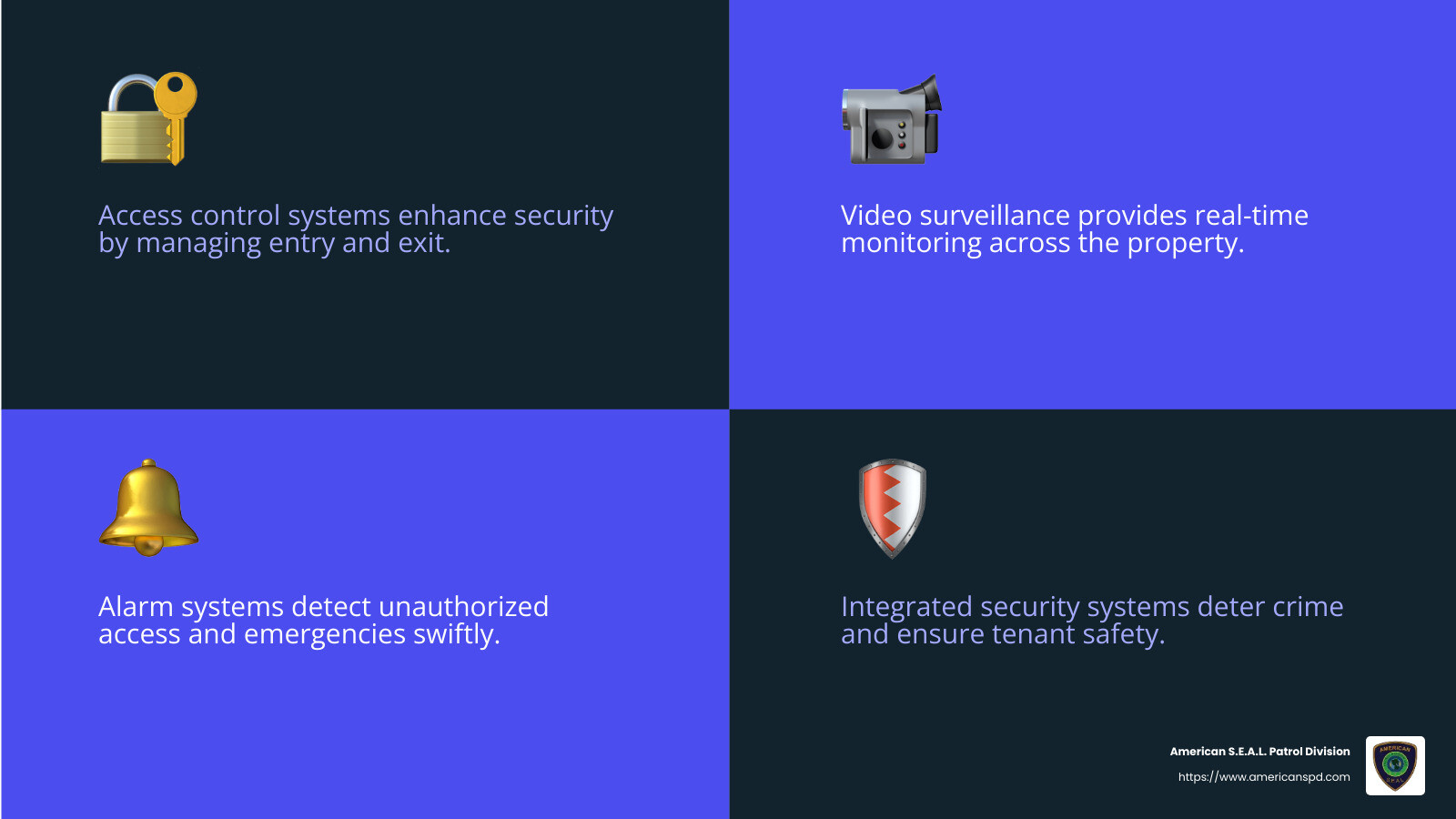
Incorporating both physical and cybersecurity measures is vital in today’s digital age. Protecting sensitive data and digital networks is just as important as securing physical assets. By integrating these systems, commercial property owners can ensure a holistic approach to security.
American S.E.A.L. Patrol Division provides a range of solutions custom to the unique needs of each property. From traditional security measures to cutting-edge technology, they help property managers create a safe and secure environment for their tenants and assets.
In the field of commercial property security, having the right features is crucial for ensuring the safety and protection of your property, tenants, and assets. Let’s explore the essential components that make up a robust security system.
Access control systems are fundamental in managing who can enter and exit a property. Modern systems have moved beyond traditional locks and keys to offer advanced solutions like keycard entry, biometric scanners, and mobile access. These technologies not only improve security but also add convenience for authorized personnel.
Smart integrations further lift access control systems by allowing users to manage access through mobile devices. This means you can open up doors or grant access remotely, providing flexibility and control at your fingertips.
Surveillance cameras serve as the eyes of your security system. High-definition cameras provide real-time monitoring and can be strategically placed to cover all vulnerable areas.
These cameras often come with AI analytics that help identify suspicious activities, such as loitering or unusual movement patterns. This technology enables security teams to respond quickly and effectively to potential threats.
Smart sensors are the unsung heroes of security systems. They detect environmental changes and unusual activities, acting as the first line of defense. Advanced sensors can monitor air quality, temperature fluctuations, and sound levels, providing a comprehensive assessment of the property’s safety.
Today’s security systems are more advanced than ever, thanks to smart integrations and AI analytics. These technologies allow for seamless communication between different components, creating a unified security network.
For example, if a sensor detects an abnormal sound, it can trigger nearby cameras to focus on the area and alert security personnel. This interconnected approach ensures a coordinated and rapid response to potential threats.
When considering a commercial security system, understanding the pricing factors is crucial. Costs can vary based on the size of your property, the number of employees, and the specific security needs.
Custom solutions are often the best approach, as they are tailored to meet the unique requirements of your property. Working with experts like American S.E.A.L. Patrol Division ensures you receive a solution that balances cost and effectiveness.
Professional installation is also a key consideration. While DIY systems are available, having professionals install your system guarantees that all components are correctly set up and integrated, providing peace of mind and reliability.
With these essential features and advanced technologies, commercial properties can achieve a level of security that protects both physical and digital assets. By investing in a comprehensive security solution, property owners can ensure a safe environment for everyone involved.
When it comes to commercial property security, understanding the key components of a security system is essential. Here’s a quick overview:
To protect your commercial property effectively, it’s important to focus on a few key areas:
The cost of installing a commercial security system can vary widely, depending on several factors:
By focusing on these key components and considerations, you can create a secure environment for your commercial property, ensuring the safety of your assets and peace of mind for everyone involved.
Choosing the right commercial property security solution is crucial for safeguarding your assets and ensuring peace of mind. At American S.E.A.L. Patrol Division, we bring over 15 years of expertise in the security industry, specializing in both residential and commercial protection across Texas.
Expert Personnel: Our team is made up of highly trained professionals who excel in security services. They are equipped with extensive training in de-escalation and interpersonal communication, ensuring they can handle various situations with professionalism and tact. Their presence alone acts as a deterrent to potential threats, providing a safe environment for your property.
Cutting-Edge Technology: We leverage the latest technology to improve our security services. Our systems include 24/7 monitoring, GPS-tracked officers, and advanced surveillance tools. This technology ensures rapid response times and constant oversight, making sure your property is always protected.
Peace of Mind: Our commitment is to provide you with a security solution that not only protects but also gives you peace of mind. With American S.E.A.L. Patrol Division, you can trust that your property is in good hands, allowing you to focus on what truly matters—running your business.
By choosing us, you’re not just investing in a security service; you’re partnering with a team dedicated to your safety and security. Our custom solutions and expert personnel make us a reliable choice for any commercial property owner looking to protect their investments effectively.
For a secure future, partner with American S.E.A.L. Patrol Division and experience the difference that expert personnel and cutting-edge technology can make. Contact us today to learn more about our services and how we can help protect what matters most to you.
“Upgrade your alarm monitoring system now to stay ahead of the game in 2025! Enhance your surveillance cameras and motion detection capabilities with our top-of-the-line upgrades. Don’t wait, get a free quote today at https://www.americanspd.com/free-quote and secure your peace of mind for the future.”
In the world of security and surveillance, technology is constantly evolving and improving. As we look towards the future of alarm monitoring, one trend that is gaining traction is the integration of video analytics for enhanced motion detection. This cutting-edge technology is set to revolutionize the way we monitor and protect our homes and businesses.
So, what exactly is video analytics? Simply put, it is the use of advanced algorithms and software to analyze video footage in real-time. This allows for more accurate and efficient detection of motion and other events. By integrating video analytics into alarm monitoring systems, we can greatly enhance the effectiveness of our security measures.
One of the key benefits of video analytics is its ability to reduce false alarms. Traditional motion detection systems can often be triggered by non-threatening events such as moving branches or passing animals. This can lead to unnecessary panic and wasted resources. With video analytics, the system is able to distinguish between human and non-human movement, greatly reducing the number of false alarms.
Another advantage of video analytics is its ability to track and analyze multiple objects simultaneously. This means that even in a crowded environment, the system can accurately detect and track suspicious activity. This is particularly useful in high-traffic areas such as shopping malls or airports, where traditional motion detection systems may struggle to keep up.
In addition to improved motion detection, video analytics also offers a range of other features that can greatly enhance the effectiveness of alarm monitoring. One such feature is facial recognition. By using advanced algorithms, the system can identify and track specific individuals, allowing for more targeted and efficient security measures. This is particularly useful in situations where there may be known threats or suspects.
Another feature of video analytics is object detection. This allows the system to identify and track specific objects, such as vehicles or weapons. In high-security areas, this can be a crucial tool in preventing potential threats from entering the premises. It also allows for more efficient monitoring of valuable assets, such as expensive equipment or artwork.
One of the most exciting developments in video analytics is the use of artificial intelligence (AI). By incorporating AI into alarm monitoring systems, we can greatly enhance their capabilities. AI algorithms are able to learn and adapt to their environment, making them more accurate and efficient over time. This means that the system can continuously improve its performance, providing even greater levels of security.
So, what does the future hold for alarm monitoring and video analytics? As technology continues to advance, we can expect to see even more sophisticated and powerful systems emerge. One area that is already being explored is the use of drones for surveillance. By combining video analytics with drone technology, we can greatly expand the reach and capabilities of alarm monitoring systems.
In conclusion, the integration of video analytics into alarm monitoring systems is set to revolutionize the way we protect our homes and businesses. With its ability to reduce false alarms, track multiple objects, and incorporate advanced features such as facial recognition and AI, video analytics offers a range of benefits that traditional motion detection systems simply cannot match. As we look towards the future, it is clear that this technology will play a crucial role in keeping us safe and secure.
In today’s world, security is a top priority for both residential and commercial properties. With the advancements in technology, alarm monitoring systems have become an essential tool in ensuring the safety and security of our homes and businesses. However, as technology continues to evolve, it is crucial to keep up with the latest upgrades to maximize the effectiveness of these systems.
One of the top upgrades for alarm monitoring systems is the integration of access control. Access control allows for the restriction of entry to a specific area or building, ensuring that only authorized individuals have access. This feature is especially useful for businesses that have sensitive areas or valuable assets that need to be protected. With access control, business owners can monitor and control who enters their premises, reducing the risk of theft or unauthorized access.
Another essential upgrade for alarm monitoring systems is the enhancement of surveillance cameras. In the past, surveillance cameras were limited to recording footage, which would then be reviewed after an incident occurred. However, with the latest upgrades, surveillance cameras now have real-time monitoring capabilities, allowing for immediate response to any suspicious activity. This feature is especially beneficial for businesses that operate 24/7, as it provides constant surveillance and the ability to address any security threats promptly.
One of the most significant upgrades in surveillance cameras is the integration of motion detection technology. This feature allows cameras to detect any movement within their field of view and trigger an alarm. With motion detection, businesses can be alerted to any potential threats, even when they are not actively monitoring the cameras. This upgrade is particularly useful for businesses that have large premises or multiple entry points, as it provides an extra layer of security.
In addition to access control and surveillance camera upgrades, there are also advancements in the software used for alarm monitoring systems. With the rise of artificial intelligence and machine learning, alarm monitoring systems can now analyze data and identify patterns to detect potential security threats. This technology allows for more accurate and efficient monitoring, reducing the risk of false alarms and providing a more reliable security system.
Another significant upgrade in alarm monitoring systems is the integration of mobile applications. With these apps, business owners can monitor their premises from anywhere, at any time. This feature is especially useful for those who travel frequently or have multiple locations to manage. With a mobile app, they can receive real-time alerts, view live footage, and even control access to their premises remotely.
Furthermore, with the rise of the Internet of Things (IoT), alarm monitoring systems can now be integrated with other smart devices, such as smart locks and sensors. This integration allows for a more comprehensive and interconnected security system, providing businesses with a more holistic approach to security.
In conclusion, as technology continues to advance, it is crucial to upgrade alarm monitoring systems to keep up with the latest security measures. The integration of access control, enhanced surveillance cameras, and advanced software and mobile applications are just some of the top upgrades that can boost the effectiveness of these systems. With these upgrades, businesses can have peace of mind knowing that their premises are secure and protected. As we look towards the future, it is essential to stay updated with the latest upgrades to ensure the safety and security of our homes and businesses.
In today’s world, security and surveillance have become top priorities for homeowners and businesses alike. With the rise of smart technology, alarm monitoring systems have evolved to provide more advanced features and capabilities. One of the most significant advancements in alarm monitoring is the integration of smart alarms and surveillance cameras. This combination offers a comprehensive and efficient approach to security, making it the ultimate choice for top-notch alarm monitoring in 2025.
Smart alarms are a significant upgrade from traditional alarm systems. They are connected to the internet and can be controlled remotely through a smartphone or tablet. This feature allows homeowners and business owners to monitor their properties from anywhere in the world. With smart alarms, you can receive real-time alerts and notifications on your phone, making it easier to stay updated on any potential security threats.
One of the most significant advantages of smart alarms is their ability to integrate with surveillance cameras. These cameras are equipped with advanced motion detection technology, making them an essential component of any alarm monitoring system. When combined with smart alarms, surveillance cameras can provide a more comprehensive and accurate approach to security.
One of the top upgrades for surveillance cameras in 2025 is the use of artificial intelligence (AI). AI-powered cameras can analyze and interpret data in real-time, making them more efficient in detecting and identifying potential threats. These cameras can differentiate between human and non-human movements, reducing the number of false alarms. They can also learn and adapt to their surroundings, making them more accurate over time.
Another significant upgrade for surveillance cameras is the use of thermal imaging technology. This technology allows cameras to detect heat signatures, making them more effective in low-light or no-light conditions. Thermal imaging cameras can also detect movement through walls and other obstacles, providing an added layer of security. This feature is especially useful for businesses that have valuable assets or sensitive information that needs to be protected.
In addition to AI and thermal imaging, another upgrade for surveillance cameras is the use of facial recognition technology. This feature allows cameras to identify and track individuals, making it easier to monitor who enters and exits a property. Facial recognition technology can also be integrated with access control systems, allowing for a more secure and efficient entry process.
Another essential upgrade for surveillance cameras is the use of cloud storage. With traditional surveillance systems, footage is stored on a physical device, making it vulnerable to theft or damage. Cloud storage, on the other hand, allows footage to be stored remotely, providing a more secure and reliable option. It also allows for easy access to footage from anywhere, making it easier to review and analyze any security incidents.
Lastly, the integration of smart alarms and surveillance cameras also allows for remote monitoring and control. This feature is especially useful for businesses that have multiple locations or properties. With remote monitoring, business owners can keep an eye on all their properties from one central location, making it more convenient and efficient.
In conclusion, the combination of smart alarms and surveillance cameras is the ultimate upgrade for alarm monitoring in 2025. With advanced features such as AI, thermal imaging, facial recognition, and cloud storage, this combination provides a comprehensive and efficient approach to security. It also allows for remote monitoring and control, making it the top choice for homeowners and businesses looking to enhance their security measures. As technology continues to advance, we can only expect further upgrades and improvements in the world of alarm monitoring.
Upgrade your smart alarms and video analytics with top motion detection technology to stay ahead of the game in 2025. Don’t miss out on the latest advancements – get a free quote from AmericanSPD today! Click here to learn more.
In the world of security systems, motion detection has long been a crucial component in keeping homes and businesses safe. However, with advancements in technology and the rise of smart alarms and video analytics, motion detection is set to undergo a major upgrade in the coming years. These upgrades will not only enhance the effectiveness of alarm monitoring, but also revolutionize the way we think about security systems.
One of the top motion detection upgrades that is expected to make a significant impact in the security industry is the use of artificial intelligence (AI). AI-powered motion detection systems will be able to differentiate between human and non-human movement, reducing the number of false alarms triggered by pets, insects, or other non-threatening objects. This will not only save time and resources for security companies, but also provide a more accurate and reliable detection system for homeowners and businesses.
Another key upgrade in motion detection technology is the use of thermal imaging. Traditional motion sensors rely on changes in visible light to detect movement, which can be easily fooled by shadows or reflections. Thermal imaging, on the other hand, detects changes in heat signatures, making it more difficult to trick the system. This will greatly enhance the accuracy of motion detection, especially in low light or dark environments.
In addition to these technological upgrades, there are also advancements being made in the physical design of motion sensors. Traditional sensors are often bulky and can be easily tampered with or disabled. However, new designs are being developed that are smaller, more discreet, and can be easily integrated into existing security systems. This will not only make them less noticeable to potential intruders, but also more difficult to disable, providing an added layer of security.
One of the most exciting developments in motion detection technology is the integration of facial recognition. This feature will allow security systems to not only detect movement, but also identify who or what is causing the movement. This can be especially useful in commercial settings, where access control is crucial. With facial recognition, businesses can ensure that only authorized personnel are entering restricted areas, reducing the risk of theft or other security breaches.
Another upgrade that is set to revolutionize motion detection is the use of 3D sensors. Traditional sensors only detect movement in a 2D plane, which can lead to blind spots and missed activity. 3D sensors, on the other hand, can detect movement in multiple planes, providing a more comprehensive view of the area being monitored. This will greatly enhance the accuracy and effectiveness of motion detection, making it more difficult for intruders to go undetected.
With all these upgrades in motion detection technology, it is clear that the future of security systems is heading towards a more intelligent and sophisticated approach. These advancements will not only improve the effectiveness of alarm monitoring, but also enhance the capabilities of video analytics. By combining motion detection with other features such as facial recognition and thermal imaging, security systems will be able to provide a more comprehensive and accurate picture of any potential threats.
In conclusion, the future of security systems is bright with the advancements in motion detection technology. From AI-powered sensors to facial recognition and 3D sensors, these upgrades will greatly enhance the effectiveness of alarm monitoring and video analytics. With these improvements, homeowners and businesses can have peace of mind knowing that their security systems are equipped with the latest and most advanced motion detection technology.

In today’s world, security and surveillance have become increasingly important. With the rise of smart homes and businesses, the need for efficient and effective surveillance systems has also increased. One crucial aspect of any surveillance system is motion detection. It allows for the detection of any movement within the camera’s field of view, triggering alarms and recording footage. However, with advancements in technology, motion detection has also evolved, and there are now various upgrades available to boost smart alarms and enhance video analytics.
One of the top motion detection upgrades for surveillance cameras is the use of artificial intelligence (AI). AI-powered motion detection algorithms can differentiate between human and non-human movements, reducing false alarms triggered by animals or moving objects. This upgrade also allows for more accurate tracking of individuals, making it easier to identify potential threats or suspicious behavior.
Another upgrade that has gained popularity in recent years is the use of thermal imaging cameras. These cameras use infrared technology to detect heat signatures, making them ideal for low-light or no-light environments. Thermal imaging cameras can detect motion even in complete darkness, providing round-the-clock surveillance. This upgrade is especially useful for outdoor surveillance, where traditional cameras may struggle to capture clear footage in low light conditions.
In addition to AI and thermal imaging, there are also upgrades available for traditional motion detection methods. For instance, some cameras now come equipped with advanced motion sensors that can detect movement in specific areas of the camera’s field of view. This feature is particularly useful for areas with high foot traffic, such as entrances or hallways. By setting up these sensors, the camera can focus on specific areas and ignore any movement outside of those designated zones, reducing false alarms and improving overall efficiency.
Another upgrade that has been gaining traction is the use of 3D motion detection. This technology uses multiple cameras to create a 3D map of the surveillance area, allowing for more accurate detection and tracking of movement. This upgrade is especially useful for large spaces, such as warehouses or parking lots, where traditional cameras may struggle to cover the entire area effectively.
One of the most significant challenges with traditional motion detection is the high rate of false alarms. This can be caused by various factors, such as moving shadows, changes in lighting, or even weather conditions. To combat this issue, some cameras now come equipped with advanced algorithms that can filter out false alarms. These algorithms can differentiate between human and non-human movements, as well as distinguish between different types of movement, such as walking, running, or crawling. This upgrade not only reduces false alarms but also provides more accurate data for video analytics.
Speaking of video analytics, another top motion detection upgrade is the integration of facial recognition technology. By combining facial recognition with motion detection, cameras can identify and track specific individuals, providing valuable data for security purposes. This upgrade is particularly useful for businesses or organizations that require strict access control, as it allows for the identification of authorized personnel and potential intruders.
In conclusion, motion detection is a crucial aspect of any surveillance system, and with the advancements in technology, there are now various upgrades available to boost smart alarms and enhance video analytics. From AI-powered algorithms to thermal imaging and 3D motion detection, these upgrades not only improve the efficiency of surveillance cameras but also provide more accurate data for video analytics. As we move towards a more connected and technologically advanced future, these upgrades will continue to play a significant role in maximizing surveillance camera efficiency.
In today’s world, security is a top priority for individuals and businesses alike. With the advancements in technology, access control and smart alarms have become essential tools in ensuring the safety of our homes and offices. One of the key components of these security systems is motion detection, which has been continuously evolving and improving over the years. As we look towards the future, it is important to understand the impact of motion detection upgrades on overall security in 2025.
Motion detection is the ability of a security system to detect movement within its designated area. This technology has been around for decades, but with the rise of smart homes and the Internet of Things (IoT), it has become more sophisticated and efficient. In 2025, we can expect to see even more advanced motion detection upgrades that will greatly enhance the capabilities of access control and smart alarms.
One of the top upgrades that we can expect to see in motion detection technology is the use of artificial intelligence (AI). With AI, security systems will be able to learn and adapt to their surroundings, making them more accurate and reliable. This means that false alarms caused by pets or moving objects such as curtains or trees will be greatly reduced. AI-powered motion detection will also be able to differentiate between human and non-human movement, providing a more targeted and efficient response.
Another upgrade that will greatly impact the effectiveness of motion detection is the integration of video analytics. With the use of high-definition cameras and advanced algorithms, video analytics will be able to analyze and interpret the movements captured by the cameras. This will not only improve the accuracy of motion detection but also provide valuable insights and data for security purposes. For example, video analytics can detect suspicious behavior or track the movement of individuals within a building, providing valuable information for security personnel.
In addition to AI and video analytics, we can also expect to see improvements in the range and sensitivity of motion detection. In 2025, motion sensors will be able to cover larger areas and detect even the slightest movements. This will be especially beneficial for outdoor security systems, where a wider range of coverage is needed. With increased sensitivity, security systems will be able to detect even the smallest movements, making them more effective in detecting potential threats.
Furthermore, motion detection upgrades will also have a significant impact on the response time of security systems. With faster and more accurate detection, security personnel will be able to respond to potential threats in a timely manner. This is crucial in emergency situations where every second counts. In addition, with the integration of AI and video analytics, security systems will be able to provide real-time alerts and notifications, allowing for a quicker response and resolution of security issues.
Apart from enhancing the capabilities of access control and smart alarms, motion detection upgrades will also have a positive impact on the overall security of buildings and homes. With more advanced and efficient motion detection, security systems will be able to prevent break-ins and intrusions, providing peace of mind for homeowners and businesses. This will also lead to a decrease in property damage and theft, resulting in cost savings for individuals and companies.
In conclusion, the continuous evolution and improvement of motion detection technology will greatly enhance the effectiveness of access control and smart alarms in 2025. With the integration of AI, video analytics, and improvements in range and sensitivity, security systems will be more accurate, efficient, and responsive. This will not only provide better protection for homes and businesses but also contribute to a safer and more secure society. As we look towards the future, it is clear that motion detection upgrades will play a crucial role in shaping the security landscape.
Upgrade your surveillance cameras with top motion detection technology to enhance access control in 2025. Don’t wait, get a free quote from AmericanSPD today! Click here to learn more.
In the ever-evolving world of security systems, motion detection technology has become a crucial component in ensuring the safety and security of both residential and commercial properties. With advancements in technology, motion detection has become more sophisticated and efficient, making it an essential upgrade for surveillance cameras and access control systems. As we look towards the future, it is clear that motion detection will continue to play a significant role in enhancing security measures. In this article, we will explore the top motion detection upgrades that will boost surveillance cameras and enhance access control in 2025.
One of the most significant upgrades in motion detection technology is the use of artificial intelligence (AI). AI-powered motion detection systems can analyze and interpret data in real-time, making them more accurate and reliable. This means that surveillance cameras equipped with AI-powered motion detection can distinguish between human and non-human movements, reducing false alarms and improving response time. Additionally, AI can learn and adapt to different environments, making it an ideal upgrade for both indoor and outdoor surveillance cameras.
Another significant upgrade in motion detection technology is the use of thermal imaging. Traditional motion detection systems rely on visual cues, which can be easily fooled by shadows, reflections, or poor lighting conditions. Thermal imaging, on the other hand, detects heat signatures, making it more accurate and reliable in detecting motion. This technology is particularly useful in low-light or no-light environments, making it an ideal upgrade for surveillance cameras in areas with limited lighting.
In addition to AI and thermal imaging, radar-based motion detection is also gaining popularity in the security industry. Radar technology uses radio waves to detect motion, making it highly accurate and reliable. Unlike traditional motion detection systems, radar-based systems can detect motion through walls and other obstacles, providing a more comprehensive surveillance solution. This technology is particularly useful for perimeter security, where it can detect and track movements in a wide area.
As we look towards the future, it is clear that motion detection technology will continue to evolve and improve. One of the most exciting developments in this field is the use of 3D motion detection. This technology uses multiple cameras to create a 3D map of the environment, allowing for more precise and accurate motion detection. With 3D motion detection, surveillance cameras can track movements in three dimensions, making it an ideal upgrade for large areas or complex environments.
Apart from enhancing surveillance cameras, motion detection upgrades can also improve access control systems. One of the most significant upgrades in this regard is the use of facial recognition technology. By combining motion detection with facial recognition, access control systems can accurately identify and track individuals entering or exiting a building. This technology is particularly useful in high-security areas, where only authorized personnel are allowed access.
Another significant upgrade in access control systems is the use of gesture recognition. This technology uses motion detection to recognize specific hand gestures, allowing for touchless access control. With gesture recognition, individuals can enter a building or room without having to touch a keypad or card reader, reducing the risk of spreading germs and viruses. This technology is particularly relevant in the current global health crisis and is expected to become a standard feature in access control systems in the future.
In conclusion, motion detection technology is continuously evolving and improving, making it an essential upgrade for surveillance cameras and access control systems. With advancements in AI, thermal imaging, radar, 3D motion detection, facial recognition, and gesture recognition, the future of security systems looks promising. These upgrades will not only enhance the effectiveness of surveillance and access control but also provide a more seamless and efficient experience for users. As we look towards 2025, it is clear that motion detection will continue to play a crucial role in ensuring the safety and security of our homes and businesses.

In today’s world, security is a top priority for businesses and individuals alike. With the rise of technology, surveillance cameras have become a common tool for monitoring and protecting properties. However, simply having cameras in place is not enough to ensure maximum security. That’s where motion detection comes in.
Motion detection is a feature that allows surveillance cameras to detect movement and trigger an alarm or recording. This technology has been around for a while, but recent advancements have made it even more powerful and effective. In this article, we will explore the top motion detection upgrades that are set to revolutionize alarm monitoring and access control in 2025.
One of the most significant upgrades in motion detection technology is the use of video analytics. This involves using algorithms and artificial intelligence to analyze video footage and detect specific types of motion. For example, instead of just detecting any movement, video analytics can be programmed to only trigger an alarm when a person enters a restricted area or when a vehicle enters a parking lot after hours.
This level of customization and accuracy is a game-changer for surveillance cameras. It not only reduces the number of false alarms but also allows for more targeted and efficient monitoring. With video analytics, security personnel can focus on the most critical areas and respond quickly to potential threats.
Another upgrade that is set to enhance motion detection is the use of thermal imaging. Traditional surveillance cameras rely on visible light to capture images, which can be limited in low light or dark environments. Thermal imaging, on the other hand, uses infrared radiation to detect heat signatures. This means that even in complete darkness, surveillance cameras can still detect movement and trigger an alarm.
Thermal imaging is particularly useful for outdoor surveillance, where lighting conditions can be unpredictable. It can also help in detecting intruders who may try to camouflage themselves in the dark. With this upgrade, surveillance cameras can provide round-the-clock monitoring and enhance access control in areas that were previously difficult to secure.
In addition to these technological upgrades, motion detection is also becoming more integrated with other security systems. For example, access control systems can now be linked to surveillance cameras with motion detection. This means that when an unauthorized person tries to enter a restricted area, an alarm will be triggered, and the surveillance camera will start recording. This integration not only enhances security but also provides a more comprehensive view of any potential threats.
Furthermore, motion detection is also being used in conjunction with facial recognition technology. This allows surveillance cameras to not only detect movement but also identify individuals. This is particularly useful in high-security areas where only authorized personnel are allowed. With facial recognition, access control can be further enhanced by ensuring that only the right people have access to restricted areas.
As technology continues to advance, we can expect even more upgrades in motion detection. For example, there is ongoing research on using artificial intelligence to predict and prevent potential security threats. This would involve analyzing patterns of movement and behavior to identify any suspicious activity before it happens.
In conclusion, motion detection is a crucial component of modern surveillance systems. With the latest upgrades in technology, it is becoming even more powerful and effective in enhancing security and access control. As we look towards 2025, we can expect to see even more advancements in motion detection, making it an essential tool for maximizing security.
In the world of security and surveillance, technology is constantly evolving and improving. As we approach the year 2025, it is important for businesses and individuals to stay up-to-date with the latest advancements in motion detection and access control. These upgrades not only enhance the effectiveness of surveillance cameras, but also improve access control measures, making them an essential component of any security system.
One of the top motion detection upgrades to look out for in 2025 is the integration of smart alarms. These alarms are designed to work in conjunction with motion detection sensors, providing a more comprehensive and accurate detection system. Unlike traditional alarms that are triggered by a specific event, smart alarms use advanced algorithms to analyze the movement patterns of individuals and objects. This means that false alarms caused by things like pets or moving branches are significantly reduced, saving time and resources for security personnel.
Another key upgrade to consider is the use of artificial intelligence (AI) in motion detection. AI-powered cameras are able to learn and adapt to their surroundings, making them more efficient at detecting and tracking suspicious activity. They can also differentiate between human and non-human movement, reducing the number of false alarms. Additionally, AI-powered cameras can be programmed to send alerts to security personnel when specific events occur, such as someone entering a restricted area or loitering in a certain location.
In addition to smart alarms and AI, the use of thermal imaging technology is also expected to become more prevalent in motion detection systems. This technology uses infrared radiation to detect heat signatures, making it ideal for detecting movement in low light or dark environments. Thermal imaging cameras can also detect movement through obstacles such as smoke, fog, and dust, making them a valuable asset in outdoor surveillance.
Another important upgrade to consider is the integration of facial recognition technology with motion detection. This combination allows for more accurate identification of individuals, making it easier to track and monitor potential threats. Facial recognition technology can also be used to grant access to authorized personnel, eliminating the need for physical keys or access cards. This not only enhances security but also streamlines the access control process.
In addition to these technological upgrades, there are also advancements being made in the field of biometric access control. Biometric systems use unique physical characteristics such as fingerprints, iris scans, or facial recognition to grant access to individuals. These systems are more secure than traditional access control methods, as they cannot be easily duplicated or stolen. In 2025, we can expect to see biometric access control systems integrated with motion detection, creating a powerful and foolproof security system.
Lastly, the use of cloud-based storage and analytics is also expected to become more prevalent in motion detection systems. This allows for real-time monitoring and analysis of surveillance footage, making it easier to identify and respond to potential threats. Cloud-based storage also eliminates the risk of footage being lost or destroyed, providing a reliable and secure way to store important surveillance data.
In conclusion, the combination of smart alarms, AI, thermal imaging, facial recognition, biometric access control, and cloud-based storage and analytics are set to revolutionize the world of motion detection and access control in 2025. These upgrades not only enhance the effectiveness of surveillance cameras but also improve access control measures, making them an essential component of any security system. As technology continues to advance, it is crucial for businesses and individuals to stay informed and invest in these upgrades to ensure the safety and security of their premises.
Upgrade your video analytics for smarter alarms and enhanced security systems in 2025. Don’t wait, get a free quote from AmericanSPD today! Click here to learn more.
In recent years, the use of video analytics in security systems has become increasingly popular. This technology allows for the analysis of video footage in real-time, providing valuable insights and data for security purposes. As we look towards the future, it is clear that video analytics will continue to play a crucial role in enhancing security systems. In this article, we will explore the top video analytics upgrades that will boost smart alarms and enhance security systems in 2025.
One of the most significant impacts of advanced video analytics on alarm monitoring in 2025 will be the ability to detect and prevent potential threats before they occur. With the use of artificial intelligence and machine learning, video analytics can analyze patterns and behaviors to identify suspicious activities. This means that security systems will be able to proactively respond to potential threats, rather than simply reacting after an incident has already occurred.
Another key upgrade in video analytics for alarm monitoring in 2025 is the integration of facial recognition technology. This will allow security systems to not only detect potential threats but also identify individuals who may pose a risk. With the ability to recognize faces, security systems can be programmed to trigger alarms or alerts when a known individual with a history of criminal activity is detected. This will greatly enhance the effectiveness of alarm monitoring and provide an added layer of security.
In addition to detecting and preventing threats, advanced video analytics will also play a crucial role in improving response times. With the use of real-time video analysis, security systems can quickly identify the location and severity of an incident, allowing for a faster response from authorities. This is especially important in emergency situations where every second counts. By providing accurate and timely information, video analytics can help to minimize the impact of potential threats and ensure the safety of individuals and property.
Furthermore, the integration of video analytics with other smart technologies will greatly enhance the overall efficiency and effectiveness of security systems. For example, video analytics can be integrated with access control systems, allowing for the automatic lockdown of a building if a threat is detected. This seamless integration of technologies will not only improve security but also streamline processes and reduce the need for human intervention.
Another significant impact of advanced video analytics on alarm monitoring in 2025 is the ability to provide valuable data and insights for businesses. With the use of video analytics, businesses can track customer behavior, monitor foot traffic, and identify areas for improvement. This data can be used to optimize store layouts, improve customer service, and increase overall efficiency. Additionally, video analytics can also help businesses to identify potential security risks and take proactive measures to prevent them.
In conclusion, the impact of advanced video analytics on alarm monitoring in 2025 will be significant. With the ability to detect and prevent threats, integrate with other smart technologies, and provide valuable data and insights, video analytics will greatly enhance the effectiveness and efficiency of security systems. As technology continues to advance, we can expect to see even more upgrades and improvements in video analytics, making our world a safer place.
In today’s fast-paced world, security systems have become an essential part of our daily lives. With the rise of technology, traditional security measures such as locks and alarms are no longer enough to keep our homes and businesses safe. This is where video analytics and access control integration come into play, revolutionizing the way we approach security systems.
Video analytics, also known as intelligent video surveillance, is the use of advanced algorithms and software to analyze video footage in real-time. This technology has been around for a while, but it is constantly evolving and improving. By integrating video analytics with access control systems, security systems can be taken to a whole new level.
One of the top video analytics upgrades that will boost smart alarms and enhance security systems in 2025 is facial recognition. This technology has been gaining popularity in recent years, and it is expected to become even more advanced and widely used in the coming years. Facial recognition allows security systems to identify individuals by analyzing their facial features, making it a powerful tool for access control. With this upgrade, security systems can be programmed to only allow authorized individuals to enter a building or restricted area, reducing the risk of unauthorized access.
Another upgrade that will greatly enhance security systems is behavior recognition. This technology uses artificial intelligence to analyze human behavior and detect any suspicious or abnormal activities. By integrating behavior recognition with access control systems, security systems can be programmed to trigger alarms or alerts when unusual behavior is detected. This can help prevent potential threats and improve response time in case of an emergency.
In addition to facial and behavior recognition, video analytics can also be used for license plate recognition. This technology uses cameras to capture and analyze license plate numbers, allowing security systems to track and identify vehicles entering or leaving a premises. This can be particularly useful for parking lots, gated communities, and other areas where vehicle access needs to be monitored. By integrating license plate recognition with access control systems, security systems can be programmed to only allow authorized vehicles to enter, further enhancing the overall security of a location.
One of the most significant benefits of video analytics and access control integration is the ability to generate real-time alerts and notifications. With traditional security systems, alarms are often triggered by motion sensors, which can result in false alarms. However, with video analytics, security systems can be programmed to only trigger alarms when specific events occur, such as a person entering a restricted area or a vehicle entering a parking lot after hours. This not only reduces the risk of false alarms but also allows for a more efficient response to potential threats.
Moreover, video analytics can also be used for crowd management and counting. This technology uses cameras to track and analyze the movement of people in a specific area, providing valuable insights for crowd control and management. By integrating this feature with access control systems, security personnel can be alerted when a certain number of people have entered a restricted area, helping to prevent overcrowding and maintain safety protocols.
In conclusion, video analytics and access control integration are revolutionizing the way we approach security systems. With advanced technologies such as facial recognition, behavior recognition, license plate recognition, and real-time alerts, security systems can be more efficient, accurate, and reliable. As these technologies continue to evolve and improve, we can expect to see even more upgrades and advancements in the coming years, making our homes and businesses safer than ever before.
In today’s world, security is a top priority for individuals and businesses alike. With the rise of technology, video surveillance has become a popular method for monitoring and protecting properties. However, with the increasing amount of data being collected by surveillance cameras, it can be overwhelming for security personnel to monitor and analyze all of it. This is where video analytics come into play.
Video analytics is the process of using algorithms and artificial intelligence to analyze video footage and extract useful information. This technology has been around for a while, but with advancements in AI and machine learning, it has become more sophisticated and accurate. In this article, we will discuss the top video analytics upgrades that will boost smart alarms and enhance security systems in 2025.
One of the most significant upgrades in video analytics is the use of motion detection. Traditional surveillance cameras would record everything, even if there was no movement in the frame. This resulted in a large amount of data that needed to be analyzed, making it difficult to identify any suspicious activity. With motion detection, cameras are only triggered when there is movement in the frame, reducing the amount of data that needs to be analyzed.
Moreover, motion detection can be customized to specific areas within the camera’s field of view. This means that cameras can be set to only detect motion in certain areas, such as entry points or high-value areas. This not only reduces the amount of data but also increases the accuracy of detecting suspicious activity.
Another upgrade in video analytics is the use of smart alarms. Traditional alarms would be triggered by a specific event, such as a door opening or a window breaking. However, with smart alarms, cameras can be programmed to detect specific behaviors or patterns that may indicate a potential threat. For example, if a person is loitering in a specific area for an extended period, the camera can trigger an alarm, alerting security personnel to investigate further.
Smart alarms can also be integrated with other security systems, such as access control or facial recognition. This means that if a person with a known criminal record is detected by a facial recognition camera, an alarm can be triggered, and access to the property can be denied. This level of integration and customization makes smart alarms a powerful tool in enhancing security systems.
In addition to motion detection and smart alarms, video analytics can also be used for crowd monitoring. With the rise of large events and gatherings, it has become essential to monitor crowds for any potential threats or safety hazards. Video analytics can analyze crowd behavior and detect any unusual patterns, such as overcrowding or aggressive behavior. This information can then be used to alert security personnel and prevent any potential incidents.
Furthermore, video analytics can also be used for traffic monitoring. With the increase in traffic congestion and accidents, it has become crucial to have efficient traffic management systems in place. Video analytics can analyze traffic patterns and detect any potential hazards, such as a vehicle driving in the wrong direction or a pedestrian crossing a busy road. This information can then be used to alert traffic authorities and prevent accidents.
In conclusion, video analytics is a game-changer in the world of security. With the use of motion detection, smart alarms, and crowd and traffic monitoring, it has become easier to identify and prevent potential threats. These upgrades will continue to evolve and become more advanced in the coming years, making surveillance cameras more efficient and enhancing overall security systems. As technology continues to advance, we can expect to see even more upgrades in video analytics, making our world a safer place.
Upgrade your smart alarm system now to take advantage of the latest video analytics and motion detection technology in 2025. Don’t miss out on the enhanced security and peace of mind it can provide. Click here for a free quote from AmericanSPD.
In today’s world, security is a top priority for both individuals and businesses. With the rise of technology, traditional security systems are being replaced by smart alarms that offer advanced features and capabilities. These smart alarms not only provide better protection but also offer convenience and peace of mind. As we look towards the future, it is clear that smart alarms will continue to evolve and revolutionize the way we think about security. In this article, we will explore the top smart alarm upgrades that will boost video analytics and enhance motion detection in 2025.
One of the most significant upgrades in smart alarms is the integration of video analytics. This technology uses artificial intelligence and machine learning algorithms to analyze video footage and detect any suspicious activity. With traditional security systems, video footage is often ignored or only reviewed after an incident has occurred. However, with video analytics, the system can automatically detect and alert the user of any potential threats in real-time. This not only saves time but also allows for a quicker response to any security breaches.
In 2025, we can expect to see even more advanced video analytics capabilities in smart alarms. These upgrades will include facial recognition technology, which will allow the system to identify and track individuals on the premises. This feature will be especially useful for businesses, as it can help identify potential intruders or track employee movements. Additionally, smart alarms will also be able to differentiate between humans and animals, reducing the number of false alarms triggered by pets or wildlife.
Another significant upgrade in smart alarms is the enhancement of motion detection. Traditional motion sensors can be easily triggered by false alarms, such as moving branches or animals. This can lead to unnecessary alerts and can desensitize users to real threats. However, in 2025, smart alarms will use advanced motion detection technology that can differentiate between human movement and other objects. This will significantly reduce the number of false alarms and provide more accurate alerts.
Moreover, smart alarms will also be able to detect and track multiple movements simultaneously. This means that the system can monitor different areas of the premises and track multiple individuals at once. This feature will be particularly useful for large businesses or homes with multiple entry points. It will also allow for a more comprehensive and efficient security system, providing better protection against potential threats.
In addition to video analytics and motion detection, smart alarms will also offer enhanced connectivity and control. With the rise of the Internet of Things (IoT), smart alarms will be able to connect and communicate with other smart devices in the home or business. This means that users can control their security system remotely through their smartphones or other devices. They can also receive real-time alerts and notifications, providing them with peace of mind even when they are away from the premises.
Furthermore, smart alarms will also offer more customization options for users. In 2025, we can expect to see smart alarms that can adapt to the user’s lifestyle and preferences. For example, the system can learn the user’s daily routine and adjust the security settings accordingly. This will not only provide convenience but also ensure that the system is always optimized for maximum protection.
In conclusion, the future of security systems is undoubtedly in smart alarms. With advanced video analytics, enhanced motion detection, and improved connectivity and control, these systems will revolutionize the way we think about security. In 2025, we can expect to see even more upgrades and advancements in smart alarms, making them an essential tool for both personal and business security. With these upgrades, we can rest assured that our homes and businesses will be well-protected in the years to come.
In today’s world, security and surveillance have become increasingly important. With the rise of smart home technology, homeowners now have access to advanced security systems that offer a range of features, including motion detection and video analytics. These features not only provide peace of mind but also help to deter potential intruders. However, as technology continues to evolve, it is important to stay updated and upgrade your smart alarm system to ensure maximum efficiency and effectiveness.
One of the key upgrades to consider for your smart alarm system is enhancing motion detection. Motion detection is a crucial aspect of any security system as it alerts homeowners to any movement or activity in and around their property. However, traditional motion detection systems can often be triggered by false alarms, such as pets or moving branches. This can be frustrating and can lead to homeowners ignoring the alerts altogether. To combat this issue, smart alarm companies are now offering advanced motion detection upgrades that use video analytics.
Video analytics use advanced algorithms and artificial intelligence to analyze video footage and distinguish between human movement and other objects. This means that homeowners will only receive alerts when there is actual human activity, reducing the number of false alarms. This upgrade not only saves time and frustration but also ensures that homeowners are alerted to any potential threats in real-time.
Another upgrade to consider for your smart alarm system is the integration of facial recognition technology. This feature allows the system to recognize and identify individuals who enter your property. This can be particularly useful for homeowners who have frequent visitors, such as family members or regular service providers. With facial recognition, homeowners can receive alerts when specific individuals enter their property, providing an added layer of security and peace of mind.
In addition to facial recognition, some smart alarm systems also offer license plate recognition. This feature uses advanced cameras and software to capture and analyze license plate numbers of vehicles entering and exiting the property. This can be useful for identifying potential intruders or keeping track of who is coming and going from your property.
Another important aspect to consider when upgrading your smart alarm system is the quality of the cameras. High-definition cameras not only provide clearer and more detailed footage but also offer a wider field of view. This means that homeowners can monitor a larger area of their property, reducing blind spots and increasing overall surveillance coverage. Additionally, some smart alarm companies offer cameras with night vision capabilities, allowing for 24/7 surveillance even in low light conditions.
In addition to these upgrades, it is also important to regularly update the software and firmware of your smart alarm system. This ensures that your system is running on the latest technology and is equipped to handle any potential security threats. It is also recommended to regularly test your system to ensure that all components are functioning properly and to address any issues promptly.
In conclusion, as technology continues to advance, it is important to upgrade your smart alarm system to maximize its capabilities and effectiveness. Upgrading to enhanced motion detection with video analytics, facial and license plate recognition, high-definition cameras, and regular software updates are all crucial steps in ensuring the security and surveillance of your property. By staying updated and investing in these upgrades, homeowners can have peace of mind knowing that their smart alarm system is equipped to handle any potential threats in 2025 and beyond.
In today’s world, security is a top priority for homeowners and businesses alike. With the rise of smart technology, traditional alarms have evolved into sophisticated systems that offer more than just a loud siren. Video analytics and access control are two key features that have revolutionized the way we think about security. As we look towards the future, it’s clear that these advancements will continue to play a crucial role in keeping our homes and businesses safe. In this article, we will explore the top smart alarm upgrades that will boost video analytics and enhance motion detection in 2025.
One of the most significant upgrades in smart alarms is the integration of video analytics. This technology uses artificial intelligence to analyze video footage and detect any suspicious activity. Unlike traditional alarms that rely solely on motion sensors, video analytics can differentiate between a person, animal, or object, reducing false alarms. This feature is especially useful for outdoor security, where traditional alarms can be triggered by animals or passing cars. With video analytics, homeowners and businesses can have peace of mind knowing that their alarms will only be activated when there is a genuine threat.
In 2025, we can expect to see even more advanced video analytics capabilities in smart alarms. For instance, facial recognition technology will be integrated into security cameras, allowing for more accurate identification of individuals. This feature will be particularly useful for businesses that want to restrict access to certain areas or track employee attendance. Additionally, video analytics will be able to detect abnormal behavior, such as loitering or tampering with cameras, and send alerts to the homeowner or security personnel.
Another crucial upgrade in smart alarms is the integration of access control. This feature allows homeowners and businesses to control who has access to their property remotely. With access control, you can grant or revoke access to specific individuals, set schedules for when doors can be unlocked, and receive notifications when someone enters or exits the property. This feature is especially useful for businesses that have multiple entry points and want to restrict access to certain areas. In 2025, we can expect to see access control integrated with other smart devices, such as smart locks and garage doors, creating a seamless and secure entry system.
One of the most significant benefits of video analytics and access control is their ability to work together to enhance motion detection. With traditional alarms, motion sensors can be triggered by anything that moves, leading to false alarms. However, with video analytics, the system can cross-reference the footage with access control data to determine if the movement is authorized or not. For example, if an employee enters the building after hours, the system will recognize their face and access code, and the alarm will not be triggered. This integration will significantly reduce false alarms and provide more accurate and reliable security.
In addition to these upgrades, we can also expect to see advancements in remote monitoring and control of smart alarms. With the rise of smart home technology, homeowners can now monitor and control their alarms from their smartphones. In 2025, we can expect this feature to become even more advanced, with the ability to view live footage, receive real-time alerts, and control access to the property from anywhere in the world. This level of control and convenience will give homeowners and businesses a sense of security and peace of mind, even when they are away from their property.
In conclusion, the future of smart alarms is exciting, with video analytics and access control leading the way in enhancing security. These upgrades will not only reduce false alarms but also provide more accurate and reliable security for homes and businesses. With the integration of these features, along with advancements in remote monitoring and control, smart alarms will continue to play a crucial role in keeping our properties safe in 2025 and beyond.