Apartment Security Patrol Houston: Reduce Crime Without the “Policed” Feel
Moe Shariff · November 26, 2026
Apartment Security Patrol Houston: Reduce Crime Without the “Policed” Feel
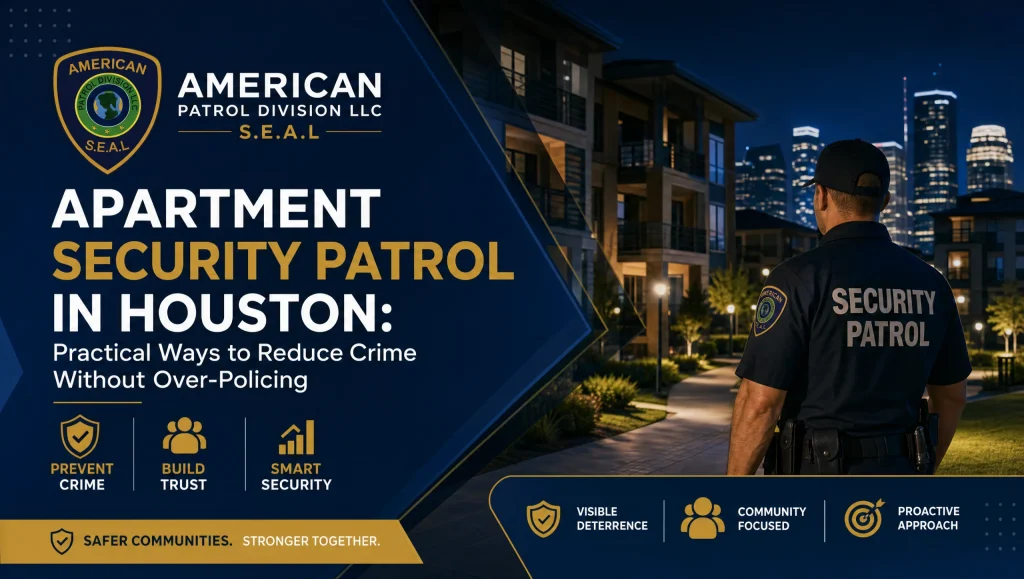
Apartment Security Patrol Houston: Practical Ways to Reduce Crime Without Over‑Policing
Apartment security patrol Houston is about building a resident‑first security program that blends visible patrols, de‑escalation, CCTV monitoring, and gate access control to deter crime and respond quickly—without making your community feel “policed.” In Houston’s fast‑moving multifamily market, the aim is safety that strengthens trust and quality of life.
What a Right‑Sized Apartment Security Patrol Houston Program Looks Like
Visibility without intimidation: uniforms, lighting, and an approachable presence
Choose professional yet approachable uniforms. A clean, clearly marked presence deters trouble without signaling aggression.
Support patrols with strategic lighting and clear sightlines. Many “security” problems are really visibility problems; well‑lit access points and walkways reduce concealment and improve camera performance.
Use calm, courteous greetings. A simple “good evening” from a courtesy officer or patrol signals oversight and accessibility rather than confrontation.
Data‑driven patrol routes and times based on incident patterns
Start with the past 30–90 days of incident reports, tow logs, gate malfunction tickets, and resident notes. Layer in seasonal patterns like holidays, move‑in cycles, and pool season.
Increase patrol frequency where you see repeat activity: side gates, mail rooms, visitor parking, back fences, dumpsters, and unlit corridors.
Adjust patrol times to match reality. Package theft often spikes mid‑afternoon; noise complaints cluster late evening; unauthorized pool access happens after closing. Patrol to the pattern—not the clock.
De‑escalation and interpersonal skills as a first resort
Train for tone, posture, and word choice that calm tense moments: open stance, low voice, nonjudgmental language, and clear explanations of property rules.
Prioritize solution paths: provide options (“Let’s step over here to talk; here’s how we can fix this”), explain consequences, and document respectfully.
Reserve enforcement for policy violations and safety threats. In multifamily settings, most situations resolve through conversation, not commands.
Core Components of a Balanced Patrol Program
Mobile patrols and foot patrols: when to use each
Mobile patrols improve deterrence and coverage, especially in large or spread‑out communities and overnight. They speed response and support perimeter, parking, and gate checks.
Foot patrols enhance approachability and detail‑oriented oversight in stairwells, breezeways, elevators, amenities, and leasing office paths. They’re often better for resident engagement and de‑escalation.
In practice, combine both: vehicles for perimeter sweeps and fast response; foot patrols for interior paths and direct resident visibility.
Courtesy officers for common areas and resident relations
Position courtesy officers during peak times—after work hours, weekends, and amenity rushes. Their role is soft‑touch compliance and a friendly presence.
Focus on community standards: pool capacity and closing times, gym access rules, quiet hours, and guest conduct.
Courtesy officers often make the difference between “enforced” and “supported.” They model neighborly, respectful interactions that reinforce trust.
CCTV monitoring and real‑time response
Use CCTV monitoring for early detection, not just after‑the‑fact review. Tie camera alerts to live dispatch so patrols reach hot spots quickly.
Prioritize cameras at gates, entrances, mail/parcel areas, parking chokepoints, and dumpsters. These are high‑value locations in Houston apartments.
When events occur, coordinate camera views with on‑scene officers to verify details and improve documentation.
Gate access control: credentials, visitors, and vendor workflows
Tighten credentials and visitor entry: keep access lists, codes, and fobs current; disable expired credentials quickly.
Standardize vendor access with clear service windows, temporary codes, and sign‑ins. Many after‑hours incidents begin as “I’m just a contractor.”
Watch for courtesy tailgating. Use brief signage and resident reminders that frame it as a community safety habit—not a punishment.
24/7 live dispatch and incident documentation that builds accountability
Live, Houston‑based dispatch elevates response and context. Dispatchers who know the property can triage better and support officers respectfully.
Expect time‑stamped, GPS‑verified patrol logs with concise notes, photos when appropriate, and clear recommendations. They should be readable, useful, and easy to share with stakeholders.
Practical Steps to Reduce Crime Without Over‑Policing
Start with a property‑specific risk assessment
Walk the site with your patrol provider to identify hotspots, blind corners, broken lighting, camera gaps, and access vulnerabilities.
Review incidents by type, location, and time. Align this with a simple property map.
Document 3–5 top risks and 3–5 quick wins (lighting fixes, landscaping trims, camera re‑aims, gate logic updates).
Set patrol objectives (trespass control, parking, amenities, hotspots)
Define success: fewer package thefts, reduced after‑hours pool usage, less parking misuse, or better visitor control.
Convert goals into tasks: e.g., “Check parcel area at 2:30 p.m. and 6:00 p.m., monitor pool during closing 9–10 p.m., sweep visitor lots on the hour after 8 p.m.”
Use GPS‑verified logs and time‑stamped reporting
Require patrol verification at key checkpoints (gates, parcel rooms, pool gates, and remote lots). This creates proof of presence and visibility into patterns.
Ask for weekly summaries that distill patterns, not just raw logs. Actionable insights are what change outcomes.
Coordinate with management on community standards and house rules
Align enforcement style with your property’s brand. A luxury mid‑rise and a garden‑style community may want different tones and priorities.
Provide officers with your house rules, parking policies, amenity hours, and escalation paths so they can explain—not just enforce—the “why.”
Communicate wins to residents to build trust
Share simple, calm updates: “We adjusted patrols near Building 7; package issues have declined the last two weeks.” Avoid fear‑based messaging—keep it practical and transparent.
Offer a single way to report concerns (QR code, email, or portal). Close the loop when issues are addressed.
For more tips, our CCTV monitoring and gate access guide shows how communication and systems work together: https://www.americanspd.com/?p=3947
Houston‑Specific Considerations for Multifamily Security
Aligning with Texas DPS and Houston‑area property norms
Work with licensed, bonded, and insured providers. American S.E.A.L. Patrol Division is licensed by the Texas DPS Private Security Bureau (License #C28662701).
Train officers on Houston’s multifamily norms: visitor parking enforcement, pool safety ordinances, and courtesy notices typical in area communities.
Build property‑specific post orders that reflect local expectations and your brand voice.
Parking, gates, and package theft in high‑traffic communities
Expect elevated evening parking pressure and mid‑afternoon package activity. Time patrols accordingly.
Keep gate readers, hinges, and closures maintained—hardware issues often lead to propped gates and tailgating.
Use a layered approach: visible patrols, camera coverage of parcel areas, and clear package room rules reduce opportunity without heavy‑handed tactics.
Working smoothly with onsite staff and maintenance teams
Share shift reports with the office team daily. Maintenance benefits from notes on lights out, gate malfunctions, and door hardware.
Create a fast path for work orders tied to security (burned‑out lights, misaligned cameras, broken latches). Small fixes compound into major deterrence.
Coordinate with leasing on move‑in/out days when access and traffic spike.
Avoiding Common Mistakes
Over‑reliance on presence without data
A visible patrol is good; a data‑driven patrol is better. Without incident timing and hotspot mapping, you’ll miss the moments that matter.
Under‑communicating with residents
Silence breeds assumptions. Short, steady updates and approachable officers prevent rumor spirals and increase cooperation.
Inconsistent patrol schedules and documentation
Predictable routines invite workarounds. Vary routes and times within your data‑driven windows, and make sure documentation is consistent and verifiable.
Short Myth vs. Fact: Patrols and a “Policed” Feel
A courtesy officer conducts an evening walk-through and gate check at a Houston apartment community.
Myth: “More visible patrols will make the property feel over‑policed.”
Fact: It’s not the visibility—it’s the approach. Calm, courteous officers paired with de‑escalation training and balanced presence build trust. Residents feel safer when visibility comes with respectful communication and clear community standards.
How American S.E.A.L. Patrol Division Supports Houston Apartments
Armed and unarmed guards with de‑escalation training
Our teams include commissioned armed guards and highly trained unarmed professionals skilled in de‑escalation and interpersonal communication. We align posture with property culture to maintain a resident‑first approach.
Mobile vehicle and foot patrols with GPS‑verified logs
We combine vehicle coverage for speed and perimeter control with foot patrols for common‑area presence. Time‑stamped, GPS‑verified logs confirm coverage and inform weekly adjustments.
CCTV monitoring with real‑time response and gate access support
Our monitoring team provides real‑time oversight, pairs camera intelligence with live dispatch, and supports gate access control so visitor flows are orderly and auditable.
24/7 live dispatch, incident documentation, and fire watch
A live Houston‑area dispatch center coordinates responses and captures details that matter to managers. We also provide fire watch services when systems are offline.
Property‑specific security plans tailored to multifamily needs
Every community is different. We build post orders around your incident patterns, house rules, and brand tone. Over 15 years on patrol and 45+ communities protected have shaped our multifamily playbook, including documented incident reductions in a heavily patrolled Houston zone (per our reports).
A brief note from the field
On a recent Houston site walk, a manager asked us to address after‑hours pool use without upsetting residents who enjoy the space. We shifted one mobile sweep 25 minutes later, added a five‑minute foot patrol pass through the pool corridor, and placed a courtesy officer near the gates during closing on weekends. Within two weeks, staff reported fewer noise complaints and better compliance—no citations needed. In our experience, small, respectful tweaks often drive the biggest wins.
Getting Started: A Simple, Resident‑First Patrol Plan
Free site walk and baseline assessment
We meet onsite, review recent incidents, and walk priority areas together. You’ll get quick wins and a plan for the next 30 days. If you’re ready to begin, you can request a patrol assessment or schedule a site walk here: https://www.americanspd.com/free-quote/
Pilot patrol schedule and reporting cadence
Launch a 30–60 day pilot with defined objectives and a clear reporting format. Include CCTV coordination and gate checks where appropriate.
Share mid‑pilot check‑ins so we can adjust routes and timing to the data.
Review and refine with management input
At the end of the pilot, review results with property leadership. Keep what works, refine what doesn’t, and lock in a resident‑first standard moving forward.
If you want a broader overview of our capabilities before the walkthrough, visit our Houston security services page: https://americanspd.com/
Quick, Practical Checklist You Can Use This Week
Map patrols to recent incidents and hotspots
Mix mobile and foot patrols for coverage and approachability
Assign courtesy officers to common areas during peak times
Coordinate CCTV monitoring with real‑time dispatch
Tighten gate access control and visitor workflows
Use GPS‑verified logs and time‑stamped reporting
Communicate safety updates and wins to residents
When to Consider External Partners
If parts of your program involve resident services, community engagement, or property operations, collaborating with trusted partners can help. For broader multifamily support, you may find value with Apartment Services Group: https://apartmentservicesgroup.com/
For deeper reading on related topics
Mobile patrols and GPS accountability: https://www.americanspd.com/?p=3944
CCTV monitoring and gate control best practices: https://www.americanspd.com/?p=3947
Security guard cost factors in Houston: https://www.americanspd.com/?p=3950
Do you need mobile patrol at your community? https://www.americanspd.com/?p=3951
Why Accountability Matters as Much as Visibility
GPS‑verified logs protect everyone: property owners, management, and residents. They verify coverage and create a learning loop for smarter patrols.
24/7 live dispatch closes the gap between “saw something on camera” and “had an officer on scene.” The faster the handoff, the more likely you’ll deter and de‑escalate rather than just document.
Clear, consistent reporting builds credibility with residents and ownership—especially when paired with respectful communication and quick fixes to environmental issues (lights, gates, landscaping).
Apartment security patrol Houston strategies that keep people safe and respected If you’re seeking apartment security patrol Houston strategies that reduce crime without over‑policing, start with right‑sized visibility, de‑escalation, and data‑driven patrols—then reinforce them with CCTV monitoring, gate access control, and consistent reporting. As a licensed, bonded, and insured provider based in Houston, American S.E.A.L. Patrol Division (Texas DPS License #C28662701) helps multifamily teams implement practical, resident‑first programs tailored to local needs. To talk through your property or schedule a site walk, contact our Houston team: https://www.americanspd.com/contact-us/. If you already know what you need, you can get a free security quote here.
Suggested image alt text: apartment security patrol houston mobile and foot patrols at a multifamily community entrance
Frequently Asked Questions
What does a right-sized apartment security patrol Houston program include?
Short answer: Balanced visibility, de-escalation, data-driven patrols, CCTV monitoring, and gate access control.
Expanded: A resident-first apartment security patrol Houston program blends approachable visibility (uniforms, lighting, calm greetings) with patrols timed to actual incident patterns. It pairs de-escalation as a first resort with CCTV monitoring, gate access control, 24/7 live dispatch, and clear, GPS-verified reporting—so you deter issues without a “policed” feel.
How do mobile patrols and foot patrols work together?
Short answer: Use vehicles for speed and coverage; foot patrols for approachability and detail.
Expanded: Mobile patrols are ideal for perimeter, parking, and fast response—especially overnights or in large sites. Foot patrols add friendly presence in breezeways, stairwells, mail areas, and amenities. Most properties see best results by combining both: vehicle sweeps plus scheduled foot passes through interior paths.
Will more visible patrols make our community feel over-policed?
Short answer: Not if the approach is respectful and de-escalation-led.
Expanded: Visibility builds trust when officers are courteous, well-trained in de-escalation, and aligned with your house rules. Calm greetings, clear explanations, and soft-touch compliance from courtesy officers prevent a “policed” vibe while keeping deterrence strong.
How does CCTV monitoring and gate access control support patrols?
Short answer: Early detection and cleaner access reduce opportunities for problems.
Expanded: Live monitoring turns cameras into an early warning system so dispatch can send patrols quickly. Gate access control keeps credentials current, standardizes vendor entry, and reduces tailgating. Together, cameras at gates, parcel areas, and parking chokepoints plus tight access workflows cut issues before they escalate.
What kind of reporting and accountability should we expect?
Short answer: Time-stamped, GPS-verified logs with useful notes and weekly patterns.
Expanded: Require checkpoint verification at gates, parcel rooms, pools, and remote lots, plus concise notes and photos when appropriate. Weekly summaries should highlight patterns and recommendations—not just raw activity. Learn how GPS logs elevate accountability here: https://www.americanspd.com/?p=3944
How are patrol times tailored to our property’s incident patterns?
Short answer: Use recent incidents and seasonal trends to set routes and timing.
Expanded: Review the last 30–90 days of incident reports, tow logs, resident notes, and maintenance tickets. Map hotspots and time windows (e.g., mid-afternoon package thefts, late-evening noise, after-hours pool use), then schedule patrols to those windows—not the clock. Field note: On a Houston community, shifting one vehicle sweep 25 minutes later and adding a five-minute foot pass near the pool at closing cut noise issues within two weeks—no citations needed.
What’s the difference between armed guards, unarmed guards, and courtesy officers?
Short answer: Armed for higher-risk needs; unarmed for routine deterrence and de-escalation; courtesy officers for resident-facing support.
Expanded: Armed, commissioned officers are appropriate for higher-risk environments or specific threats. Unarmed guards focus on deterrence, observation, and de-escalation. Courtesy officers emphasize a friendly presence in common areas, reinforcing community standards (pool rules, amenity hours, guest conduct) with a soft touch.
How do we get started with a resident-first patrol plan?
Short answer: Schedule a free site walk, launch a 30–60 day pilot, then review and refine.
Expanded: Begin with a property-specific walk to identify quick wins and top risks. Pilot a right-sized schedule (including CCTV coordination and gate checks), set reporting cadence, and hold mid-pilot check-ins. Request a site walk or quote here: https://www.americanspd.com/free-quote/ and see our Houston services overview: https://americanspd.com/
How do patrols coordinate with onsite staff and maintenance?
Short answer: Daily report sharing and a fast path for security-related work orders.
Expanded: Shift reports should flag lights out, gate malfunctions, and camera issues for quick fixes. Coordination with leasing on move-in/out days and with maintenance on access hardware keeps the environment aligned with patrol goals and improves deterrence.
How do you reduce crime without over-policing amenities like pools and gyms?
Short answer: Pair courteous presence with targeted timing and clear rules.
Expanded: Place courtesy officers during peak times, communicate amenity standards, and run short, well-timed patrol passes around closing. This approach encourages voluntary compliance, minimizes confrontations, and keeps spaces welcoming.
Are you licensed and experienced in the Houston multifamily market?
Short answer: Yes—licensed, bonded, insured, and Houston-based with 15+ years on patrol.
Expanded: American S.E.A.L. Patrol Division is licensed by the Texas DPS Private Security Bureau (License #C28662701). We’re Houston-based, with 15+ years on patrol and 45+ communities protected, offering armed/unarmed guards, mobile and foot patrols with GPS-verified logs, CCTV monitoring, live dispatch, and fire watch.
What results are realistic to expect from a balanced patrol program?
Short answer: Better deterrence, faster response, and clearer reporting—without guarantees.
Expanded: Expect improvements in visibility, documentation, and resident confidence as patrols align with your incident patterns. While outcomes vary by property and adherence to fixes (lighting, gates, landscaping), our reports document significant reductions in a heavily patrolled Houston zone. For budget planning, see security cost factors: https://www.americanspd.com/?p=3950