Multifamily Security Houston: A Practical Planning Guide
Moe Shariff · November 14, 2026
Informational — Multifamily Security Houston: A Practical Planning Guide
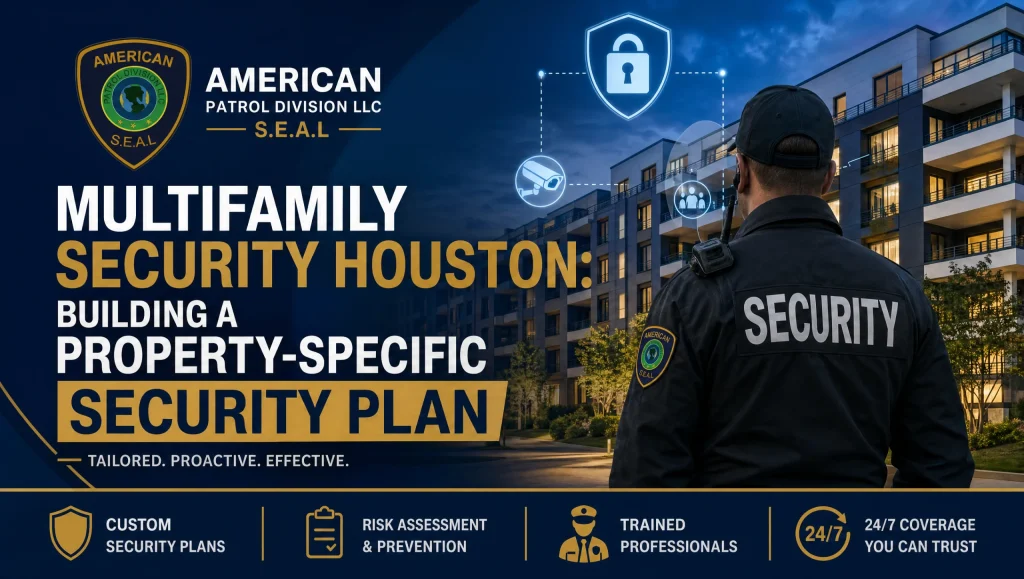
Multifamily Security Houston: Building a Property-Specific Security Plan
Apartment communities in Houston juggle a wide range of security priorities—gate reliability, package room control, late-night access, parking management, and amenity oversight, to name a few. A property-specific plan brings order to those moving parts. Instead of relying on one-size-fits-all measures, you layer defenses based on your layout, resident routines, and incident patterns—so every dollar and hour of effort make a real difference. This guide lays out a clear, step-by-step framework for multifamily security Houston teams can put to work right away, with an emphasis on risk assessment, layered security, and access control that fits real-world Houston communities.
What Is a Property-Specific Apartment Security Plan?
Why “generic” plans fall short in Houston
Houston’s apartment properties vary widely—garden-style communities with multiple vehicle gates, mid-rises with structured parking, and high-rises with concierge-style access. Neighborhood patterns, delivery traffic, visitor flow, and amenity hours all influence risk. Generic plans often miss:
Track master keys and rekey promptly after turnover.
Check door closers, latch guards, and peepholes on common entry doors.
Ensure maintenance uses sign-in/out procedures for unit access.
Technology: CCTV coverage, storage, and real-time monitoring
Ensure overlapping fields of view on building entries, gates, and parking choke points.
Set minimum storage retention appropriate to your incident investigation timeline.
Plan for remote monitoring and clear escalation paths (onsite, patrol, HPD) when alerts trigger.
Human presence: armed vs. unarmed guards, courtesy officers, patrol cadence
Courtesy officers support resident engagement and de-escalation in common areas.
Unarmed guards fit many day-to-day coverage needs and amenity checks.
Armed officers may be appropriate during higher-risk periods or for specific threats.
Match patrol cadence to risk: increase walk-throughs around package rooms during delivery spikes and add vehicle patrols overnight.
Access Control That Works in Houston Communities
Gate access control best practices
Keep your resident database current; remove move-outs within 24 hours.
Assign delivery windows and use one-time or time-bound access codes.
Establish a weekend/holiday access policy for cleaners, maintenance, and leasing tours.
Balancing convenience with security
Create distinct entry protocols for contractors, rideshare, and food delivery.
Post simple, clear callbox instructions; avoid publishing universal codes.
Provide a staffed or monitored line for access issues during higher-risk hours.
Audit trails and alerting
Enable access logs for gates, mail rooms, and garages.
Set alerts for repeated failed entries, doors held open, or off-hours access attempts.
Review exceptions weekly and adjust post orders or schedules as needed.
Patrol Model and Documentation
Mobile vehicle and foot patrols with GPS-verified, time-stamped logs
Use vehicle patrols to cover parking, perimeters, and gates; foot patrols for amenities, stairwells, and building interiors.
Require GPS-verified, time-stamped patrol checkpoints; review coverage for consistency and blind spots.
For a deeper dive into documentation and accountability, see Mobile Security Patrols in Houston: GPS-Verified Coverage Property Managers Can Trust at https://www.americanspd.com/?p=3944.
24/7 live dispatch and incident documentation
Pair patrols with live dispatch so camera or access control alerts route to a human.
Standardize incident reports: time, location, narrative, photos/video references, actions taken, and follow-up tasks.
Maintain a simple dashboard noting incident type, response time, and outcome.
How patrol data informs plan adjustments
If logs show repeated gate malfunctions after 10 p.m., schedule preventive maintenance and shift patrol timing.
If incidents cluster around a certain building, add lighting or adjust camera angles.
Consider this related read on coverage decisions: Houston Apartment Security—Do You Need Mobile Patrol at Your Community? at https://www.americanspd.com/?p=3951.
CCTV Monitoring and Real-Time Response
Camera placement for multifamily layouts
Prioritize approaches to building entries, pedestrian gates, mail/package areas, garages, and dumpsters.
Aim for face-level angles at entries; adjust for nighttime glare and deep shadows.
Cover tailgating risks at vehicle gates with dual-view angles.
Remote monitoring and escalation paths
Define who watches, when, and how they escalate: onsite staff, patrol dispatch, or both.
Create playbooks for common scenarios: suspicious activity observed, verified trespass, active damage, or a medical assist.
When appropriate, coordinate with HPD using clear, factual descriptions and camera evidence.
Integrating CCTV with access control and patrols
Link door-held-open alerts to camera views for quick verification.
Send exception alerts to patrol units; include camera snapshots where possible.
After incidents, tag and archive relevant footage to streamline follow-up.
Staffing the Plan: Armed, Unarmed, and Courtesy Officers
Decision factors
Risk level and incident history: timing, types, and locations of issues
Resident expectations: visibility versus discretion, community culture
Property layout: number of gates, buildings, and blind spots
Budget and coverage goals: 24/7 presence versus targeted higher-risk windows
Post orders tailored to property risks
Define priority patrol points, access control checks, camera hotspots, and report cadence.
Include special instructions for deliveries, contractor oversight, and amenity closures.
Build in variance protocols: what to do if a gate is down, a camera is offline, or a door won’t secure.
Fire watch and special coverage
When systems are impaired or construction impacts life safety, schedule qualified fire watch coverage.
Use short-term staffing spikes around holidays, move-in weekends, or special events.
Resident Communication and Community Standards
In Houston, a security specialist and apartment manager map a community-specific apartment security plan with layered security and access control.
Clear policies, newsletters, and signage
Publish simple access control rules, package pickup steps, and amenity hours.
Use quarterly safety updates to share improvements and reminders.
Reporting channels and feedback loops
Offer a single, easy way to report concerns (phone, portal, or app).
Close the loop by acknowledging reports and sharing outcomes when appropriate.
Building a culture of safety without fear
Encourage “see something, say something” while avoiding alarmist messaging.
Highlight wins: improved lighting, smoother gate access, and a clearer package room process.
Compliance, Coordination, and Vendor Management
Texas DPS licensing awareness and expectations
In Texas, security providers should be licensed, bonded, and insured. American S.E.A.L. Patrol Division holds Texas DPS Private Security Bureau License #C28662701.
Ask for proof of licensing for guard and patrol work; confirm supervision and training standards.
Working with maintenance, gates, and camera vendors
Align post orders with gate vendor maintenance schedules.
Document camera downtime and coordinate timely repairs.
Partner with property management teams and trusted vendors, such as Apartment Services Group at https://apartmentservicesgroup.com/, to keep operations and security aligned.
Incident cooperation with HPD and property management
Share clear, time-stamped reports and relevant footage when appropriate.
Maintain a secure evidence-handling process for video and access logs.
Implement, Measure, Improve
90-day rollout timeline and checkpoints
Days 1–30: Risk assessment, vendor coordination, draft post orders, pilot patrol routes.
Days 31–60: Finalize access control settings, refine camera angles, implement resident communications.
Days 61–90: Validate patrol coverage with GPS-verified logs, review KPIs, and adjust staffing windows.
KPIs to track
Incident types and frequency by location and time of day
Response times to alerts and calls
Access control exceptions (failed entries, doors held open)
Camera uptime and footage retrieval speed
Patrol compliance rates for checkpoints
Quarterly reviews and plan revisions
Meet every quarter to review data, resident feedback, and vendor updates.
Update post orders and patrol cadences; adjust camera coverage and lighting where needed.
Align budget with what’s working; reallocate from low-value measures to proven steps.
Brief Field Note from Houston Patrols
On a west Houston community we patrol, late-night walk-throughs showed a blind corner near the package room where loitering spiked after 10 p.m. We adjusted camera angles, added a timed lighting change, and shifted a foot patrol check-in by 15 minutes. Those small tweaks cut down after-hours activity there and made package pickup feel more orderly for residents.
Myth vs. Fact: Apartment Security Planning
Myth: One good camera system solves most problems. Fact: Cameras are only one layer. Without reliable access control, patrol coverage, and clear post orders, footage becomes evidence after the fact rather than a prevention tool.
Myth: If gates are closed, access control is “done.” Fact: Gate performance, database accuracy, visitor and vendor protocols, and tailgating controls matter just as much as a closed gate.
Myth: Armed guards are always the safest choice. Fact: The right choice depends on risk profile, resident experience goals, and timing. Many properties blend unarmed courtesy coverage with targeted armed response during higher-risk windows. For cost considerations that influence this decision, see Security Guard Cost in Houston: Pricing Factors for Apartments and HOAs at https://www.americanspd.com/?p=3950.
A Simple First-Step Checklist You Can Print Today
Confirm goals and gather your last 6–12 months of incident history.
Conduct a day/night walk-through; mark blind spots and gate issues.
Map layers: perimeter lighting, access control, common areas, buildings, and tech.
Decide staffing mix and patrol cadence; draft property-specific post orders.
Configure CCTV monitoring and escalation paths with live dispatch procedures.
Communicate policies to residents; set up a single reporting channel.
Track KPIs weekly; run a 90-day review and adjust.
Collaborate on risk prioritization and access control settings.
Finalize post orders and patrol routes aligned to your KPIs.
For experienced security services in Houston, visit our Houston security services page at https://americanspd.com/. If you’re ready to talk specifics, you can schedule a site walk via https://www.americanspd.com/contact-us/ or request a free quote tailored to your property at https://www.americanspd.com/free-quote/.
Conclusion
A strong multifamily security Houston plan is always property-specific: assess risk, layer defenses, align access control and patrols, monitor in real time, and document everything you do. When you measure results and refine quarterly, you build a steadier routine for residents and staff—and you spend smarter on what actually works for your community. If you’d like a practical walkthrough for your property in the Houston area, contact us to schedule a site walk or request a free quote, and we’ll help you turn this framework into a clear, working plan for your community. (Alt text example for a hero image: multifamily security Houston access control gate)
Frequently Asked Questions
1) What is a property-specific apartment security plan?
Short answer: It’s a tailored roadmap that aligns your staffing, access control, patrols, and technology with your property’s layout, routines, and incident patterns.
Expanded answer: A property-specific apartment security plan connects risk assessment, layered security, access control, staffing, patrol/monitoring, and documentation to your exact conditions. In Houston, that means accounting for gate norms, delivery surges, open-air footpaths, and neighborhood context so each measure—guards, CCTV, gate access control, and post orders—works together.
2) Why do generic security plans fall short for Houston apartments?
Short answer: Houston communities have diverse layouts, access patterns, and neighborhood dynamics that generic plans ignore.
Expanded answer: Garden-style, mid-rise, and high-rise properties face different gate, parking, and visitor flows. Houston’s late-night rideshare and delivery traffic, contractor access, and open-air paths can bypass simple controls. Without local patterns, live dispatch escalation, and gate access control tuned to your site, “standard” plans leave gaps.
3) How do we start a Houston-focused risk assessment?
Short answer: Map assets and access points, review 6–12 months of incidents, and walk the property by day and night.
Expanded answer: Diagram buildings, garages, gates, footpaths, and amenities. Review calls for service and internal logs, then conduct day/night walk-throughs to test lighting, camera views, and access control. Prioritize risks by likelihood and impact (e.g., unsecured pedestrian gates, dark parking areas, malfunctioning vehicle gates).
4) What does “layered security” look like for multifamily properties?
Short answer: Multiple coordinated layers—perimeter, access control, common areas, residential buildings, technology, and human presence.
Expanded answer: Start with lighting, fencing, and gate performance; add strong access control (credentials, visitor/vendor management, gate access control); secure common areas and buildings; ensure effective CCTV coverage and retention; and match staffing (armed/unarmed, courtesy officers) and patrol cadence to real risk windows, supported by 24/7 live dispatch.
5) Which access control practices work best in Houston communities?
Short answer: Keep resident databases current, use time-bound visitor/vendor credentials, and avoid universal codes.
Expanded answer: Remove move-outs quickly, issue one-time or time-bound codes, and set clear weekend/holiday access rules. Provide clear callbox instructions, distinct protocols for contractors and deliveries, and audit trails for gates, mail rooms, and garages with alerts for repeated failed entries or off-hours attempts.
6) How should we choose between armed guards, unarmed guards, and courtesy officers?
Short answer: Base it on risk level, resident expectations, property layout, and budgeted coverage windows.
Expanded answer: Unarmed and courtesy officers often fit day-to-day coverage and de-escalation; armed officers may be appropriate for specific threats or higher-risk periods. Define post orders around your incident history and blind spots. For cost factors that influence this choice, see Security Guard Cost in Houston: Pricing Factors for Apartments and HOAs at https://www.americanspd.com/?p=3950. Explore our Houston security services at https://americanspd.com/.
7) What role do mobile patrols and GPS-verified logs play?
Short answer: They deliver accountable coverage and actionable data to adjust your plan.
Expanded answer: Vehicle patrols cover parking, perimeters, and gates; foot patrols handle amenities and interiors. Time-stamped, GPS-verified checkpoints confirm coverage and reveal blind spots. Pair patrols with 24/7 live dispatch for faster escalation. For a deeper dive, see Mobile Security Patrols in Houston: GPS-Verified Coverage Property Managers Can Trust at https://www.americanspd.com/?p=3944.
8) How can CCTV monitoring deliver real-time response, not just evidence?
Short answer: Combine smart camera placement with live monitoring and clear escalation playbooks.
Expanded answer: Aim cameras at approaches to entries, pedestrian gates, package areas, garages, and tailgating risks. Use remote monitoring with defined escalation (onsite staff, patrol dispatch, HPD when appropriate). Link alerts (door held open, repeated failed entries) to camera views and route snapshots to patrol units for swift verification and action.
9) What KPIs should we track—and how often should we adjust the plan?
Short answer: Track incident types/frequency, response times, access control exceptions, camera uptime, and patrol compliance; review at 90 days and quarterly.
Expanded answer: Use a 90-day rollout to validate coverage, then hold quarterly reviews to reallocate efforts to what works. Analyze clusters (time, location), adjust patrol timing, lighting, and camera angles, and update post orders as needed to keep the apartment security plan effective.
10) When do we need fire watch coverage?
Short answer: When life safety systems are impaired or construction impacts alarms/sprinklers.
Expanded answer: Schedule qualified fire watch when required by code or property conditions. Document coverage clearly within post orders, and coordinate timelines with maintenance and vendors so temporary measures bridge the gap until systems are restored.
11) Can small adjustments make a noticeable difference?
Short answer: Yes—minor tweaks to cameras, lighting, and patrol timing can reduce after-hours issues.
Expanded answer: On a west Houston community we patrol, late-night loitering near a package room dropped after we slightly adjusted camera angles, added timed lighting, and shifted a foot patrol check-in by 15 minutes. These targeted, low-disruption changes fit the property’s routines and improved resident experience.
12) How can American S.E.A.L. Patrol Division help us implement this plan?
Short answer: We provide site walks, risk reviews, tailored post orders, data-driven patrols, 24/7 dispatch, and documented incident reporting.
Expanded answer: With 15+ years on patrol in Houston and a data-driven model, we align staffing (armed/unarmed, courtesy officers), patrol cadence, CCTV monitoring, and gate access control with your KPIs. Start with a site walk and risk review, then finalize property-specific post orders. Visit https://americanspd.com/, schedule a site walk at https://www.americanspd.com/contact-us/, or request a free quote at https://www.americanspd.com/free-quote/.