Licensed Security Company Houston: Verify DPS & Insurance
Moe Shariff · September 1, 2026
Licensed Security Company Houston: Verify Texas DPS Licensing and Insurance
Licensed Security Company Houston: What to Verify for Texas DPS Licensing and Insurance
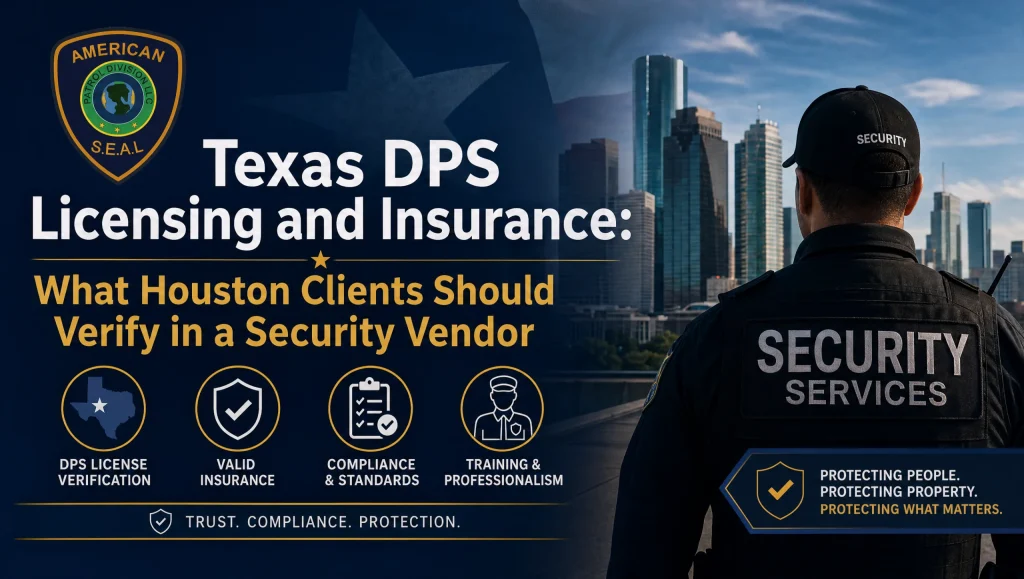
Hiring a licensed security company Houston property managers can trust is as much about compliance as it is about safety. In a city with thousands of multifamily units, HOAs, and mixed-use sites across Houston and Harris County, the biggest risk isn’t only crime—it’s bringing on an unqualified vendor who puts your community on the hook for liability. This guide walks you through a practical, step-by-step compliance checklist to verify Texas DPS Private Security licensing, confirm bonded and insured status the right way, and complete smart vendor due diligence before you sign.
What a Licensed Security Company Houston Really Means
Texas DPS Private Security overview and who must be licensed
In Texas, security companies and their officers are licensed by the Texas Department of Public Safety (DPS) Private Security program. Licensing applies to:
Security companies (the business entity)
Commissioned (armed) security officers
Non-commissioned (unarmed) security officers
Managers and qualified representatives who supervise operations
A truly licensed vendor will maintain:
An active company license with DPS
Active individual licenses for all officers assigned to your site
Proper liability insurance and bonding that match Texas requirements and your contract
Commissioned vs. non-commissioned officers at a glance
Commissioned (armed) officers: Complete enhanced training and qualification, carry firearms on duty, and operate under stricter licensing requirements.
Non-commissioned (unarmed) officers: Focus on observation, reporting, and de-escalation; often ideal for lower-risk posts and courtesy officer roles.
If you’re weighing options, a deeper overview is here: Armed vs Unarmed Security Guards in Houston (https://www.americanspd.com/?p=3949).
Texas DPS maintains a public online portal for Private Security licensing. You can search by company name, license number, or individual officer name. When vetting a vendor:
Search the company by its exact legal name (as it appears on proposals and contracts).
Request license numbers for all officers slated for your property and verify each one.
What to check: active status, expiration, disciplinary actions
Active status: Both company and officer licenses must be active on the day services begin.
Expiration date: Confirm no licenses will lapse during your contract term; set a process to re-verify at each renewal.
Disciplinary actions: If any appear, ask for written context and corrective measures.
Red flags: name mismatches, lapsed licenses, no company listing
The company name on the contract doesn’t match DPS records (even small spelling differences matter).
Expired or “pending” licenses for the company or assigned officers.
No listing in the DPS portal at all (this could mean an unlicensed operator or a DBA mismatch—both require careful review).
Bonded and Insured: What Houston Clients Should Require
General liability, workers’ comp, auto liability—what to request
At minimum, obtain Certificates of Insurance (COIs) for:
Commercial General Liability (CGL): Covers bodily injury and property damage claims.
Workers’ Compensation: Protects you if an officer is injured while working on your property (or verify a valid alternative if permitted).
Auto Liability: Essential if the vendor operates vehicles onsite (e.g., patrols or gate access response).
Note: Appropriate limits vary by property type and risk profile. If you’re budgeting coverage alongside service costs, here’s a useful primer on Security Guard Cost in Houston (https://www.americanspd.com/?p=3950).
Additional insured, primary & non-contributory, and waiver of subrogation—why they matter
Additional Insured (AI): Extends the vendor’s liability coverage to your property/ownership entities for claims arising from their work.
Primary & Non-Contributory: Makes the vendor’s policy respond first, without requiring your policy to contribute.
Waiver of Subrogation: Prevents the insurer from seeking recovery from you for covered losses.
How to read a Certificate of Insurance (COI) and verify with the carrier
Confirm your property’s legal entities are correctly listed as certificate holders and additional insureds (ask for endorsement forms, not just the COI).
Match effective and expiration dates to your contract term.
Verify endorsements: Request copies of AI, primary & non-contributory, and waiver of subrogation endorsements. Don’t rely on a checkbox on the COI.
Call the broker or carrier shown on the COI to confirm active status and endorsements. COIs can be outdated; direct verification reduces risk.
Myth vs. Fact: Compliance Edition
Myth: “The COI says ‘additional insured’—we’re covered.” Fact: The COI is informational. Your protection comes from the actual endorsement forms attached to the policy.
Myth: “They showed one active officer license—that’s enough.” Fact: Every officer assigned to your site must have an active license you can verify.
Myth: “If they’re bonded and insured, training doesn’t matter.” Fact: Insurance transfers financial risk; training, supervision, and documentation help prevent incidents in the first place.
A Practical Compliance Checklist (Copy-and-Use)
Licensing documentation (company + officer)
DPS verification: Company’s active license status (screenshot or reference)
DPS verification: Each officer’s active license status and expiration
Names match across DPS, proposal, contract, and W-9
COIs, endorsement pages, and limits
COIs for CGL, workers’ comp, and auto liability with effective dates
Additional insured, primary & non-contributory, and waiver of subrogation endorsements (actual forms)
Confirmation call to broker or carrier for policy and endorsement validity
Incident reporting, dispatch availability, and patrol logs
Sample incident report format with response and escalation fields
24/7 live dispatch phone number and documentation standards
Patrol verification method (GPS/time-stamped logs), report access, and retention periods
If you require vehicle patrols, ask about GPS-verified mobile security patrols in Houston (https://www.americanspd.com/?p=3944)
Indemnification clause aligned with your risk strategy
Termination for cause and without-cause notice rights
Defined scope (post hours, patrol frequency, camera monitoring, gate access)
Supervision structure (site checks, field supervisors, escalation hierarchy)
Site-specific plan, post orders, and escalation paths
Written site plan with zones, hotspots, and after-hours expectations
Post orders that address visitor management, amenities/common areas, and courtesy officer duties
Clear escalation path for emergencies and coordination with law enforcement
Vendor Due Diligence Questions to Ask
Before hiring a vendor, Houston properties should verify Texas DPS licensing, proof of being bonded and insured, and a clear compliance checklist. American S.E.A.L. Patrol Division — Texas DPS License #C28662701.
Supervision and training (de-escalation, reporting)
What de-escalation and report-writing training do officers receive?
How are field supervisors scheduled, and how often do they audit posts?
How are performance issues documented and corrected?
Patrol verification (GPS, time-stamped logs)
What GPS system is used? Can we receive time-stamped, GPS-verified logs?
How are missed checkpoints handled and reported to management?
24/7 live dispatch and documentation standards
Is dispatch staffed by live personnel at all times?
What is the standard for incident documentation and client notifications?
How quickly are incident reports delivered to property management?
Data security and camera access controls for CCTV
Who can access live and recorded video?
How is evidence preserved, logged, and shared with law enforcement?
Are administrator roles and password policies defined?
Common Houston-Specific Considerations
Multifamily communities, courtesy officers, and gate access control
Clarify roles for courtesy officers in common areas (pool, fitness, clubhouse), visitor parking, and quiet-hours enforcement.
Define gate access control protocols: officer access levels, vendor lists, visitor verification, and after-hours entry procedures.
Fire watch needs and local coordination
If a system impairment triggers fire watch, define patrol frequency, reporting templates, and coordination with the fire authority having jurisdiction.
For a deeper dive on compliance, see Fire Watch Services in Houston (https://www.americanspd.com/?p=3952).
Working with HOAs and property managers in Harris County
HOA boards should document due diligence steps in meeting minutes.
Property managers can centralize compliance files (DPS checks, COIs, endorsements, incident reports) for easy audits and renewals.
How American S.E.A.L. Patrol Division Meets These Standards
American S.E.A.L. Patrol Division is licensed, bonded, and insured. Our Texas DPS Private Security Bureau License is #C28662701. For Houston properties, we align services with compliance best practices:
Officer options: Armed and unarmed guards, including courtesy officers for common areas
Patrol accountability: Mobile vehicle and foot patrols with time-stamped, GPS-verified logs
Operations backbone: 24/7 live dispatch staffed by real people, with incident documentation
Technology support: CCTV monitoring with real-time response and gate access control
Readiness: Fire watch services and property-specific security plans tailored to your risks
Proof points:
15+ years on patrol in Greater Houston
45+ communities protected
Per our reports, we’ve documented 60%+ reductions in incidents in a heavily patrolled Houston zone, tied to data-driven patrol scheduling and supervision
From the field: what onboarding looks like
When we onboard a new apartment community in Houston, we start with a walk-through alongside management to map hotspots like mail centers, parking corridors, and gate pinch points. We review your lease rules, amenity hours, and tow policy, then draft post orders that fit your daily rhythms—package rushes, trash valet windows, pool season, and shift overlaps. Before the first shift, supervisors confirm DPS license checks, COIs, endorsements, and radio/camera access. During week one, we fine-tune patrol checkpoints and report templates so what hits your inbox is useful, not noise.
What to Do Next
Collect documents, run the checklist, compare vendors
Gather: Company and officer DPS license details, COIs with endorsements, sample incident report, patrol verification specs, dispatch contacts, and proposed post orders.
Run the compliance checklist in this article and note any gaps.
Compare service proposals only after compliance is clear. Credible vendors welcome verification—it protects everyone.
Where to get help or a compliant quote in Houston
Browse our Houston security services (https://americanspd.com/) to see how we support multifamily, HOAs, and mixed-use sites.
If you want a side-by-side, compliance-ready proposal, you can request a free quote (https://www.americanspd.com/free-quote/).
Prefer to talk it through first? contact us (https://www.americanspd.com/contact-us/) to speak with a security specialist about your site and documentation needs.
Featured quick reference: definition and steps
A licensed security company Houston property managers can trust is a vendor registered with the Texas DPS Private Security program, holding active company and officer licenses, and maintaining proper bonded and insured coverage with verifiable certificates and endorsements.
Steps to verify:
Look up the company and officers in the Texas DPS Private Security database.
Confirm active status, expiration dates, and any disciplinary actions.
Request Certificates of Insurance for CGL, auto, and workers’ comp.
Verify additional insured, primary & non-contributory, and waiver of subrogation endorsements.
Ask for sample incident reports, GPS/time-stamped patrol logs, and 24/7 dispatch details.
Review contract terms: scope, supervision, indemnity, and termination.
Conclusion
Choosing a licensed security company Houston buyers can verify lowers liability and sets clear expectations for performance. Start with Texas DPS Private Security checks, validate bonded and insured status with real endorsements, and insist on patrol verification, 24/7 live dispatch, and disciplined reporting. If you’d like a straightforward path to a compliant proposal tailored to your property, explore our quality Houston security services (https://americanspd.com/), contact us (https://www.americanspd.com/contact-us/), or request a free quote (https://www.americanspd.com/free-quote/) for a side-by-side, compliance-ready comparison.
[Image alt: licensed security company Houston conducting GPS-verified patrol at a Houston multifamily gate]
Frequently Asked Questions
Q1: What does a licensed security company Houston mean under Texas DPS rules?
Short answer: It means the company and its officers hold active licenses with the Texas DPS Private Security program and carry proper insurance and bonding.
Expanded answer: In Texas, a licensed security company Houston properties can trust is registered with the Texas Department of Public Safety (DPS) Private Security program. The business, its managers, and every officer (armed and unarmed) assigned to your site must hold active licenses. The vendor should also be bonded and insured with verifiable Certificates of Insurance (COIs) and required endorsements.
Q2: How can I verify a company’s Texas DPS Private Security license?
Short answer: Use the DPS Private Security online portal to search the company’s legal name and request officer license numbers to check individually.
Expanded answer: Go to the DPS Private Security public lookup and search by the company’s exact legal name as it appears on proposals and contracts. Ask your vendor for the license numbers of all officers scheduled for your property and verify each one. Confirm active status and expiration dates, and note any disciplinary actions for follow-up.
Q3: Do all onsite security officers need active DPS licenses?
Short answer: Yes—every commissioned (armed) and non-commissioned (unarmed) officer must be active on the day they work.
Expanded answer: Licensing is individual as well as corporate. One active officer license is not enough; each officer who will work your site must have an active DPS license you can verify. Set a re-verification cadence before renewals and whenever staffing changes.
Q4: What insurance and endorsements should I require from a security vendor?
Short answer: COIs for General Liability, Workers’ Comp, and Auto Liability, plus Additional Insured, Primary & Non-Contributory, and Waiver of Subrogation endorsements.
Expanded answer: Request current COIs that cover CGL, workers’ compensation (or a valid alternative where permitted), and auto liability if vehicles are used. Ask for actual endorsement forms naming your entities as Additional Insured, designating Primary & Non-Contributory status, and including a Waiver of Subrogation. Match policy and endorsement effective dates to your contract.
Q5: How do I confirm a COI and endorsements are real and current?
Short answer: Get the endorsement forms and call the broker or carrier listed on the COI to verify.
Expanded answer: Treat COIs as informational. Ask for the endorsement pages themselves (AI, P&N, Waiver). Confirm legal names, addresses, and dates, then call the issuing broker or carrier to verify the policy and endorsements are active and match your contract scope. Re-request updated documents at renewal.
Q6: What are red flags of a noncompliant or risky security vendor?
Short answer: Name mismatches, lapsed or pending licenses, no DPS listing, and vague or missing insurance endorsements.
Expanded answer: If the company’s legal name doesn’t match DPS or COI records, or if you find expired/pending licenses for the company or assigned officers, pause immediately. Lack of a DPS listing, reluctance to share endorsement forms, or relying on COI checkboxes alone are signals to dig deeper before signing.
Q7: What belongs on my compliance checklist before I sign a contract?
Short answer: DPS license verifications, COIs with endorsements, patrol verification method, dispatch details, incident reporting samples, and clear contract terms.
Expanded answer: Verify company/officer DPS status and names, collect COIs and endorsement pages, and confirm limits and dates. Ask for sample incident reports, 24/7 live dispatch contacts, and how patrols are verified (GPS/time-stamped logs). Review contract indemnity, termination rights, post orders, supervision structure, and escalation paths. For GPS-verified patrol expectations, see Mobile Security Patrols in Houston: https://www.americanspd.com/?p=3944.
Q8: How do patrol verification and 24/7 dispatch factor into compliance?
Short answer: They demonstrate accountability and support timely, documented response.
Expanded answer: GPS-verified vehicle/foot patrol logs and time stamps show where and when officers were onsite, which helps during audits and incident reviews. A 24/7 live dispatch staffed by real people ensures urgent calls are answered, incidents are documented, and property managers get prompt reports with clear escalation steps.
Q9: What Houston-specific issues should apartments and HOAs include (courtesy officers, gates)?
Short answer: Define courtesy officer duties in common areas and set gate access control protocols and after-hours procedures.
Expanded answer: In Houston multifamily and HOAs, clarify quiet-hours enforcement, amenity rules, visitor parking, and vendor access. For gates, document officer access levels, visitor verification, vendor lists, and after-hours entry steps. Make sure these are reflected in post orders and supported by incident reporting standards.
Q10: How often should I re-verify licenses and insurance?
Short answer: At contract start, before each renewal, and anytime staffing or coverage changes.
Expanded answer: Build re-verification into your vendor management routine: confirm company/officer DPS status quarterly or prior to renewals, and request updated COIs and endorsements at every policy renewal. Re-check licenses whenever the roster at your site changes.
Q11: How does American S.E.A.L. Patrol Division meet these standards?
Short answer: We are licensed, bonded, and insured; Texas DPS Private Security Bureau License #C28662701, with GPS-verified patrols, 24/7 live dispatch, CCTV support, and property-specific plans.
Expanded answer: Based in Houston, we offer armed and unarmed officers (including courtesy roles), mobile and foot patrols with time-stamped, GPS-verified logs, real-person 24/7 dispatch and incident documentation, CCTV monitoring with gate access control, and fire watch services. For service details, visit our Houston Security Services page (https://americanspd.com/), request a free quote (https://www.americanspd.com/free-quote/), or contact us (https://www.americanspd.com/contact-us/). From the field (practical note): During a recent Houston apartment onboarding, our team walked the site with management to map hotspots like mail rooms and parking corridors. We synced post orders to amenity hours and tow policies, confirmed DPS checks and COIs before the first shift, and tuned GPS patrol checkpoints in week one so reports were useful to the onsite team.