Armed vs Unarmed Security Guards Houston: How to Choose
Moe Shariff · July 24, 2026
Armed vs Unarmed Security Guards Houston: How to Choose for Your Property
Armed vs unarmed security guards Houston refers to selecting between commissioned officers who carry firearms and unarmed guards who focus on prevention, observation, and de-escalation—guided by your property’s risk, budget, and the resident or customer experience you want to create.
For Houston property managers, the choice between armed and unarmed coverage affects everything you balance each day: risk exposure, operating costs, resident expectations, and liability. There isn’t a universal answer. A Midtown mixed-use site with late-night tenants faces different pressures than a garden-style community in Westchase or a retail strip off I-10. This guide offers a clear, local framework to compare your options, build a property-specific plan, and combine guard staffing with mobile patrols, CCTV monitoring, and 24/7 dispatch. The goal is measurable coverage without overspending.
Key differences at a glance
Risk level addressed: Higher-risk sites often call for armed commissioned officers; routine deterrence typically fits unarmed guards.
Duties: Armed—deterrence and rapid response; Unarmed—patrols, access control, and customer service.
Complementary tools: Both models improve with mobile patrols, CCTV monitoring, and 24/7 live dispatch.
Cost/liability: Armed coverage generally carries higher cost and stricter policies.
Quick answers
When to choose armed: Elevated crime exposure, late-night operations, prior serious incidents, or cash/high-value assets on site.
When to choose unarmed: Community-focused apartments, lobbies and amenities, daytime retail, and properties that prioritize service.
Best practice: Pair guard staffing with GPS-verified patrols, incident documentation, and CCTV with real-time response to right-size coverage.
Armed vs Unarmed Security Guards Houston: What’s the Difference?
Roles and Training: Commissioned Officers vs. Unarmed Guards
Commissioned officers (armed): Licensed to carry a firearm and trained in use-of-force policies, Texas legal compliance, defensive tactics, and emergency response. They’re positioned for higher-risk environments where a strong deterrent and the ability to intervene quickly are required.
Unarmed guards: Emphasize prevention through visibility, observation, interpersonal communication, and de-escalation. Common duties include access control, routine foot patrols, amenity checks, and resident or customer support.
Typical Duties in Houston: Apartments, Retail, and Commercial Sites
Apartments/multifamily: Access control, amenity monitoring, parking and gate oversight, patrols of breezeways and lots, and coordination with management after-hours. apartment security best practices
Retail/mixed-use: High-visibility presence in storefronts and common areas, closing walkthroughs, addressing loitering, and vendor/contractor access control.
Commercial/industrial: Perimeter checks, key control, dock and gatehouse procedures, and alarm/camera response.
Resident Experience and Public Perception
Armed coverage signals strong deterrence, which can reassure residents and staff—especially after serious incidents—but may feel intense in family-focused communities.
Unarmed coverage is approachable and service-forward, fitting properties where day-to-day interactions and a calm community feel are priorities.
The right fit balances the tone you want to set: firm deterrence where risks demand it, or steady customer service when prevention and rapport are the goals.
When to Choose Armed Security in Houston
Higher-Risk Scenarios and After-Hours Concerns
A history of serious incidents, repeated vehicle break-ins or burglaries, or patterns of late-night trespass.
On-site cash handling or high-value inventory.
Locations with heavy nightlife foot traffic, isolated or multi-level parking structures, or limited lighting.
Temporary spikes in risk: unit make-readies with high-value tools, extended vacancies, or storm-related power outages.
Commissioned Officers with Clear Deterrence Needs
Armed commissioned officers provide a visible, authoritative presence. Their training supports strict policy adherence, coordinated response, and defined escalation protocols when needed.
Consider armed coverage during peak risk windows—overnights, weekends, or specific events—rather than 24/7 if that better matches your budget and exposure.
Integrating Armed Guards with Mobile Patrols and CCTV Monitoring
Combine a posted armed officer with scheduled mobile patrol sweeps and live CCTV monitoring to extend coverage efficiently.
Use camera alerts and gate access logs to direct the officer to hotspots in real time.
24/7 live dispatch helps prioritize responses, document incidents, and coordinate with law enforcement as appropriate.
When to Choose Unarmed Security in Houston
De-escalation, Customer Service, and Courtesy Officers
Unarmed guards excel at relationship-building and early intervention—answering questions, guiding guests, and resolving minor conflicts before they escalate.
Courtesy officers in common areas reinforce house rules, uphold amenity hours, and keep shared spaces welcoming.
Lobby, Amenities, and Gatehouse Coverage for Apartments
Lobby and clubhouse coverage during leasing hours and early evenings.
Pool and fitness center checks to maintain posted rules.
Gatehouse oversight for visitor management and contractor access.
Parking and noise issues addressed with a calm, consistent presence.
Pairing Unarmed Guards with Gate Access Control and Dispatch
Gate access control plus unarmed guards adds structure without feeling heavy-handed.
With 24/7 live dispatch, unarmed guards receive quick guidance, log events, and escalate when needed.
CCTV monitoring backs them up by watching secondary areas—back lots, package rooms—and triggering targeted patrols.
Cost, Coverage, and Liability Considerations
Budget and Scheduling: Post Coverage vs. Patrols
Fixed posts: Continuous presence at a lobby, gatehouse, dock, or main entrance; ideal for visibility and controlled access.
Mobile patrols: Scheduled vehicle or foot sweeps across multiple buildings or sites; cost-effective for larger footprints or dispersed assets.
Hybrid approach: A smaller fixed-post window plus patrols during riskier hours can balance coverage and cost.
Insurance, Policies, and Site Rules
Armed coverage typically involves stricter policies, detailed post orders, and closer oversight to manage liability.
Regardless of guard type, align site rules for trespass warnings, amenity closures, noise issues, and parking enforcement.
Clear, property-specific post orders protect residents, staff, vendors, and the guard team.
Incident Documentation, GPS-Verified Patrols, and Reporting
Expect time-stamped, GPS-verified patrol logs to confirm coverage and help refine your plan.
Incident reports should be prompt, factual, and aligned with site rules and camera footage when available.
Documentation supports accountability, helps with insurance needs, and reveals patterns that guide targeted deterrence.
Building a Property-Specific Security Plan
Risk Assessment: Crime Patterns, Access Points, and Activity Peaks
Review nearby crime patterns and police calls.
Identify blind spots: rear entries, package/mail areas, long breezeways, and dim parking sections.
Track activity peaks: weekend nights, shift changes, school holidays, pool season, or delivery surges.
Good/Better/Best Packages for Apartments and Multifamily
Good: Unarmed guard + CCTV monitoring + live dispatch
– Best when you need steady visibility, rule enforcement, and camera-backed coverage without overstaffing.
Better: Unarmed guard + mobile patrols + gate access control
– Adds roving deterrence and structured visitor management; ideal for larger footprints with multiple entries.
Best: Armed commissioned officer + mobile patrols + CCTV with real-time response
– Suited for elevated risk or post-incident stabilization; places a trained deterrent on site and directs resources using live camera intelligence.
Measuring Impact: Incident Logs and Resident Feedback
Use monthly summaries of patrol logs, incidents, and camera-triggered responses to adjust staffing.
Track resident and staff feedback—perception improves when visibility is consistent and communication is clear.
If repeat issues persist in a hotspot, adjust patrol timing, lighting, camera angles, or post orders accordingly.
How American S.E.A.L. Patrol Division Supports Houston Properties
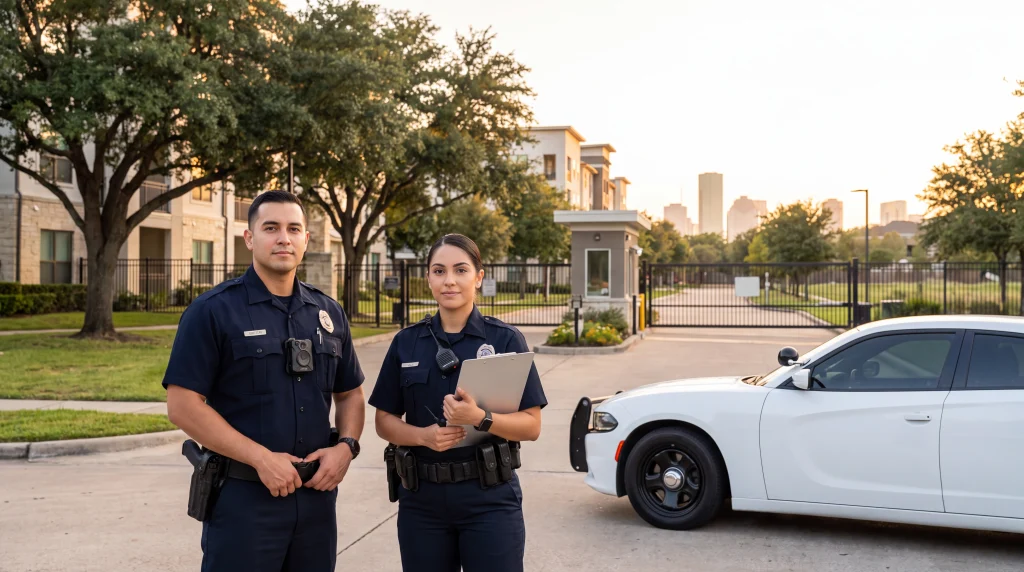
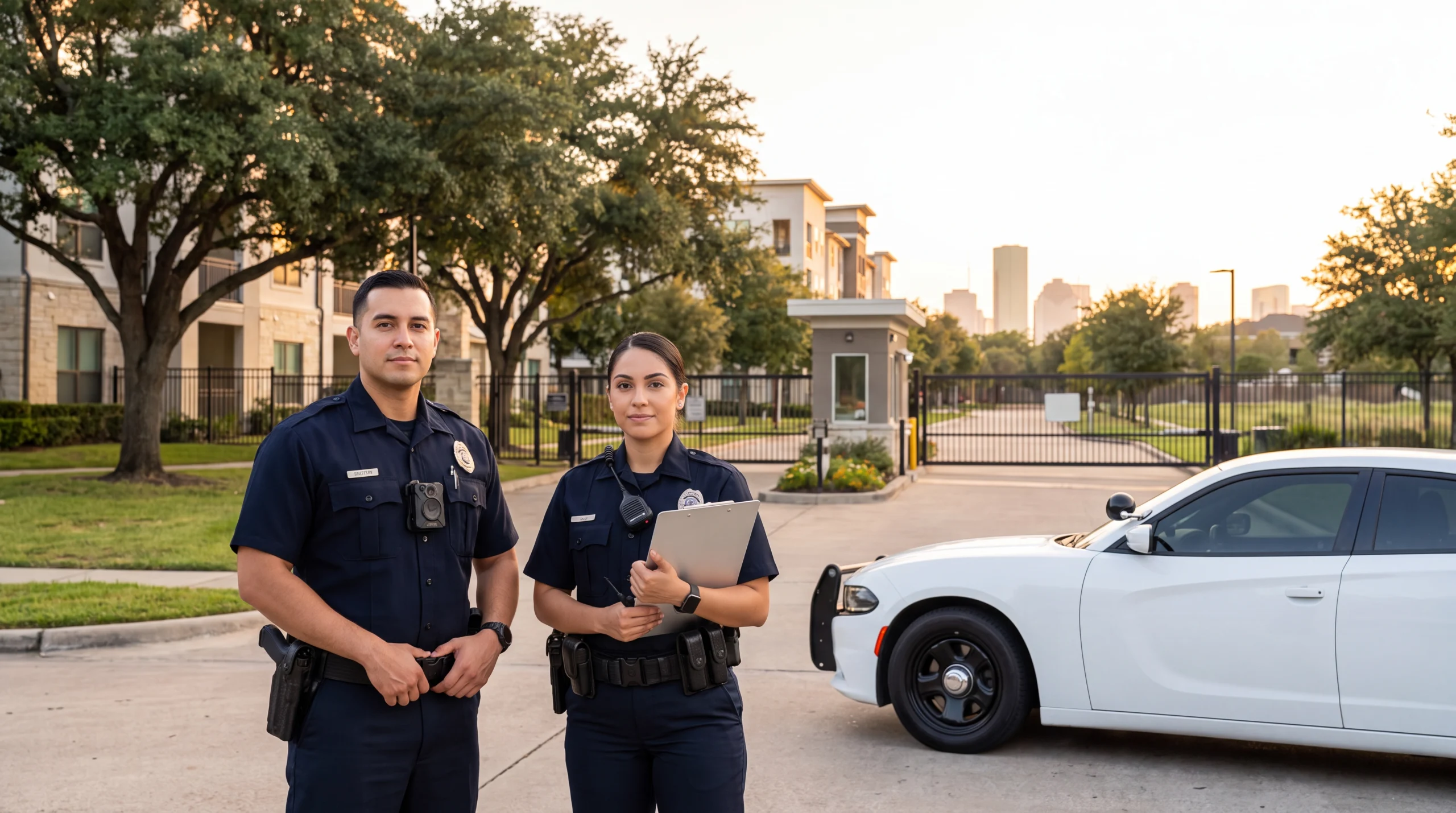
Commissioned officer and unarmed guard work together at a Houston multifamily property—an example of matching guard type to risk, budget, and resident experience.
Proactive, Data-Driven Patrol Model for Apartments and Multifamily
We specialize in proactive security for Houston apartment and multifamily communities using a data-driven patrol model that zeroes in on hotspots and peak hours.
Services include armed and unarmed guards, courtesy officers for common areas, and both mobile vehicle and foot patrols supported by GPS-verified logs.
24/7 Live Dispatch, Time-Stamped GPS Logs, and Incident Documentation
Our 24/7 live dispatch keeps eyes and ears on your property, coordinates guard response, and documents incidents in real time.
You receive time-stamped, GPS-verified patrol logs and clear incident reports to maintain accountability and guide improvements over time.
Licensed, Bonded, and Insured (Texas DPS PSB #C28662701)
American S.E.A.L. Patrol Division is licensed, bonded, and insured. Texas DPS Private Security Bureau License #C28662701.
Based in Houston, we understand how conditions vary by neighborhood and property type across Harris County.
Myth vs. Fact: Choosing Guard Types
Myth: Armed guards are always better.
– Fact: Armed coverage is right for specific risks; many properties see strong results from unarmed guards paired with patrols and CCTV.
Myth: Unarmed guards can’t deter crime.
– Fact: Visible presence, consistent patrols, and quick reporting can change behavior patterns—especially when backed by cameras and gate control.
Myth: One guard type fits all hours.
– Fact: Risk changes by time and place. Many managers mix unarmed coverage by day with armed or enhanced patrols overnight.
Real-World Perspective from the Patrol
On recent overnight patrols at several West Houston communities, our team saw how a steady, visible presence and quick radio check-ins with 24/7 dispatch helped settle weekend foot traffic. In those settings, unarmed guards handled access questions and amenity closures smoothly, while a nearby commissioned officer covered exterior patrols where vehicle break-ins had been reported earlier in the season.
Quick Decision Checklist
Match Risk, Visibility, and Budget to Guard Type
Elevated risk, valuables, or late-night incidents: consider an armed commissioned officer.
Community-forward, service-focused coverage: start with unarmed guards or courtesy officers.
Not sure? Begin with unarmed coverage and targeted patrols; escalate during higher-risk windows as needed.
Confirm Coverage: Posts, Patrols, and Monitoring
Choose your fixed posts: lobby, gatehouse, clubhouse, or dock.
Layer mobile patrols where line-of-sight is limited or your footprint is large.
Add CCTV monitoring and gate access control to expand reach and coordinate faster response.
Align Policies, Resident Expectations, and Reporting
Set post orders that match your rules and local conditions.
Establish how incidents are reported and who is notified.
Review GPS-verified patrol logs monthly and shift coverage to hotspots.
Scenarios to Guide Your Choice in Houston
Garden-style apartments near a busy corridor:
– Start with unarmed guards for evening amenities and parking checks, plus mobile patrols on weekends. Add armed coverage temporarily if trends escalate.
Mixed-use property with nightlife tenants:
– Armed officer during peak late-night hours; unarmed lobby coverage earlier in the evening; CCTV watching parking structures with real-time dispatch direction.
Daytime retail with frequent vendors:
– Unarmed guard for customer service, contractor verification, and opening/closing routines. Use patrols and cameras to watch rear access lanes.
Large multifamily with multiple gates:
– Unarmed courtesy officer at the gatehouse, mobile patrols at shift changes, and camera-backed gate access control to reduce tailgating.
How to Integrate Tools for Better Outcomes
Mobile patrols with GPS logs: Validate coverage, reveal trends, and focus attention where it matters.
CCTV with real-time response: Directs guards efficiently, reduces blind spots, and creates documentation.
24/7 dispatch and incident documentation: Keeps communication tight, supports escalation protocols, and maintains a record for property managers and insurers.
A Note on Results and Expectations
Every property and neighborhood is different. While our team has reported documented incident reductions of 60%+ in a heavily patrolled Houston zone per our internal reports, the best outcomes come from a fresh risk assessment rather than broad assumptions. Start with visibility and documentation, then tune staffing and tools to your property’s true activity patterns.
Images to Support This Guide
Houston apartment gatehouse with guard (alt: armed vs unarmed security guards Houston at apartment entry)
Patrol vehicle on Houston property (alt: Houston security guards mobile patrol with GPS logs)
CCTV monitoring station (alt: apartment security CCTV monitoring with live dispatch)
How to Get Started
Explore our Houston security services to see how guard staffing, patrols, and monitoring work together: https://americanspd.com/
If you’re weighing armed vs unarmed coverage right now, request a free security quote so we can map options to your risk, layout, and budget: https://www.americanspd.com/free-quote/
Have questions about post orders, documentation, or gate access control? Contact our Houston security team to talk with a security specialist: https://www.americanspd.com/contact-us/
Conclusion: Choosing Armed vs Unarmed Security Guards Houston
Ultimately, choosing between armed vs unarmed security guards Houston comes down to your risk profile, the experience you want residents and customers to have, and how you layer coverage with patrols, CCTV, and 24/7 dispatch. Use the scenarios and checklist above to match guard type, schedule, and tools to your property. For a plan built around your site’s real conditions, explore our Houston security services at https://americanspd.com/, contact our Houston security team at https://www.americanspd.com/contact-us/, or request a free security quote at https://www.americanspd.com/free-quote/. American S.E.A.L. Patrol Division is licensed, bonded, and insured in Texas (DPS PSB #C28662701) and supports properties across Houston and Harris County with data-driven patrols, time-stamped GPS logs, and clear incident documentation.
Frequently Asked Questions
Armed vs unarmed security guards Houston: which should I choose?
Short answer: Match the guard type to your property’s risk, resident experience goals, and budget—then layer patrols, CCTV, and 24/7 dispatch.
Expanded: In Houston, armed commissioned officers fit higher-risk windows or locations with serious incidents or high-value assets. Unarmed guards fit community-forward spaces that prioritize visibility, service, and de-escalation. Most properties see the best value by combining guard staffing with GPS-verified mobile patrols, camera monitoring, and live dispatch to direct attention to hotspots.
What’s the core difference between armed and unarmed guards?
Short answer: Armed guards carry firearms and handle higher-risk deterrence; unarmed guards focus on prevention, observation, and de-escalation.
Expanded: Armed commissioned officers are licensed to carry firearms and trained in use-of-force, Texas legal compliance, and coordinated response. Unarmed guards emphasize visibility, access control, amenity checks, and customer service. Both can deter issues; choose based on risk level, property type, and the tone you want to set.
When should I choose armed commissioned officers in Houston?
Short answer: Use armed coverage for elevated crime exposure, late-night operations, prior serious incidents, or on-site cash/high-value assets.
Expanded: Consider armed officers during peak-risk windows—overnights, weekends, or special events—especially near nightlife, isolated parking structures, or areas with repeated break-ins. Armed presence provides strong deterrence and a defined escalation path. You don’t have to staff armed 24/7; match schedules to risk.
When is unarmed security a better fit?
Short answer: Choose unarmed guards for community-focused apartments, lobbies, amenities, daytime retail, and service-forward coverage.
Expanded: Unarmed officers excel at approachable interactions, early intervention, and consistent rule enforcement. They manage access control, amenity checks, parking and noise concerns, and guest guidance. Paired with gate access control, CCTV, and live dispatch, unarmed coverage can deliver steady deterrence without feeling heavy-handed.
Can I mix armed and unarmed coverage or change by time of day?
Short answer: Yes—many Houston properties mix coverage based on risk windows and locations.
Expanded: You might staff an unarmed lobby post in the evening, add an armed officer overnight for exterior patrols, and use mobile sweeps to cover larger footprints. Risk shifts by hour and area; a hybrid plan aligns guard type and schedule with your property’s actual activity patterns.
How do mobile patrols, CCTV monitoring, and 24/7 dispatch fit in?
Short answer: They extend reach, direct guards efficiently, and document what happens.
Expanded: GPS-verified mobile patrols validate coverage and reveal trends. Live CCTV monitoring and gate access control reduce blind spots and trigger targeted responses. A 24/7 real-person dispatch helps prioritize issues, coordinate guards, and produce timely incident documentation—often improving results without overspending.
What are the cost and liability differences?
Short answer: Armed coverage generally costs more and requires stricter policies; unarmed offers strong prevention with a lighter footprint.
Expanded: Commissioned armed officers involve tighter post orders and oversight to manage liability. Unarmed coverage focuses on visibility and service, often at a lower cost. Either way, align site rules, trespass warnings, amenity hours, and reporting standards to your property’s needs and insurance requirements.
What documentation should I expect from a professional Houston security program?
Short answer: Time-stamped, GPS-verified patrol logs and prompt, factual incident reports.
Expanded: Expect coverage verified by GPS, clear incident documentation aligned with site rules and camera footage when available, and monthly summaries to guide adjustments. This accountability supports insurers, informs staffing changes, and helps target recurring hotspots.
Do you serve Houston apartments and multifamily specifically?
Short answer: Yes—we specialize in proactive, data-driven security for Houston apartments and multifamily communities.
Expanded: American S.E.A.L. Patrol Division supports apartments and multifamily across Houston and Harris County with armed and unarmed guards, courtesy officers, and mobile patrols—backed by 24/7 dispatch, GPS-verified logs, and incident documentation. The team brings 15+ years on patrol and experience protecting 45+ communities.
What does this look like on a typical Houston night?
Short answer: Visible presence, steady check-ins, and quick direction from dispatch where it’s busiest.
Expanded (real-world perspective): On recent weekend patrols in West Houston, unarmed guards handled amenity closures and visitor questions in clubhouse areas while a nearby commissioned officer made exterior sweeps where vehicle break-ins had been reported earlier in the season. Short radio updates with 24/7 dispatch kept everyone focused on the right lots and breezeways as foot traffic picked up.
How do I measure whether my plan is working?
Short answer: Review incident logs, GPS patrol data, and resident feedback monthly and tune coverage.
Expanded: Track where and when issues occur, confirm patrol timing and routes, and align camera alerts to real hotspots. If trends persist, adjust lighting, camera angles, or post orders, and shift staffing to peak-risk hours. Some zones have shown strong reductions per internal reports when coverage matches actual activity patterns.
How do I get started or request a quote?
Short answer: Explore services, contact our team, or request a free quote online.
Expanded: See how guard staffing, patrols, and monitoring work together at https://americanspd.com/. To map options to your risk, layout, and budget, request a free quote at https://www.americanspd.com/free-quote/ or contact our Houston team at https://www.americanspd.com/contact-us/.